AdLib
The AdLib sound card, launched in August 1987 by the Canadian company AdLib, Inc., established the first widely adopted standard for PC audio synthesis, centering on FM-generated music and effects in an era when the IBM PC speaker was still the norm.
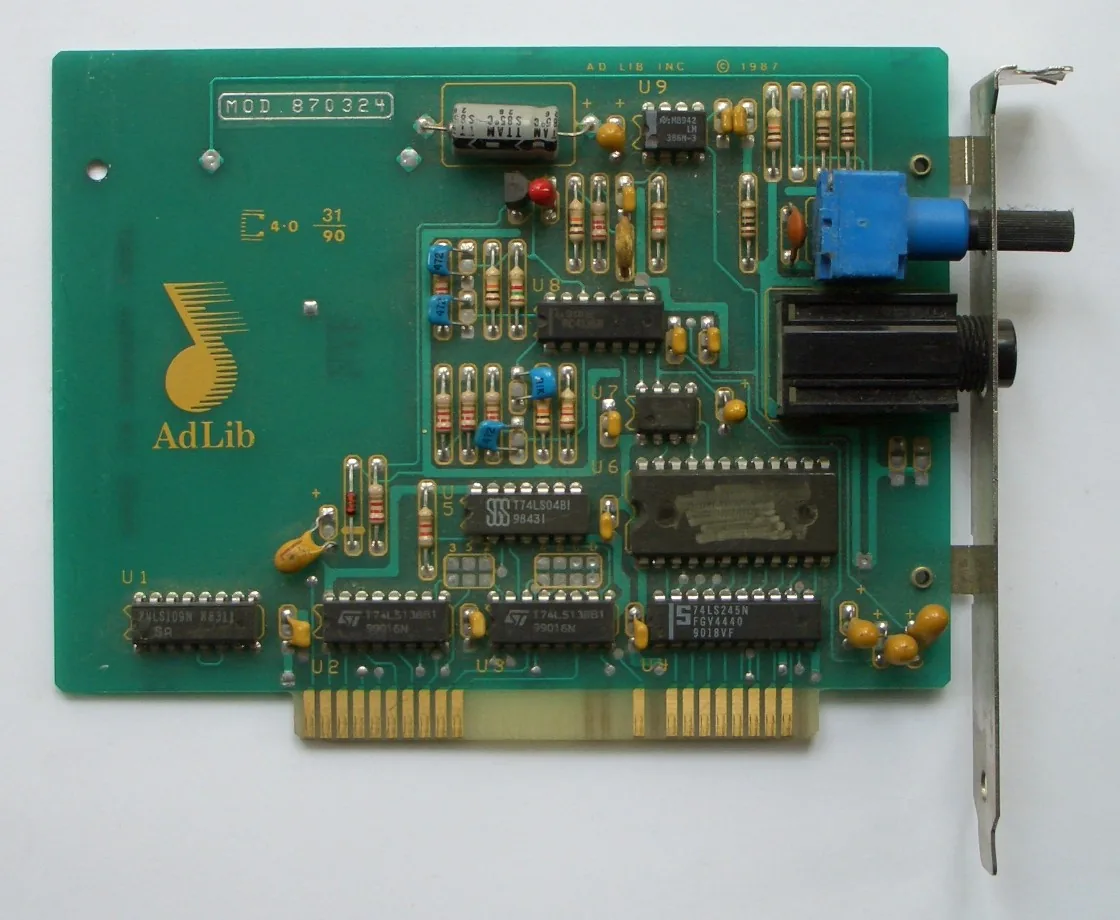
AdLib did not invent computer music, but it delivered the first FM synthesizer card to gain traction among game developers and players23. Priced at $195 in 1989 and $199.95 in 1988, the card was available for $249.95 when bundled with Visual Composer software914. It targeted IBM PC, XT, AT, and compatible systems running DOS 2.0 or higher with at least 256K RAM14. It required CGA, EGA, or MGA graphics, a constraint reflecting its intended use alongside graphical adventure and action titles. The card shipped with Juke Box, the original music playback program, and supported additional software such as Visual Composer, a composition guide priced at $89.95, and the MIDI Supplement add-on for sequencing at $39.9514.
The AdLib card’s architecture relied on FM synthesis, a technology chosen by AdLib engineers who designed the system around “the latest-and-greatest integrated circuits for sound” from a well-known semiconductor manufacturer23. While the exact chip model remains undocumented in the source material, its output defined a sonic era: music and special effects that, though monophonic in output character, created the illusion of layered sound through rapid channel cycling. The service manual and contemporary documentation make no mention of sample playback capability, digital audio channels, or bit depth for the original card. Its strength was algorithmic synthesis, not reproduction14.
Initial adoption was slow. Few players owned the card, and game developers showed limited interest23. That changed when Taito of America, a major software publisher at the time, committed to supporting AdLib in its games23. Players experienced a qualitative leap: explosions had depth, melodies carried weight, and ambient cues heightened immersion. The effect was immediate. “Anyone who took games seriously absolutely had to buy one of these AdLib cards,” the record states23. From 1987 to 1989, AdLib held a virtual monopoly on the game sound card market and “made a ton of money because of it”2.
Yet AdLib’s dominance unraveled not from competition, but from its own ambition. The company designed a next-generation card featuring stereo sound and 12-bit digital audio, clearly superior to the emerging Sound Blaster23. To prepare the market, AdLib launched a costly advertising campaign, running full-page ads in leading computer magazines23. The problem: the custom integrated circuits required for the new card never arrived. For over a year, AdLib sold ads for a product it could not manufacture. By the time the chips were ready, the company had exhausted its capital23.
By 1992, the AdLib Gold 1000 appeared in German publications priced at approximately 450 Deutsche Mark, with a Surround-Modul at 150 Mark and an Anrufbeantworter (answering machine) system7. A SCSI adapter enabled CD-ROM connectivity, signaling a pivot toward multimedia7. In the U.S., the Ad Lib Gold 1000 was listed at $17958, with companion products like the $64 Surround Sound and Telephone Module58. The Ad Lib Visual Composr sold for $75, and the Adlib Progrmrs Manual for $275. Speakers, a rare accessory listing, were priced at $155.
Legacy support persisted. Microsoft included adlib.drv and vadlibd.386 in Windows 3.1, with the system recognizing “Ad Lib” as a MIDI device via the entry adlib= 3:adlib.drv,'MIDl','Ad Lib',4:vadlibd.3864. Modern emulation is straightforward: DOSBox emulates the Ad Lib synthesizer natively, allowing use of original tools like Instrument Maker and Visual Composer, which stored song data in ROL format6. The AdLib Programming Guide, referenced in developer circles, remained a critical resource6.
AdLib’s story is one of timing, hubris, and the fragility of first-mover advantage. It created the market, defined the standard, and then vanished not because the technology failed, but because the supply chain did. Its name, however, endured: even clones like the SoundMan Card advertised “voll AdLib” compatibility, and Sierra On-Line bundled titles with Visual Composer software as a selling point9. The software game industry was revolutionized; the sound card industry followed23. But AdLib, Inc., headquartered at 50 Staniford Street, Suite 800, Boston, MA, would not lead it past 198914.
References
- Computer Gaming World - 198912 - Number 66 (1989)
- ProAudio16TheOfficialBook IvanLukDavidGolden
- SoundBlasterTheOfficialBookSecondEdition RidgeGoldenLukSindorf
- 030-31645 Microsoft Windows 3.1 Resource Kit 1992 (1992)
- Computer Gaming World - 199302 - Number 103 (1993)
- Computer Gaming World - 199301 - Number 102 (1993)
- gccc41 2nl
- Power.Play.N052.1992.07-kultcds (1992)
- Sierrafall1988 (1988)
- Computer Gaming World - 199003 - Number 69 (1990)
- Compute Issue 109 1989 Jun (1989)