Sony Trinitron
Sony Trinitron was a CRT display technology and product line distinguished by its single-gun, one-lens system and aperture grille, used in computer monitors and televisions from the 1970s onward, and recognized with an Emmy award for its engineering
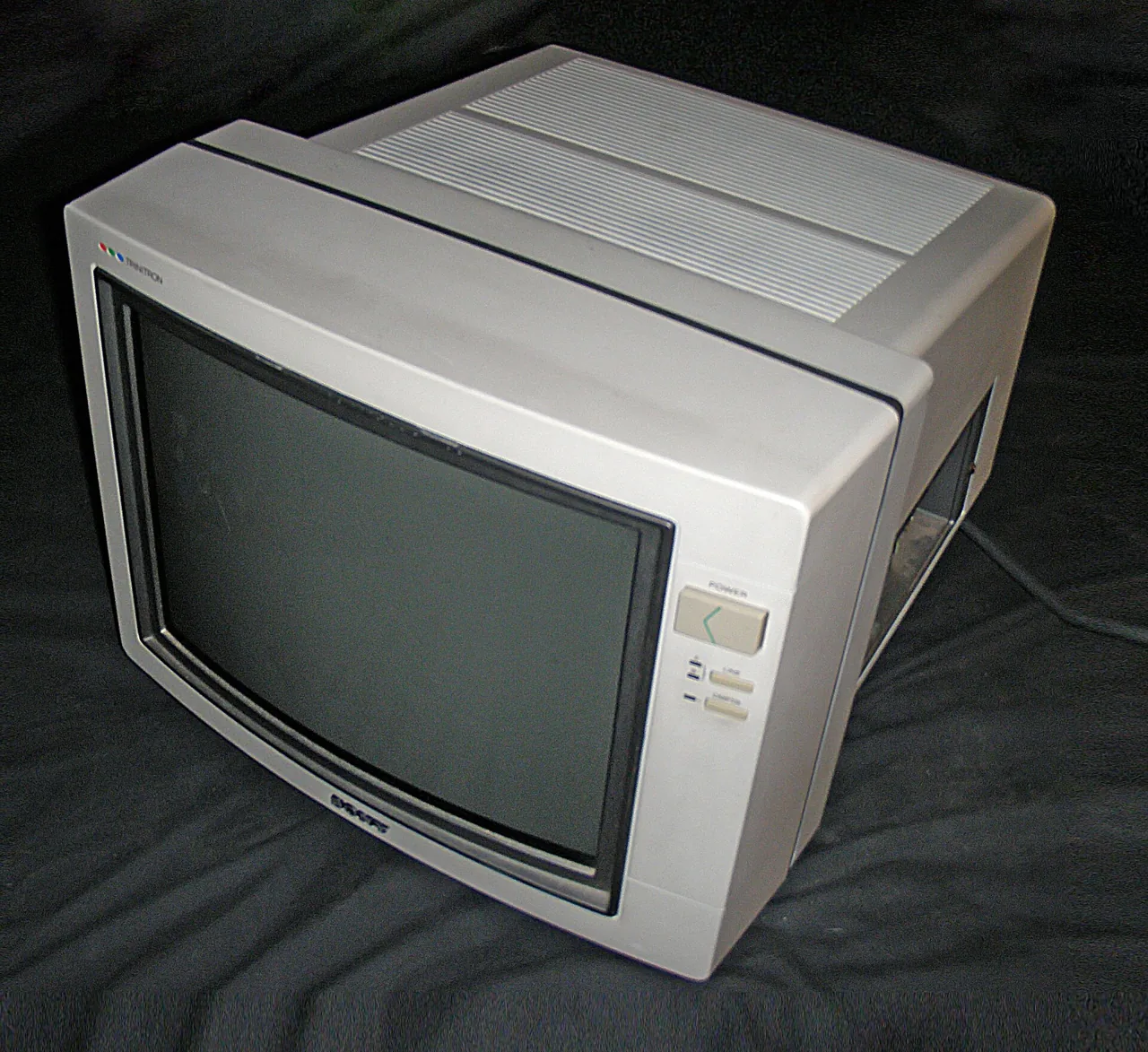
The Trinitron name belongs both to a family of Sony displays and to the proprietary cathode-ray tube technology that defined them. The design diverged from conventional shadow-mask CRTs by using a single electron gun aligned vertically, firing through a vertically tensioned aperture grille composed of "miniscule small slits" that directed the beam precisely to phosphor stripes on the screen7. This "special design of the aperture grille" enabled superior focus across the entire screen area, particularly at the corners, where traditional three-gun systems with spherical screens suffered from distortion4. The manufacture of such grilles was reportedly "very complicated," and their precision directly determined image fineness; Sony claimed the more exact the grille, the finer the resulting picture7.
Trinitron tubes featured a cylindrical screen (curved horizontally but flat vertically), a configuration later refined into "flat square tube (FST)" designs that curved only in the horizontal axis9. Sony also developed versions that were flat in both directions under the "FD Trinitron" designation, one of the first such CRTs for PCs following the short-lived Zenith FTM monitors of the late 1980s9. The screen's flatness reduced glare and improved image accuracy, a trait many users preferred despite the higher cost compared to conventional curved CRTs9. The black-matrix coating applied over the Trinitron’s phosphor structure was exclusive to Sony and contributed to contrast and color purity7.
Monitor sizes ranged from 9 to 25 inches, with front-projection systems scaling up to 200 inches1. Specific models included the 13-inch KV-1334, the 16-inch 365-1079 and 17-inch 355-11138, and professional-grade units like the 21-inch CPD-G500 and the 24-inch GDM-W900 Wide Trinitron6. The Sony CPD-1604S, a 17-inch multiscan monitor priced at $1,699.95, featured a 0.25mm super fine pitch aperture grille and low magnetic emissions, making it suitable for office environments14. It supported resolutions up to 1,024x768 and delivered notably crisp text, a trait emphasized in contemporary assessments14.
Trinitron monitors achieved maximum pixel resolutions as high as 2,048x1,152, with other models supporting 1,920x1,200, 1,800x1,440, and 1,600x1,2003. They were marketed as having "the finest dot pitch and the highest horizontal resolution of any monitors in their price class"1. Input options included both analog RGB and digital signals1. The technology was used in third-party systems such as the Apple Performa’s 14-inch built-in color monitor12, and the Sony Hit Bit computer, which shipped with Trinitron-equipped displays15. In workstation environments, Trinitron monitors were paired with Sun Microsystems systems including the SPARCstation 2 and SUNstation, with configurations listing 16-, 17-, 19-, and 20-inch models510. One advertisement hailed the Trinitron as a "PERFECT LOW-COST SONY TRINITRON X-TERMINAL!" for Sun users10.
Accessories and software ecosystems developed around high-end Trinitron setups. Truevision offered image processing boards and software (including the $3,995 TARGA 24 board capable of displaying 16.8 million colors) designed to take full advantage of the Trinitron’s color fidelity1. The service manual for the TRINITRON Graphic Display Monitor GDM-1603 carries Sony part number 0-558-986-01, indicating formal documentation within Sony’s engineering framework11. The brand’s marketing consistently emphasized exclusivity and performance, declaring that "only Sony gives you the performance of Emmy award-winning Trinitron technology"1.
Despite the premium pricing (entry-level computer monitors started at $4951), Trinitron displays occupied a tier above conventional CRTs, not only in image quality but in perceived reliability. A Swedish user noted that "on a Sony Trinitron it always works" when using a ZX Spectrum as a monitor, a statement reflecting its consistent signal handling13. While flat-panel LCDs eventually surpassed CRTs in cost and form factor, flat-screen Trinitrons remained significantly cheaper, priced at one-third to one-half the cost of early LCDs, while delivering superior image quality for professional use9.
Specifications
| Display Technology | Trinitron CRT with aperture grille and single-gun, one-lens system |
| Screen Sizes | 9 to 25 inches (up to 200 inches in front projection) |
| Resolution (Maximum) | Up to 2,048x1,152 |
| Dot Pitch | 0.25mm (Super Fine pitch on CPD-1604S); .24AG on G400/G500 models |
| Input | Analog RGB and digital input |
| Notable Models | CPD-1604S, CPD-G400, CPD-G500, GDM-1603, KV-133 |
| Special Features | Flat square tube (FST) and FD Trinitron (fully flat) variants; black-matrix coating; low magnetic emission (CPD-1604S) |
| Original Price | $495 (entry-level computer monitor); $1,699.95 (CPD-1604S) |
References
- 1986 08 BYTE 11-08 Object-Oriented Languages (1986)
- 1988.09 Your Computer September 1988 (1988)
- SunExpert-v08n12-1997-12 (1997)
- PERSONAL COMPUTING JULY 1983 (1983)
- SunExpert-v04n04-1993-04 (1993)
- PC Gamer - 200007 - Volume 7 Number 7 (2000)
- msx computer magazine 05 dec 1985 jan 1986 (1985)
- SunExpert-v03n02-1992-02 (1992)
- URP 12th edition
- SunExpert-v03n07-1992-07 (1992)
- 2243131-0001 ExplFieldMaint
- ApplePerformaFamily
- Datorhobby1983-1 (1983)
- ACs Guide To The Commodore Amiga Summer 94 1994 PiM Publications US (1994)
- Run 1985-05 (1985)
- SunExpert-v03n04-1992-04 (1992)