HP-15C
Hewlett-Packard’s HP-15C was an advanced programmable scientific calculator designed to consolidate the functionality of the HP-11C and HP-34C while adding built-in support for matrix operations, complex numbers, and numerical integration and root-solving.
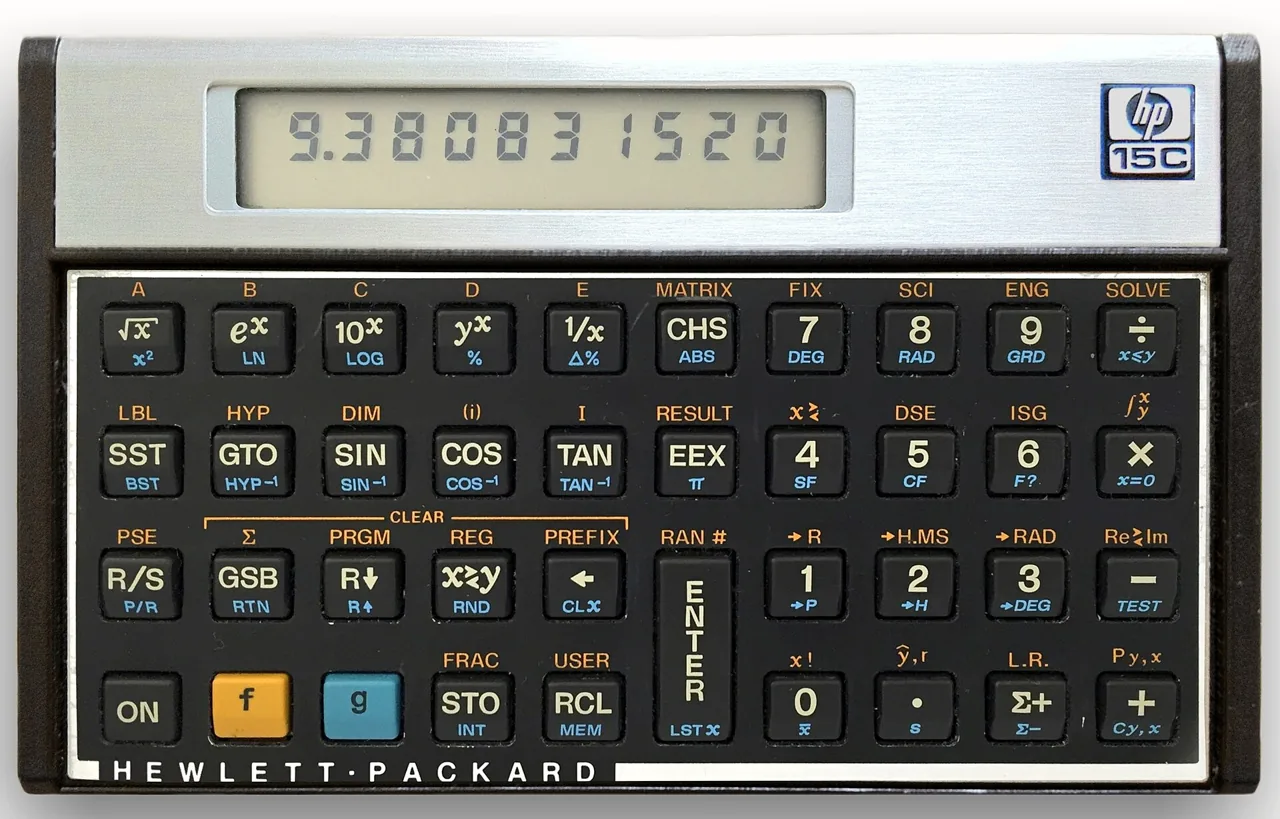
The HP-15C distinguished itself from contemporaries not by raw speed or display clarity (neither of which the documentation quantifies) but by algorithmic rigor and memory flexibility. Its 67 registers (R⁰ to R⁶⁵ and the Index register) could be dynamically partitioned between data storage and program space, with an initial configuration of 21 registers reserved for data (R⁰ to R⁹, R.0 to R.9, and Index) and 46 for programming and advanced functions13. Each register consumed seven bytes, yielding up to 322 program bytes when no registers were allocated to data13. Memory reallocation was user-directed: specifying the highest-numbered data register automatically freed all higher-numbered registers for program use13. Continuous memory preserved programs and data indefinitely until manually reset3, a feature emphasized in period documentation as essential for field use.
Its computational engine relied on a 14-digit (56-bit) binary-coded-decimal internal format, minimizing floating-point rounding errors in scientific and engineering applications4. The calculator supported matrix operations including addition, multiplication, inversion, transposition, and norm calculation4. It could invert matrices in place, with a practical limit of 8-by-8 matrices, and solve linear systems up to 7-by-7 within available memory4. A maximum of 64 matrix elements could be distributed across five matrices4. Complex number arithmetic was fully integrated, accessible via dedicated keystroke sequences rather than a separate mode.
Two advanced operators defined its analytical capability: SOLVE and ∫. The SOLVE operator numerically located roots of user-programmed functions using an implementation guided by Professor William Kahan, whose contributions to the mathematical algorithms were foundational4. The ∫ operator performed numerical approximation of definite integrals over a specified interval, again relying on adaptive algorithms developed under Kahan’s oversight4. These functions operated directly on user-written programs, requiring no symbolic input, and were documented in depth in the separately available HP-15C Advanced Functions Handbook12.
Programming features included 25 program labels, 12 conditional tests, and indirect program control6. Programs could be edited using insertion and deletion methods, a refinement over earlier overwrite-only editing6. Five keys were user-redefinable, allowing customization of frequently used sequences6. The calculator reportedly offered 448 lines of continuous memory6, though this figure may reflect a linearized view of the byte-addressable register space rather than discrete program steps.
Rich Carone served as software project manager, shaping early design concepts and maintaining development momentum4. The Owner’s Handbook was authored by Diana Roy, Robert Barkan, and Hank Schroeder4, while Professor Kahan also contributed directly to the Advanced Functions Handbook4. HP described the device as “a powerful problem solver, convenient to carry and easy to hold,” underscoring its role as a portable engineering workstation3.
Original pricing varied across sources: $92.00 was listed in multiple 1983 publications57, though other contemporaneous reports cite $99.00814, $88.991315, $87.9512, or $73.9510. The discrepancy suggests regional pricing or promotional adjustments, but the surviving documentation offers no clarification. The device shared the slim-line case design of the HP-11C4 and was positioned alongside models such as the HP-10C, HP-12C, and HP-41CV in HP’s product literature56789101112131415.
A modern re-release of the HP-15C was later produced, estimated to run at least 150 times faster than the original and offering approximately one year of battery life under normal use3. The low-power indicator provided advance warning before operational failure3.
Specifications
| Model | HP-15C |
| Manufacturer | Hewlett-Packard |
| Type | Advanced Programmable Scientific Calculator |
| Introduction | 1983 |
| Registers | 67 (R⁰ to R⁶⁵ + Index) |
| Register size | 7 bytes |
| Max program memory | 322 bytes |
| Floating-point format | 14-digit BCD (56-bit) |
| Matrix elements | Up to 64 across 5 matrices |
| Max matrix inversion | 8×8 in place |
| Linear system capacity | 7×7 |
| Program labels | 25 |
| Conditional tests | 12 |
| User-redefinable keys | 5 |
| Editing | Insertion/deletion |
| Continuous memory | Yes |
| Advanced functions | SOLVE, ∫, complex numbers, matrix operations |
| Original price | $92.00 (commonly reported) |
References
- HP-15C Owner's Manual
- HP-15C Advanced Functions Handbook
- Archive item #2623057
- HP Journal 1983-05 (1983)
- micro 65 oct 1983[ocr] (1983)
- 074 - Nova Eletronica - Abr 1983 (1983)
- 1983 04 BYTE 08-04 New Chips (1983)
- MICRO Vol60-05 83
- micro 58 mar 1983[ocr] (1983)
- 1986 06 BYTE 11-06 Computers and Music (1986)
- 1984 08 BYTE 09-08 Modula-2 (1984)
- 1986 01 BYTE 11-01 Robotics (1986)
- MICRO Vol71-0405 84
- MICRO Vol58-03 83
- micro 72 jun 1984[ocr] (1984)