HP-71B
Hewlett-Packard’s HP-71B, introduced in the mid-1980s, was a handheld computer designed for technical professionals, combining a 240-keyword BASIC interpreter with expandable memory and modular peripherals to function as both an advanced calculator and a portable computing platform.
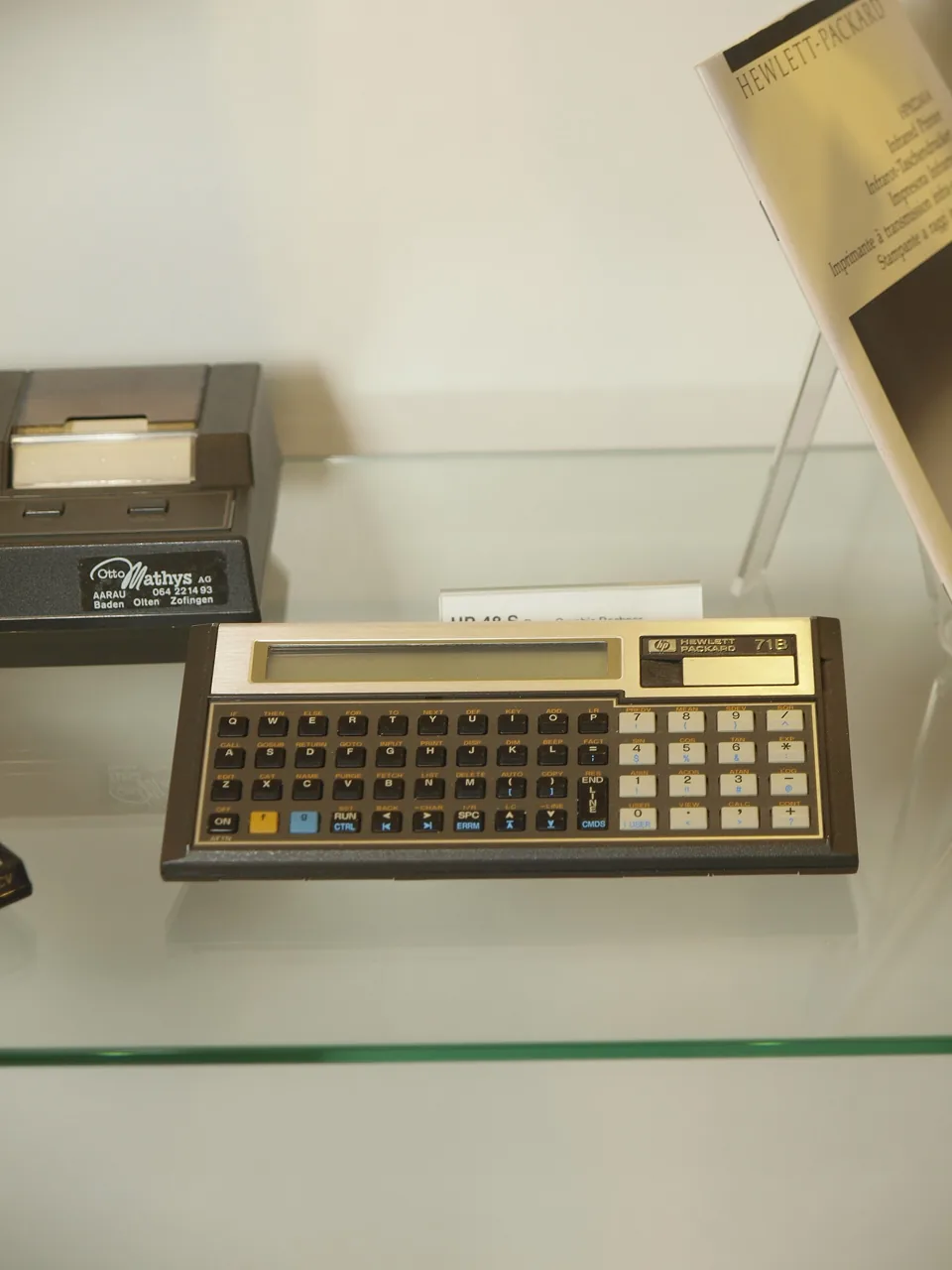
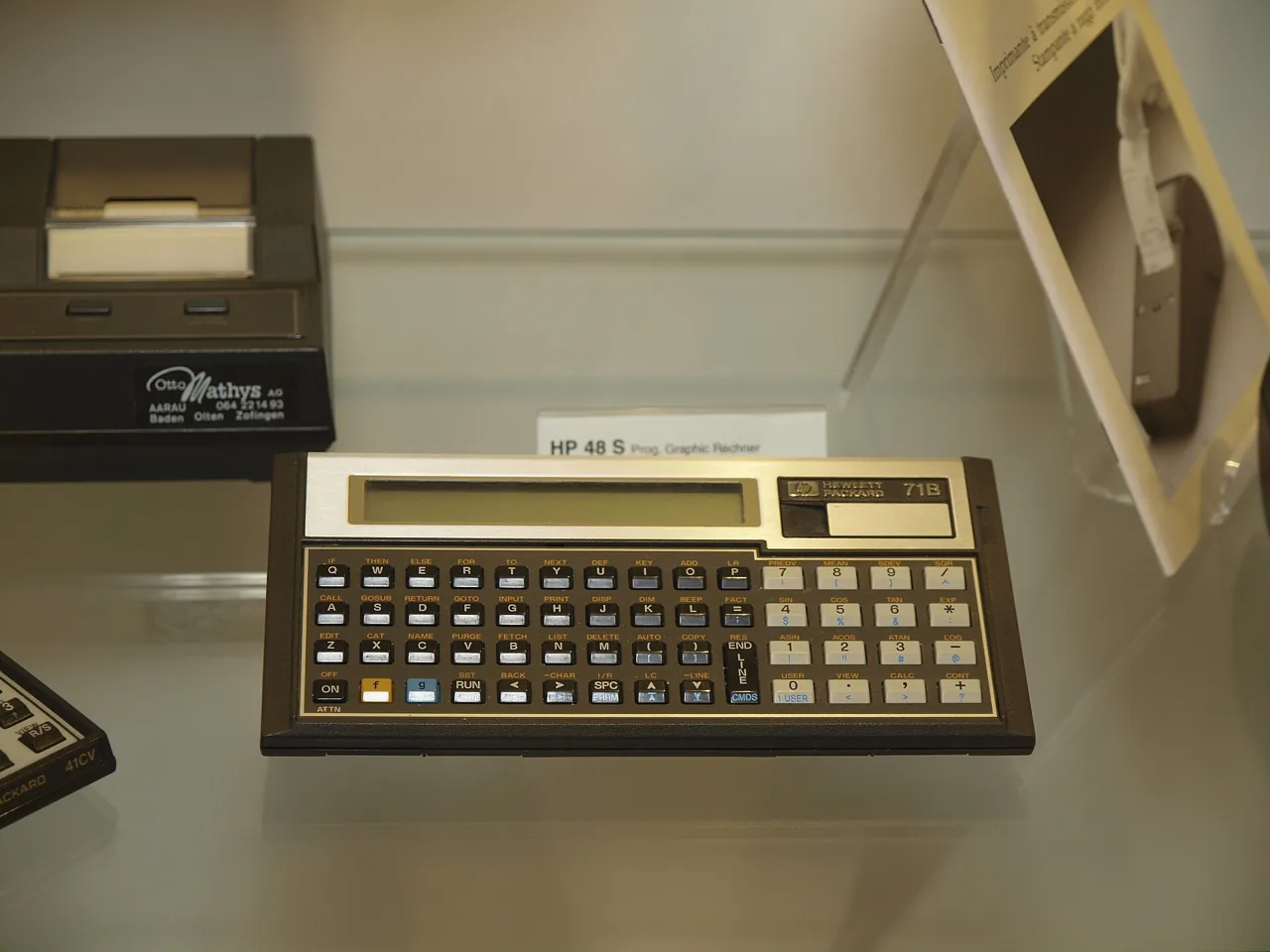
The HP-71B occupied a 7.2 x 1-inch form factor and weighed 12 ounces, marketed as a “pocket-sized package” despite its heft1. It centered on the Saturn CPU, a proprietary processor using 20-bit addressing to access up to 512K bytes of address space2. While base RAM and ROM sizes are absent from documentation, expansion modules offered 4K bytes of RAM and up to 64K bytes of ROM capacity1. Four internal ports allowed for direct attachment of RAM or ROM modules to the mainframe1, and the 82401A I/O module eliminated the need for a separate I/O ROM1.
The machine ran a dedicated operating system and featured a 240-keyword BASIC programming language with internal 15-digit precision math routines13. The OPTION statement extended support for system-level configuration, including OPTION BASE for array indexing and OPTION ANGLE for trigonometric units3. Temperature conversion was integrated into the language keywords, supporting Celsius, Fahrenheit, Kelvin, and Rankine units3. Programs written in assembly language reportedly achieved a 20-to-1 speed improvement over interpreted BASIC3.
Software expansion relied on plug-in ROM pacs, including Finance, Circuit Analysis, Surveying, Text Editor, Curve Fit, Math, and FORTH/Assembler1. The Finance Pac replicated most HP-12C functions with a keyboard layout mirroring the HP-12C’s top row1. The Circuit Analysis Pac significantly outperformed earlier software on HP’s Series 40 and Series 80 Computers1. The Surveying Pac introduced a user-friendly file management system for coordinate-based calculations1. The FORTH/Assembler Pac aimed to attract independent developers, enable custom applications, and offer low-level access to the machine’s architecture1.
Peripheral expansion was facilitated through the HP-IL (Hewlett-Packard Interface Loop), with optional modules adding a hand-pulled card reader for portable mass storage or enabling communication via RS-232-C/V.24 and HP-IB (IEEE 488) through additional interfaces1. External keyboards and displays could be connected via HP-IL or adapted interfaces1. The HP-IL data protocol had precedent in earlier models like the HP-41C1.
Pricing varied across contemporary publications: $389.95 in one listing4, $419.99 in five separate sources6891113, and $499 in two others5710. The discrepancy remains unexplained in the source material. The HP-71B was positioned alongside other HP models including the HP-41CV, HP-41CX, HP-11C, HP-12C, HP-15C, HP-16C, HP-75C, and HP-75D456789101113, suggesting a cohesive technical product line.
The HP-71B Internal Design Specification (IDS) documented the system’s hardware, software, and peripherals in detail, indicating a structured engineering approach2. Despite its capabilities, the device retained “calculator-like friendliness” to ease adoption among engineers and scientists3. It was explicitly intended for use by technical professionals and could operate as either a high-end algebraic calculator or a full programmable computer1.
Specifications
| Manufacturer | Hewlett-Packard |
| Model | HP-71B |
| Product type | Handheld Computer |
| Weight | 12 ounces |
| Dimensions | 7.2 x 1 inch (approximate, based on OCR interpretation) |
| CPU | Saturn |
| Address bus | 20-bit |
| Address space | Up to 512K bytes |
| RAM expansion | 4K bytes available |
| ROM expansion | Up to 64K bytes available |
| Ports | Four for RAM/ROM expansion |
| Internal math precision | 15-digit |
| Built-in language | 240-keyword BASIC |
| System interfaces | HP-IL, RS-232-C/V.24 (via adapter), HP-IB (IEEE 488) (via adapter) |
| Optional modules | Card reader, HP-IL, 82401A I/O module |
| Software pacs | Finance, Circuit Analysis, Surveying, Text Editor, Curve Fit, Math, FORTH/Assembler |
| Temperature units | Celsius, Fahrenheit, Kelvin, Rankine |
References
- HP Journal 1984-07 (1984)
- Customize Your HP 28
- HP Journal 1986-03 (1986)
- 1986 06 BYTE 11-06 Computers and Music (1986)
- micro 72 jun 1984[ocr] (1984)
- 1984 08 BYTE 09-08 Modula-2 (1984)
- MICRO Vol71-0405 84
- Compute Issue 055 1984 Dec (1984)
- micro 74 aug 1984[ocr] (1984)
- MICRO Vol72-06 84
- MICRO Vol73-07 84
- HP Journal 1984-12 (1984)
- 1986 01 BYTE 11-01 Robotics (1986)