Texas Instruments Speak & Spell
Texas Instruments released the Speak & Spell in 1978 as an educational toy featuring synthetic speech, a luminous display, and interchangeable memory modules for spelling games and language exercises.
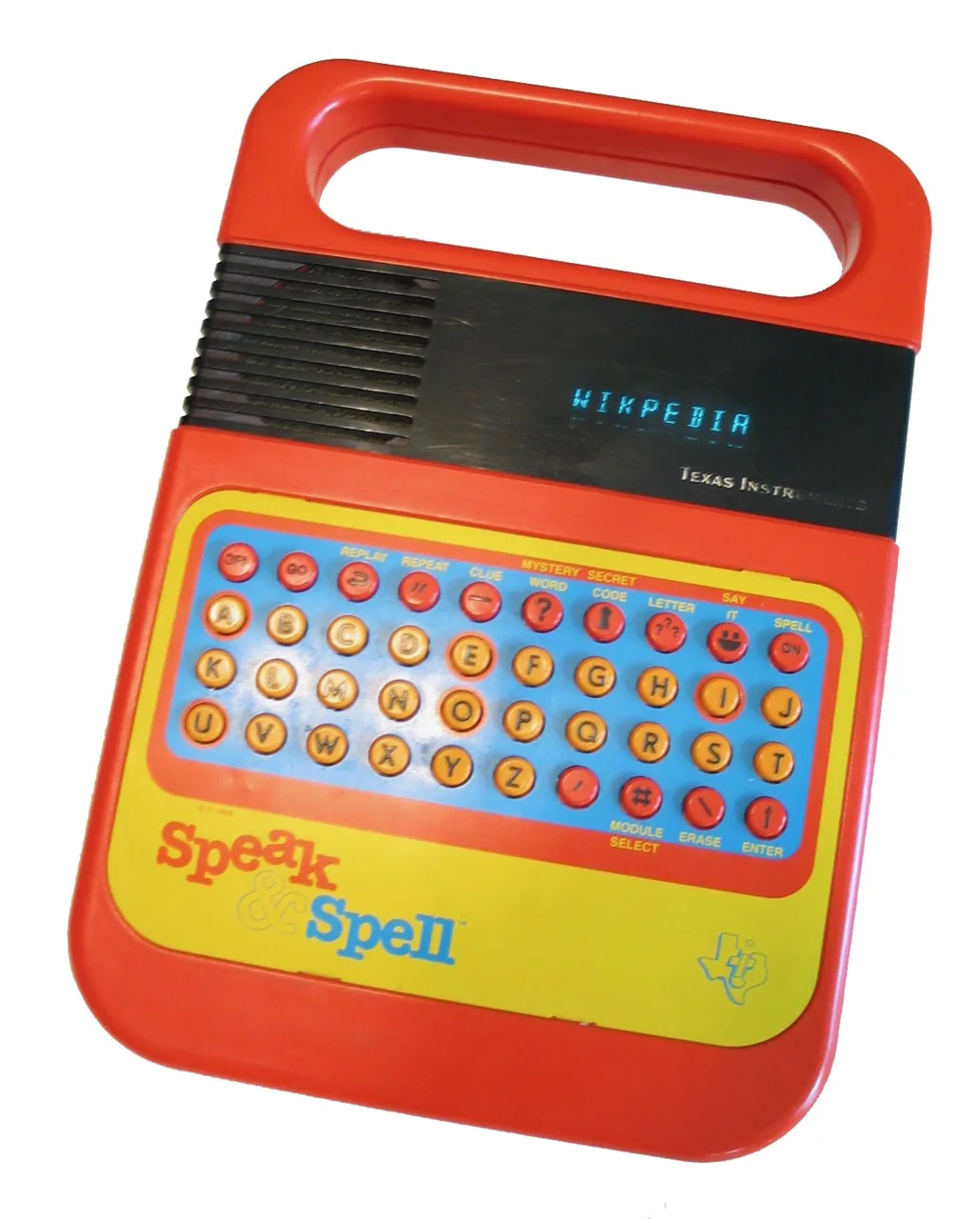
The Speak & Spell distinguished itself from contemporary electronic toys not by imitating a computer, but by focusing entirely on one well-defined purpose: spoken language drills. Marketed as a "clever game" and "children's learning tool," it used a custom speech-synthesizer chip, the TMC0281, to generate a male voice that prompted users to spell words drawn from a built-in list of approximately 150 to 200 entries11011. The device's voice was not sampled audio but synthesized in real time using a digital lattice filter and D/A converter embedded in the TMC0281, a processor pipeline designed by Larry Brantingham with fixed-point arithmetic transformations implemented by Richard Wiggins at TI's Central Research Laboratory in Dallas4. Speech data itself resided in the TMC0351 ROM, a 128 K-bit device organized as 16,384 by 8 bits, with an 18-bit internal address counter and dual 8-bit output buffers4.
Control logic relied on the TMC0271, a modified member of the TMS1000 family of calculator chips, adapted to support enhanced BCD arithmetic and an expanded instruction set4. An output multiplexer reduced pin count, a pragmatic integration choice that reflected TI's calculator heritage4. The system was explicitly not based on the SN76477N complex-sound generator, nor did it store speech as pulse sequences; each phoneme was algorithmically reconstructed5. Users interacted via an alphabetical keyboard and a luminous display, progressing through exercises such as spelling games, hangman ("jogo da Forca"), mystery letter, and secret code drills1011.
Expandable Design and Third-Party Interfaces
Capacity could be increased by swapping memory modules, and a dozen or so additional cartridges were reportedly made available111. This modularity attracted hobbyist interest. The Percom Data Co. "Speak 2 Me 2" interface allowed BASIC-level communication with the device, powered by a calculator battery pack and installed in the battery compartment; it included a cable, operating software, and user manual for $69.9523. Dave Kemp of East Coast Micro Products introduced a competing SP-1 interface, also enabling computer connectivity69. These add-ons transformed the toy into a programmable speech peripheral, a repurposing that anticipated later circuit bending practices.
Product Line and Variants
The Speak & Spell anchored a series of educational toys that included Speak & Read and Speak & Math, collectively referred to as the "Texas Instruments 'Speak &' talking toy series"18. Spanish-language versions existed in multiple configurations: one with a Spanish-speaking voice, keyboard, and packaging; others retained the English voice but featured Spanish packaging, bezel, and instructions7. These variants were part of TI's broader line of electronic educational products targeting language and mathematics learning11.
Legacy in Accessibility and Hacking
By 1982, the device was recognized not only as a "highly successful device currently on the market" but also as a potential communication aid for disabled users; typing messages letter by letter bypassed the spelling function and used the synthetic voice for expression12. Decades later, the Speak & Spell reemerged in a different context: a staple for beginning circuit benders, valued for its durable construction and distinctive vocal output8. Its voice (mechanical, nasal, unmistakably male) became a sonic artifact of early digital speech, preserved not in museums but in hacked enclosures and DIY noise instruments.
References
- book how to win at video games complete guide
- 1980 05 BYTE 05-05 Floppy Disks (1980)
- 1980 08 BYTE 05-08 The Forth Language (1980)
- 1981 02 BYTE 06-02 The Computer and Voice Synthesis (1981)
- 1981 04 BYTE 06-04 Future Computers (1981)
- Compute2 Issue 1 1980 Apr May (1980)
- Straitline Marketing Catalog Spring 1982 (1982)
- MAKE Magazine OH 04
- SYM-PHYSIS Issue 03
- 040 - Nova Eletronica - Jun1980 (1980)
- 078 - Nova Eletronica - Ago1983 (1983)
- 1982 09 BYTE 07-09 Computers and the Disabled (1982)