HP-41CV
Hewlett-Packard’s HP-41CV, introduced as a memory-enhanced variant of the HP-41C, shipped with 2.2K bytes of internal memory and 320 registers, enabling significantly expanded programmability while maintaining full peripheral compatibility with the broader HP-41 system.
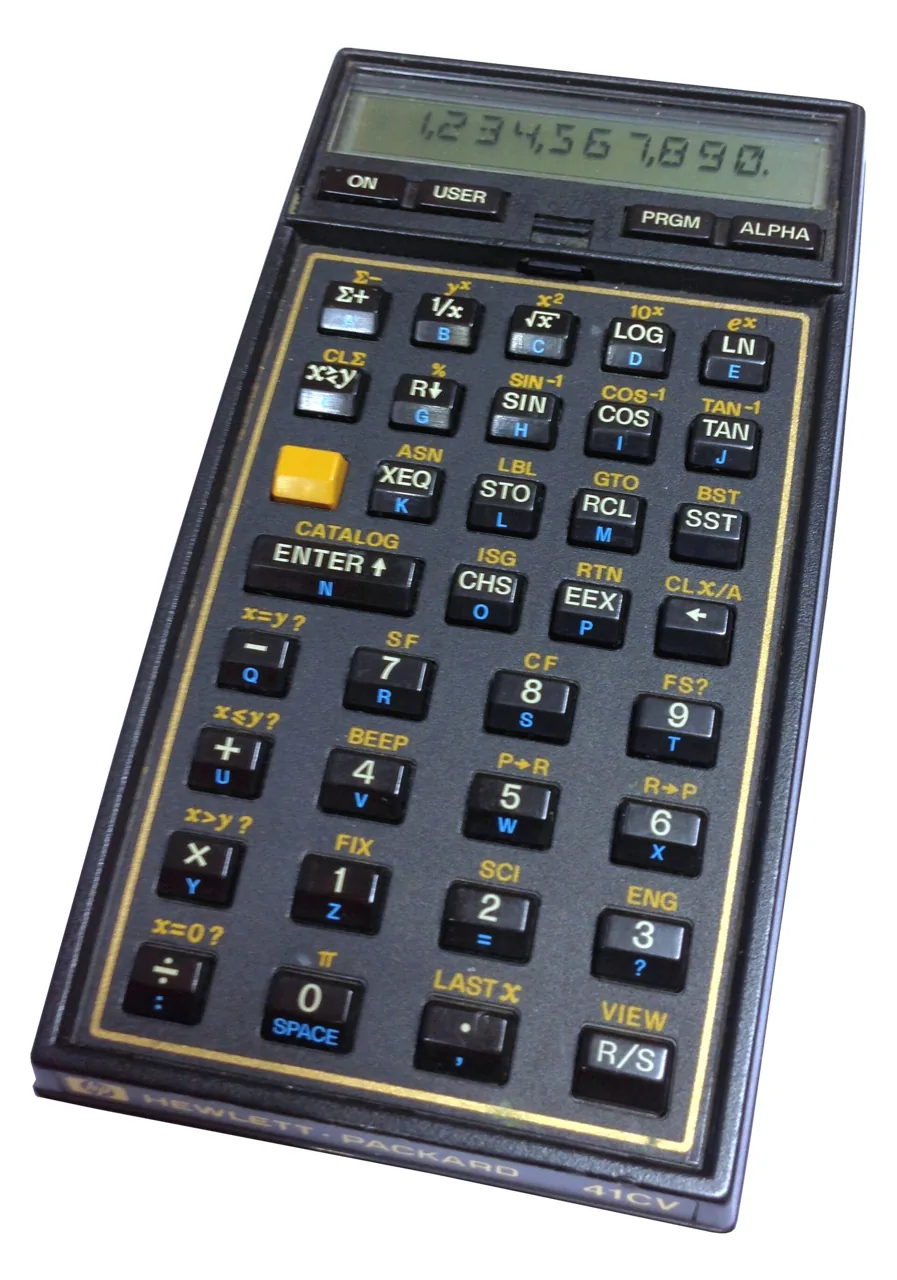
The HP-41CV’s defining trait was its memory capacity: 2.2K bytes spread across 320 registers, including a permanent .END. register89. This quintupled the memory of the HP-41C, which held only 63 registers23. Despite this expansion, the documentation emphasizes that neither the HP-41C nor HP-41CV could exceed 319 usable memory registers23, a ceiling likely due to firmware or addressing constraints, though the exact reason is not stated in surviving materials.
Physically, the HP-41CV retained the slanted keyboard design of its predecessor1, a deliberate ergonomic choice that influenced hand position during extended use. Four I/O ports on the rear allowed daisy-chaining of peripherals, a modular approach central to HP’s vision of the calculator as a portable system controller10. The HP-IL Interface Module (HP 82160A) plugged into one of these ports, enabling communication with devices such as the HP 82143A Printer/Plotter, HP 82104A Card Reader, HP 82161A Digital Cassette, and HP 82163A Video Interface51013. The optical wand was also supported, allowing barcode-style data entry from printed programs14.
Alphanumeric capability distinguished the HP-41CV from simpler calculators of the era. It could process text input through key code detection, using two distinct coding schemes: one based on key topology and another derived from ASCII12. This allowed labeled output, custom prompts, and rudimentary user interfaces, features utilized by software packs like the MATH PAC, STATISTICS PAC, and SURVEYING PAC515. The system’s flexibility was further extended by modules such as the X FUNCTIONS (HP 82180A) and X MEMORY (HP 82181A), which enhanced computational and storage capabilities89.
HP marketed the HP-41CV as part of configurable systems. The HP-41 System I bundled the calculator with the HP 82104A Card Reader for $399 (list $495)11114. System II added the HP 82143A Printer/Plotter, priced at $679 (list $840)11114. At launch, the standalone unit retailed for $325, with dealer cost estimates ranging from $256 to $270145. By 1986, street pricing had dropped to $130.9516.
The HP-41CV was not a radical departure but a targeted upgrade. Documentation explicitly states it differed from the HP-41C only in the size of its built-in memory23. Later, the HP-41CX would surpass it with extended functions, though the CV remained suitable for most advanced software89. Indicators on the display provided continuous feedback on operating mode and battery status23, a small but critical usability feature in field use.
Specifications
| Manufacturer | Hewlett-Packard |
| Model | HP-41CV |
| Product type | Calculator |
| Memory | 2.2K bytes, 320 registers |
| Memory comparison | 5× the HP-41C (63 registers) |
| Maximum memory | 319 usable registers |
| Keyboard | Slanted |
| I/O ports | Four rear-mounted slots |
| Alphanumeric capability | Yes, via key code detection |
| Key code systems | Topographical location, ASCII-derived internal codes |
| Indicators | Operating mode, battery status |
| Original retail price | $325.00 |
| Dealer cost | $256.00–$269.95 |
| 1986 street price | $130.95 |
References
- 1981 06 BYTE 06-06 Operating Systems (1981)
- Archive item #6383326
- Archive item #6383326text
- micro 43 dec 1981[ocr] (1981)
- BYTE Vol 07-05 1982-05 Japanese Computers (1982)
- Byte Magazine Atari Articles
- 1983 11 BYTE 08-11 Inside the IBM PC (1983)
- TR-Dateiverwaltung-HP41
- TR-Dateiverwaltung-HP41
- HP Journal 1983-01 (1983)
- 1981 04 BYTE 06-04 Future Computers (1981)
- BYTE Vol 11-10 1986-10 Apple II GS (1986)
- Family Computing Issue 01 1983 Sep (1983)
- Interface Age-1981-06 (1981)
- 1982 09 BYTE 07-09 Computers and the Disabled (1982)
- 1986 04 BYTE 11-04 Number Crunching (1986)