HP-41C
Hewlett-Packard’s HP-41C, introduced in 1980, was a programmable scientific calculator with alphanumeric display and expandable memory, notable for its system-like architecture and user-reconfigurable keyboard.
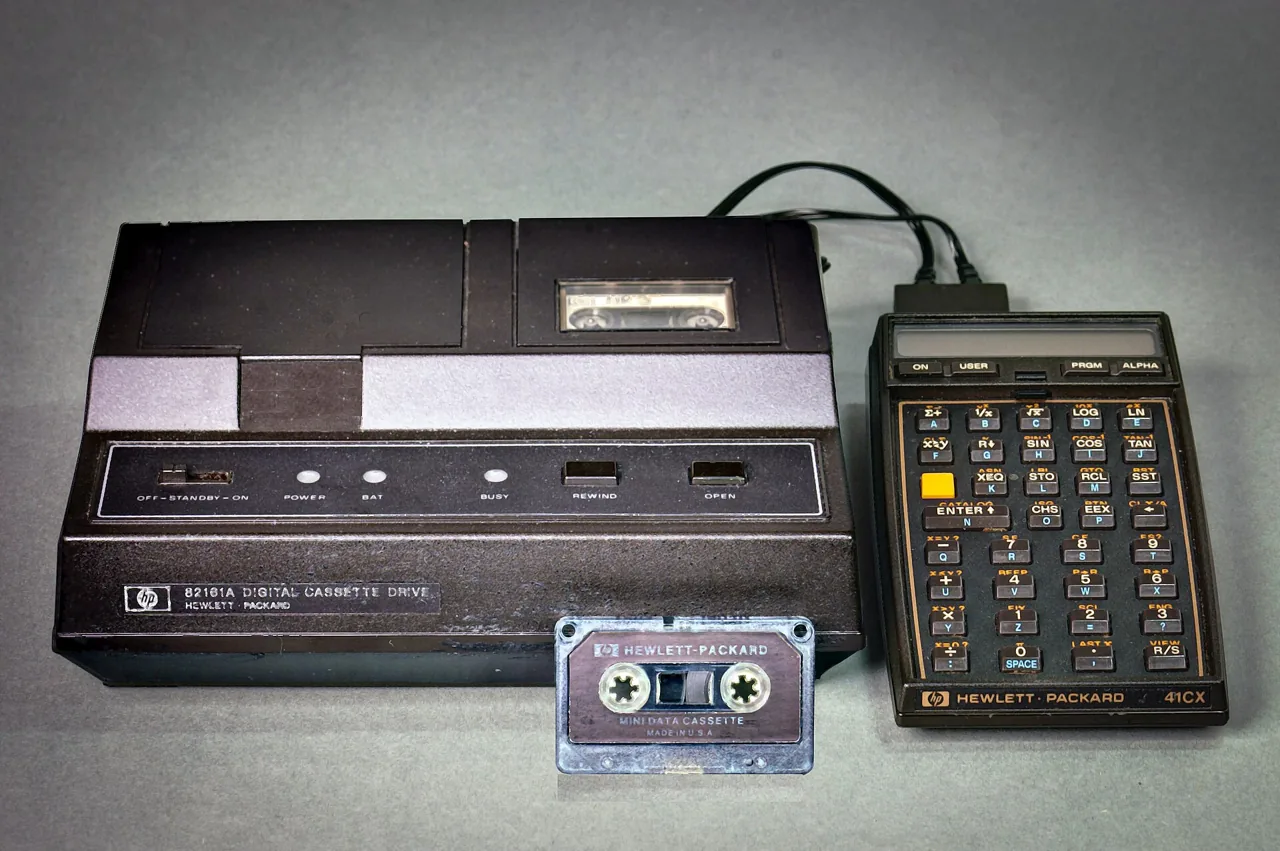
The HP-41C was a modular computation system, a deliberate departure from fixed-function devices of its era2. Its design centered on flexibility: users could reconfigure the entire keyboard in USER mode, assigning custom functions to physical keys, a radical notion in 19802. This, combined with Continuous Memory that preserved programs and data when powered off, made it feel less like a tool and more like a personal companion for engineers and scientists1.
The HP-41C relied on a CMOS-based chipset comprising one CPU, five data storage chips, three ROMs, two display drivers, and a single bipolar circuit, all mounted on a four-layer printed circuit board2. This integration allowed for low power consumption and supported an operating speed that was twice that of HP’s earlier calculator architectures2. The machine shipped with 63 registers of memory (usable for programs, data, or a mix) and could be expanded to 319 registers using four HP 82106A Memory Modules, each adding 64 registers1. With full expansion, program capacity ranged between 1,000 and 2,000 lines1. The system also supported 7K bytes of RAM and offered a ROM address space of 64K 10-bit words, enabling extensive software expansion2.
Its alphanumeric liquid crystal display showed key annunciators: BAT, USER, GRAD, SHIFT, 01234, PRGM, ALPHA, providing real-time status feedback uncommon in contemporaries1. The calculator automatically powered down after ten minutes of inactivity, a practical concession to battery life, though the documentation remains silent on battery type or expected runtime1.
The HP-41C’s true ambition lay in its ecosystem. It functioned as the hub of a distributed system, accepting plug-in application modules for surveying, navigation, astronomy, and electrical engineering17. At launch, it included a ROM "Math-Pac" and a companion book of application programs7. Users could further augment it with peripherals such as the HP 82104A Card Reader, which featured a built-in translator for converting HP 67/97 magnetic card software into HP-41C format, a pragmatic nod to backward compatibility27. Other supported devices included the HP 82143A Printer, HP 82160A IL Interface, HP 82161A Digital Cassette, HP 82163A Video Interface, optical wand, timer module, and extended function module23911.
Pricing varied significantly across regions and years. Ads from 1980 list it at $289.9513, while 1981 and 1982 U.S. advertisements cite $250.00410, and one source records a $200.00 price in Byte Magazine5. By 1984, the price had dropped to $144.996. In the UK, it retailed at £159.58 plus VAT in 198215.
The HP-41C was soon joined by enhanced models: the HP-41CV, advertised with "2K mem" and quad memory capability459, and later the HP-41CX, mentioned in 1984 ads61114. It was explicitly differentiated in marketing from other HP models including the HP-11C, HP-12C, HP-15C, HP-16C, HP-34C, HP-67, and HP-9745913.
Despite its sophistication, the HP-41C demanded care. Users were warned to power down before inserting or removing plug-in extensions, failure of which could damage both the accessory and the calculator1. This fragility, coupled with its premium price, made it a machine for the committed. Yet its modular, reconfigurable, system-oriented architecture set a precedent few calculators would match. The surviving documentation is silent on dimensions, weight, and discontinuation date, but its influence lingers in the cult of extensibility it inspired among technical users.
Specifications
| Manufacturer | Hewlett-Packard |
| Product type | Programmable scientific calculator |
| Basic memory | 63 registers (program/data) |
| Maximum memory | 319 registers (with four HP 82106A modules) |
| RAM capacity | 7K bytes |
| ROM address space | 64K 10-bit words |
| Program memory capacity | 1,000–2,000 lines (fully expanded) |
| Display | Alphanumeric liquid crystal |
| Annunciators | BAT, USER, GRAD, SHIFT, 01234, PRGM, ALPHA |
| Power management | Auto power-off after 10 minutes |
| Memory expansion | Four HP 82106A modules (64 registers each) |
| Operating speed | 2× improvement over prior HP architecture |
| Chip technology | CMOS (except one bipolar circuit) |
| Circuit board | Single four-layer PCB |
| Key feature | USER mode with full keyboard reconfiguration |
| System concept | Distributed computing with peripherals |
References
- HP-41C OWNERS HANDBOOK AND PROGRAMMING GUIDE
- HP Journal 1980-03 (1980)
- 1983 11 BYTE 08-11 Inside the IBM PC (1983)
- BYTE Vol 07-05 1982-05 Japanese Computers (1982)
- Byte Magazine Atari Articles
- MICRO Vol69-02 84
- The Macintosh Project Selected Papers Feb80
- HP Journal 1987-08 (1987)
- 1982 09 BYTE 07-09 Computers and the Disabled (1982)
- Interface Age-1981-06 (1981)
- micro 72 jun 1984[ocr] (1984)
- HP Journal 1981-12 (1981)
- 1980 08 BYTE 05-08 The Forth Language (1980)
- BYTE Vol 09-01 1984-01 1984 And Beyond (1984)
- ComputingToday198204 (1982)