HP-16C
Hewlett-Packard’s HP-16C was a programmable calculator explicitly designed for digital electronics and computer science tasks, notable for its deep bit-level manipulation and cross-base arithmetic capabilities.
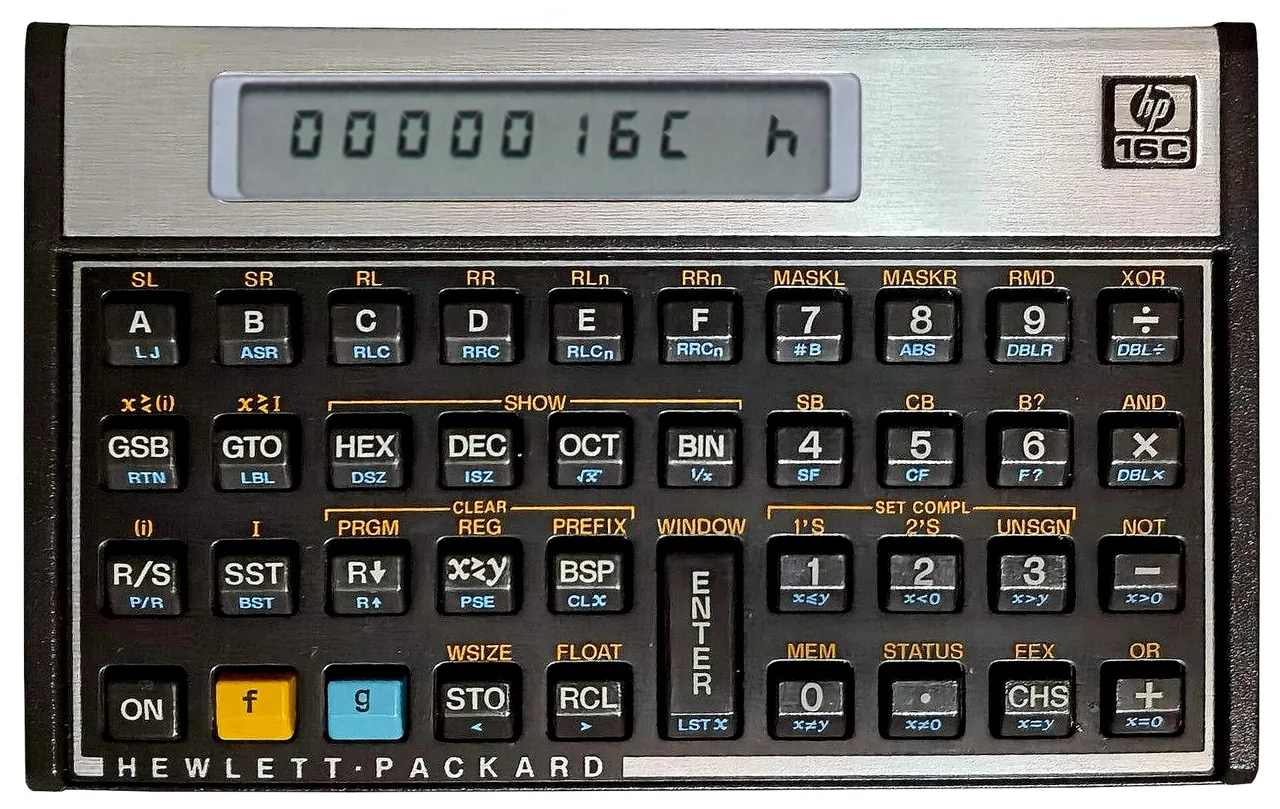
Market positioning for the HP-16C emphasized its niche as a tool for computer science professionals and engineers, with advertising in technical publications describing it as “For Digital Electronics and Computer Science”2. It differed from HP’s general-purpose scientific calculators by supporting direct arithmetic and logical operations in hexadecimal, octal, decimal, and binary number systems, a feature set tailored to low-level programming and embedded systems development2. The machine implemented RPN (Reverse Polish Notation) logic, a hallmark of HP’s high-end calculators, and included continuous memory to preserve programs and data across power cycles2.
One of its defining technical features was the explicit handling of the carry bit, which was indicated in software by the state of flag 4 and represented in the display by a dedicated C annunciator1. This allowed users to monitor arithmetic overflow conditions critical in simulating processor instruction sets, a capability the manufacturer claimed enabled programming to “simulate instructions commonly found in commercial processors”1. The architecture exposed the X and Y registers directly to the user, consistent with HP’s RPN stack model, though no documentation in the source material specifies additional internal registers or memory capacity.
The HP-16C was advertised with a list price of $120.00, though sale prices as low as $87.95 were reported by 198623714. Prices fluctuated across regional distributors and time, with listings ranging from $88.99 to $99.00 between 1983 and 19849101315. It shipped in a package weighing 3 pounds, suggesting substantial packaging or inclusion of accessories despite the calculator’s likely compact form2. The device included an automatic turn-off function and a self-diagnostic mode, both practical features for a portable instrument intended for field use2.
Design leadership came from John Van Boxtel, who developed many of the fundamental concepts behind the calculator’s functionality1. Rich Carone was responsible for the software routines that managed display formatting, a non-trivial task given the need to render multiple number bases and annunciators simultaneously1. Stan Blascow performed extensive software testing, ensuring reliability in a device where bit-level accuracy was paramount1. The owner’s handbook, a critical component for such a specialized tool, was authored by Diana Roy1.
The marketing literature of 1983 claimed the HP-16C offered “the most powerful combination of bit manipulation, word size, and programming capabilities of any pocket calculator in the marketplace to date”2. Whether this claim held across all contemporary devices is unverified in the source material, but the specificity of its feature set, particularly the carry flag visibility and base-conversion agility, suggests a deliberate engineering focus on precision and control. The rugged construction and convenient design were highlighted, though no physical dimensions or materials are documented2.
Despite its technical ambition, the surviving documentation is silent on key specifications: the processor, memory capacity, display resolution, I/O, expansion, and operating system are not described. No peripherals are listed as compatible, and no reception data or user reviews are present in the source set. The release year, discontinuation date, and sales figures remain unknown. The absence of such details in primary sources suggests either limited public documentation or a highly specialized distribution channel.
Specifications
| Manufacturer | Hewlett-Packard |
| Model | HP-16C |
| Logic System | RPN Logic |
| Display Type | LCD |
| Number Base Support | Hexadecimal, Octal, Decimal, Binary |
| Memory | Continuous Memory |
| Carry Flag Indication | C annunciator (via flag 4) |
| Registers Accessible | X register, Y register |
| Power Management | Automatic Turn-off Function |
| Self-Test | Self Diagnosis |
| Shipping Weight | 3 lbs |
| List Price | $120.00 |
| Reported Sale Prices | $87.95–$99.00 (1983–1986) |
References
- HP Journal 1983-05 (1983)
- 1983 04 BYTE 08-04 New Chips (1983)
- 1986 01 BYTE 11-01 Robotics (1986)
- MICRO Vol67-12 83
- micro 58 mar 1983[ocr] (1983)
- MICRO Vol60-05 83
- 1986 06 BYTE 11-06 Computers and Music (1986)
- MICRO Vol69-02 84
- MICRO Vol71-0405 84
- micro 72 jun 1984[ocr] (1984)
- MICRO Vol58-03 83
- Compute Issue 039 1983 Aug (1983)
- micro 74 aug 1984[ocr] (1984)
- 1986 04 BYTE 11-04 Number Crunching (1986)
- micro 68 jan 1984[ocr] (1984)