HP-41CX
Hewlett Packard’s HP-41CX, a scientific calculator in the HP-41 series, extended the platform’s capabilities with built-in time and alphanumeric functions, enabling programmable alarms and ASCII-based data handling.
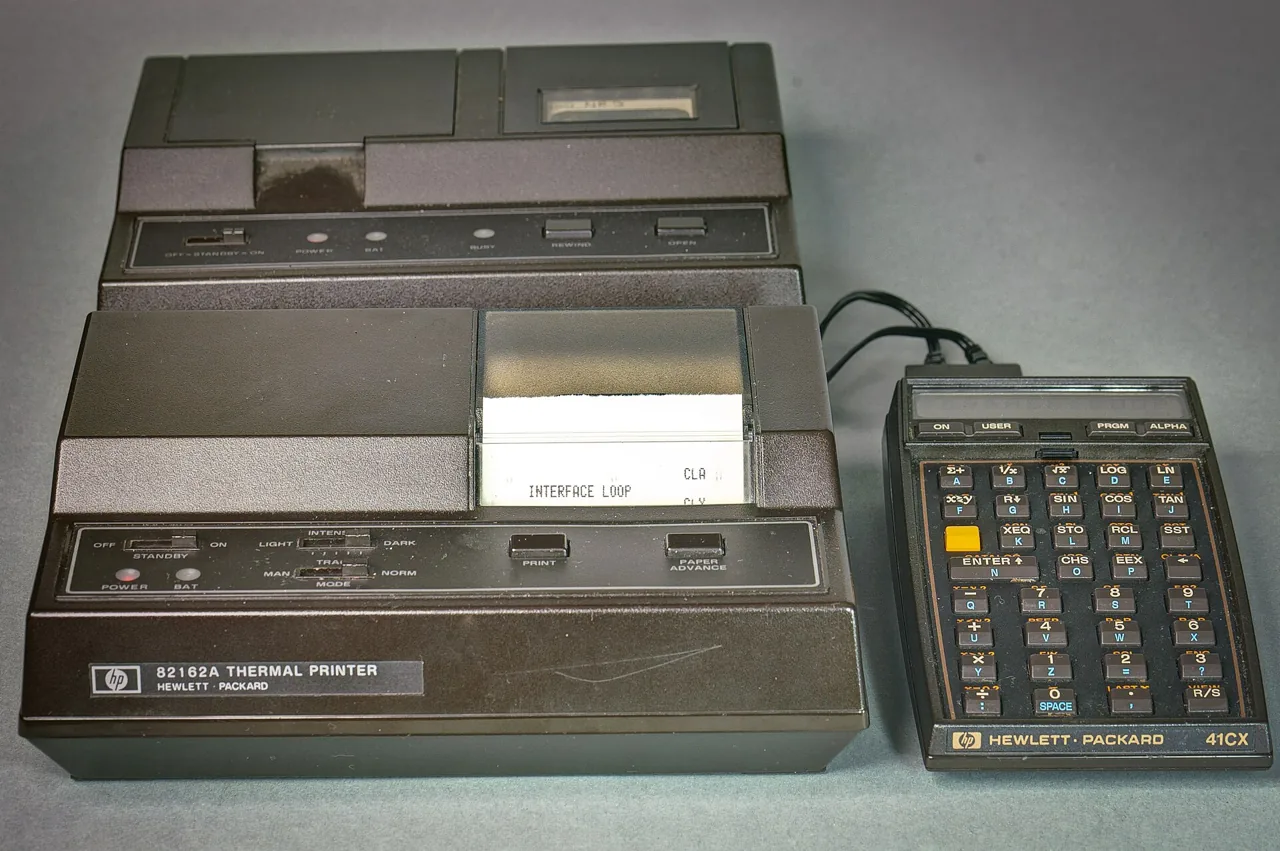
The HP-41CX was not a standalone innovation but a targeted evolution of the HP-41 platform, integrating functionalities previously available only through external modules. It incorporated the full instruction set and functions of the HP-82180A X FUNCTIONS Module directly into firmware, eliminating the need for separate installation while preserving compatibility with existing add-ons 23. This consolidation made it the preferred base unit for software relying on the date-handling system documented in TR-Dateiverwaltung-HP41, a technical reference that assumed the CX’s expanded capabilities 23.
Memory architecture centered on 320 registers, a limit shared with other high-end models in the series, though the exact byte equivalent remains undocumented. These registers accommodated both numerical data and program steps, with the final register permanently reserved for the .END. marker, a constraint that influenced program structuring in practice 23. For users managing larger datasets, the calculator supported the HP-82181A X MEMORY Modules, either one or two depending on cassette data volume, as well as the HP-82170A QUAD MEMORY and HP-82180A X FUNCTIONS Module, ensuring backward and forward compatibility within the ecosystem 23.
A defining feature was its alarm system, unusually sophisticated for a handheld calculator. Users could schedule alarms years into the future, configure them to repeat at fixed intervals, attach a 24-character alphabetic message, and assign each alarm to execute a specific program upon triggering 5. This functionality, combined with ALPHA string handling and ASCII-File data structures, enabled the creation of customized scheduling and data logging tools that blurred the line between calculator and programmable organizer 23.
The HP-41CX maintained full interoperability with key HP peripherals and expansion modules. It worked with the HPIL Module, allowing connection to HPIL-compatible cassette drives and printers 7101314. It also supported the Card Reader, Extended Function Module, and Time Module, the latter suggesting redundancy unless used for additional time-related features or calibration 7101314. Despite this expandability, the surviving documentation is silent on physical I/O specifications, keyboard layout, and enclosure dimensions.
Pricing across sources varies significantly: listed at $187.95 in one 1986 issue of BYTE 111, $169.90 in a 1989 BYTE price table 4, and $249.99 or $259 in multiple 1983–1984 publications 79121314. The outlier of $1249, likely a scanning error, appears in an OCR-processed German micro magazine 10. The CX was consistently grouped with the HP-41CV in pricing and categorization, both labeled "Scientific" calculators, though the CX’s added functionality justified its higher price points in practice 147891011121314.
| Manufacturer | Hewlett Packard |
| Product type | Scientific calculator |
| Memory capacity | 320 registers (includes permanent .END.) |
| Alarm capability | Programmable time alarms with 24-character message and program execution |
| Module compatibility | HP-82181A X MEMORY, HP-82170A QUAD MEMORY, HP-82180A X FUNCTIONS, HPIL Module, Card Reader, Extended Function Module, Time Module |
| Internal features | Built-in X FUNCTIONS Module instructions, ALPHA functions, ASCII-File data structure |
| Product series | HP-41 (with HP-41C, HP-41CV) |
| Original price range | $169.90–$259 (sources vary) |
References
- 1986 04 BYTE 11-04 Number Crunching (1986)
- TR-Dateiverwaltung-HP41
- TR-Dateiverwaltung-HP41
- 1989 12 BYTE 14-12 5 New Laptops and Sound Image Processing and Case Tools (1989)
- Vintage Technology magazine Issue 3
- BYTE Vol 10-01 1985-01 Through The Hourglass (1985)
- MICRO Vol69-02 84
- Byte Magazine Atari Articles
- BYTE Vol 09-01 1984-01 1984 And Beyond (1984)
- micro 72 jun 1984[ocr] (1984)
- 1986 06 BYTE 11-06 Computers and Music (1986)
- 1984 03 BYTE 09-03 Simulation (1984)
- micro 67 dec 1983[ocr] (1983)
- Compute Issue 055 1984 Dec (1984)