Sega Mega-CD
Sega’s add-on unit that grafted CD-ROM capability onto the Mega Drive, introducing full-motion video and audio CDs to the 16-bit console generation with a dual-CPU architecture and a fragmented global rollout.
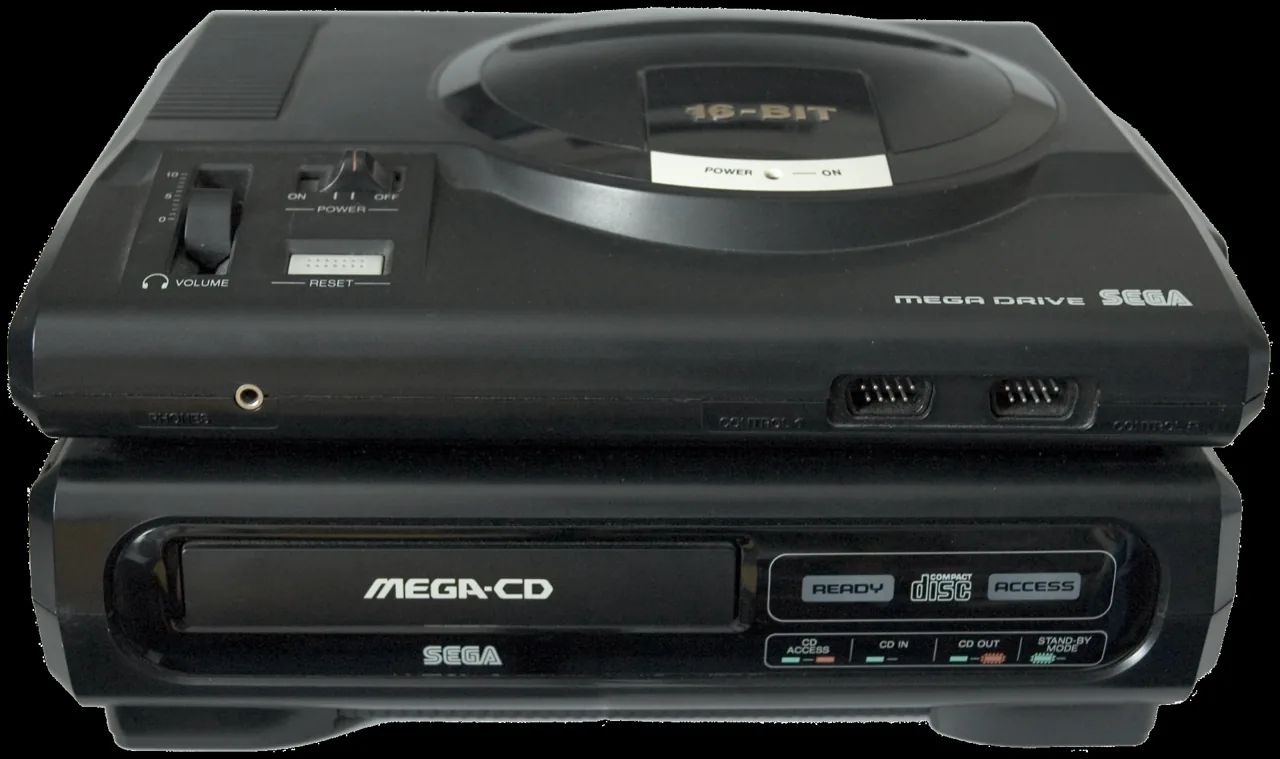
The Mega-CD, known as Sega CD in North America15, was not a standalone console but a peripheral designed to interface directly with the Mega Drive56. It extended the base system’s capabilities by incorporating its own 68000 CPU alongside the host console’s processor, enabling parallel processing for CD-based data retrieval and decompression56. Data transfer occurred over a dedicated 68000-to-68000 link, with the CD unit preparing assets in its internal memory before dispatch56. While the Mega Drive’s main CPU ran at 8MHz56, the Mega-CD’s clock speed was documented as 12.5MHz in North American specifications15, though this figure does not appear in European or Japanese documentation. The unit provided an 8-channel stereo sound output15, preserving the Genesis/Mega Drive’s graphical palette and sprite handling15.
Two primary revisions existed: the original Mega-CD and the slimmer Mega CD II (also styled Mega CD 2)138. The latter included a 10-bit processor, a term appearing in German-language materials without further technical elaboration38. Bundled software varied by region and revision: the Mega CD II shipped with Road Avenger in some markets38, while a 1995 UK bundle included Eternal Champions CD1. Game libraries diverged significantly; Japanese titles included Afterburner III, Final Fight, and Sol-Feace16, while Western catalogs featured Jaguar XJ 220 CD and Prince of Persia CD3. One German review described a puzzle-skill title priced at approximately 130 Deutsche Mark, rated difficulty 4 to 5, supporting password saves14.
Sega pursued multiple form factors beyond the standard add-on. The WonderMega, a combined Mega Drive and Mega-CD system, integrated both hardware units into a single chassis and remains the only 16-bit Sega system with S-Video output7. Two versions were produced: the first included karaoke functionality, the second added a remote-controlled six-button pad and dual controller ports on the rear panel7. The WonderMega is frequently cited as “extremely desirable” among collectors, with the initial karaoke-equipped model considered slightly more coveted7. JVC also released a combined Mega-CD and Mega Drive unit4, and Sega partnered with AIWA to launch the CSD-GM1, a portable Mega-CD system with radio, cassette recorder, and CD playback, released 1 September and priced around £3004.
Media support extended beyond standard game discs. The Mega-CD played audio compact discs and CD-G (CD+Graphics) discs1348. Sega produced proprietary write-once media labeled MEGA CD-R, spinning at 1.25 m/s and marked with a blue Sega logo9. These discs were incompatible with quadruple-speed writing operations9. The associated writing software, SEGACDW.EXE, and private media model CDM12PS71 (bearing the Saturn logo) were documented in technical archives9. The system came standard with a Sega controller4, and developers such as CRI (CSK Research Institute Corp.) contributed titles2. Third-party support included Tengen, Electronic Arts, and Sony Imagesoft15.
Pricing reflected regional disparities. In Germany, a Mega CD II bundled with Road Avenger retailed for 555.00 Deutsche Mark, while a Mega Drive II plus Mega CD II combo sold for 777.003. A 1995 UK bundle offered the Mega CD for 119.991. The peripheral was positioned as a performance leap over competing hardware, with one 1992 report claiming it boosted the Mega Drive “far beyond even the Super NES’s” capabilities10. However, the surviving documentation is silent on exact RAM allocation within the CD unit. The base Mega Drive had 64K each of processor and video RAM56, the Mega-CD’s memory is cited only as “6 Megabit” in a North American comparison table, without breakdown15. Likewise, no source specifies the data bus width, I/O configuration, or physical dimensions.
The Mega-CD was distinct from later Sega expansions such as the 32X, Saturn, and Dreamcast2. Its development followed a trajectory similar to NEC’s CD-ROM² and Commodore’s CDTV initiative, aiming to expand storage and multimedia through optical media56. By 1991, Sega had not yet announced a UK release date10, and the system’s rollout remained staggered. The Wonder Library suite offered compatible functionality for certain WonderMega and Mega CD variants2, suggesting a niche for home-burned or educational content. Despite its technical ambitions, the Mega-CD’s legacy rests on its fragmentation: multiple regional names, inconsistent bundling, and a proliferation of all-in-one variants that diluted its identity. It was, in execution, less a unified platform than a series of experiments in optical media convergence, some brilliant, some baffling, all bearing the fingerprints of a company racing to define the future of console gaming.
References
- MMSega 38 Dec 1995 (1995)
- Sega Saturn Encyclopedia vol2
- Video Games 1993-12 (1993)
- 1994-09-Games-Amusement-Pleasure-03 (1994)
- The One (1991-02) (1991)
- The One (1991-02) (1991)
- EDGE.RETRO.N3.2003.Guide.collecting-DURiAN (2003)
- Video Games 1993-12 (1993)
- Sattechs
- MeanMachines 16 Jan 1992 (1992)
- Archive item #6489137
- Archive item #CVG110199101
- Archive item #7427924
- Video Games 1995-04 (1995)
- Electronic Gaming Monthly's 1993 Video Game Buyer's Guide (1993)
- Computer and Video Games Issue 146 1994-01 EMAP Images GB (1994)