Atari 2600
A machine that outlived its creators’ ambitions, surviving not by technical merit but by the stubborn loyalty of players and the accidental genius of its open software model.
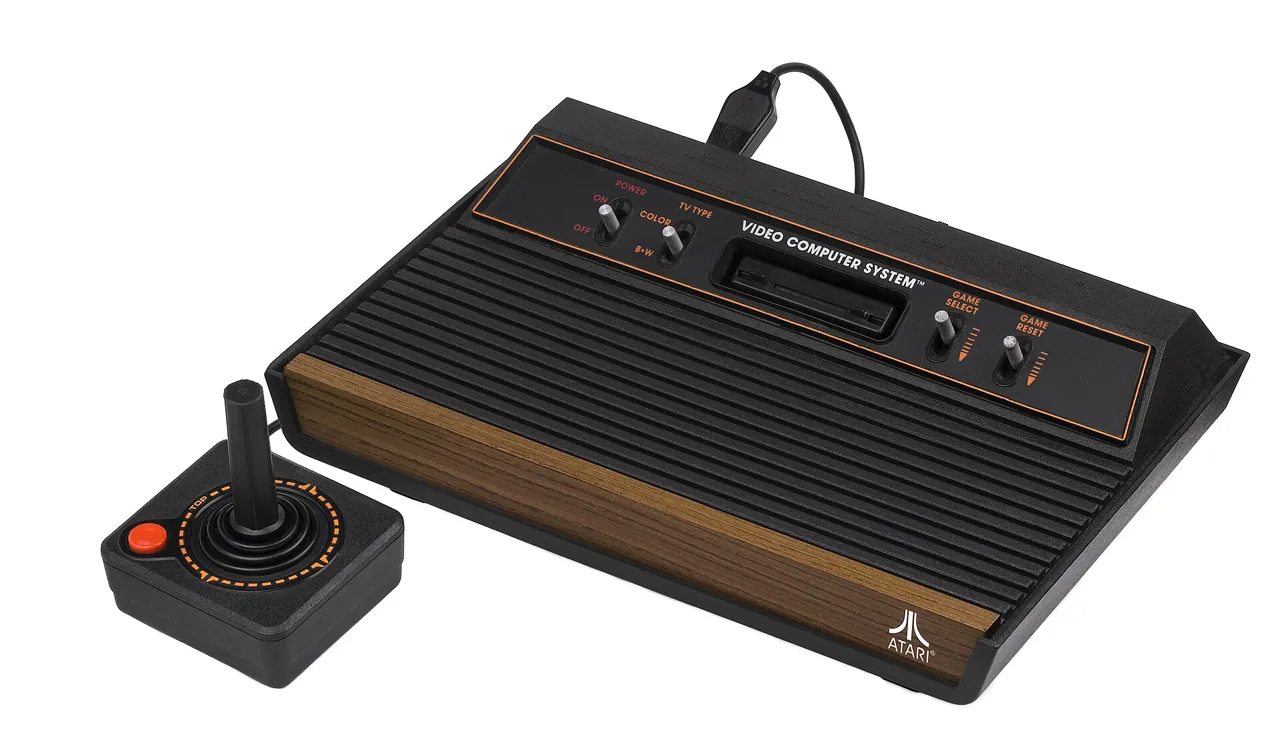
The Atari 2600 was not the first home video game console, nor the most advanced of its era, but it became the one that defined the template: cartridge-based, joystick-driven, living under the television. Its legacy rests less on engineering precision and more on cultural penetration. Released in 1977, the system carried Atari through a decade of triumph and collapse, emerging on the other side as a folk artifact of early digital play12.
The hardware itself was a study in minimalism bordering on austerity. An 8-bit system built around the 6507 processor—a stripped-down variant of the 6502, limited to addressing 4K blocks of memory instead of the full 64K4. There was no dedicated RAM beyond what resided in the RIOT chip, a multipurpose component handling input/output and system timing, positioned on the motherboard between the cartridge slot and the CPU4. This frugality dictated the programming style: every byte counted, every cycle was bartered. Yet within these constraints, developers mastered tricks like the “repeat register,” which duplicated on-screen objects without consuming additional memory, and multicolored sprites achieved by re-coloring scanlines mid-frame—clever workarounds that gave the illusion of complexity4.
Its controller port, a nine-pin connector, became a de facto standard across early home gaming and computing, a rare case of Atari establishing an interface that outlasted its own dominance10. The design of the unit varied across revisions, particularly in the 2600A models, where later production runs (Revision 14 and beyond) included additional components to refine output circuitry2. Even minor capacitor choices on the switchboard—C101, C103, sometimes present, sometimes absent, sometimes ceramic, sometimes mylar—varied by production date, a quirk that still confounds restorers2.
Software availability became the 2600’s true engine. Initially, Atari maintained a closed ecosystem: no third-party developers, no external publishers12. That changed when several programmers, frustrated by lack of credit, left to form Activision—the first independent console game developer67. Their success opened the floodgates. By 1993, approximately 60 titles were commercially available, priced between $10 and $15, with promotions like “buy three, get one free” still in effect3. Atari’s own 1990 catalog included titles such as Xenophobe, Ikari Warriors, and Double Dunk1, though major third parties like Activision and Absolute Entertainment had ceased 2600 development by then1.
The machine’s name carried no internal logic. The “2600” derived from the product numbering scheme—games and accessories bore codes starting with “26xx”—but the reasoning behind the number itself was never disclosed4. Originally marketed as the ATARI Video Computer System, it was retroactively rebranded the 2600 following the release of the Atari 5200, a technically superior but commercially awkward successor based on Atari’s home computer architecture67. The 5200’s games were often enhanced ports of 2600 titles, and compatibility with the older system arrived only as an afterthought67.
Atari’s downfall was sealed not by competition but by self-inflicted wounds. The 1980 home release of Space Invaders sent hardware sales soaring67, but the 1982 releases of Pac-Man and E.T. the Extra-Terrestrial became cautionary tales. The Pac-Man port was widely criticized and considered a poor representation of the arcade original67. E.T. was reportedly produced in quantities exceeding the number of 2600 units in circulation67. When sales collapsed, Warner Communications announced on December 7 that VCS sales had missed projections, triggering a 32 percent drop in stock value in a single day67. The alleged landfill burial of unsold cartridges in a New Mexico landfill became myth and metaphor67.
Despite this, the 2600 refused to die. Atari continued to believe in its market as late as 1990, even as prices dropped to $29.951. A complete CX2600JR model sold for $50 in 19933. Coleco released its own version, the Gemini System, a compact clone that fit more easily into a suitcase11. Adapters allowed 2600 games to run on ColecoVision10, and Atari itself marketed add-ons for the 5200 to lure 2600 owners upward10. The proposed line of 2600 keyboards and other peripherals, however, never materialized10.
The system’s endurance is best measured not in sales figures—unknown in surviving documentation—but in cultural afterlife. Even as Atari faded, first under Jack Tramiel’s ownership and later as a diminished corporation12, the 2600 maintained a following. By the 1990s, it was praised as a low-cost entry point for young players and budget-conscious families1. Its open architecture invited homebrew development, a scene that remains active decades later9. One enthusiast called it “the best all-round system for people of all ages,” a statement not about its specs, but about its reach11.
The 2600 was never elegant. It was underpowered, inconsistent in build, and burdened by corporate missteps. But its openness—first forced by defections, then embraced by necessity—created a model that would outlive it: a console as a platform, not a prison.
References
- atari-2600-connection-001
- FD100133 Atari2600FieldServiceManualRev02 Jan83
- atari-2600-connection-016
- atari-2600-connection-013
- atari-2600-connection-015
- vgc03
- vgc03
- Electronic Games Issue 16 Vol 02 04 1983 Jun (1983)
- MAKE Magazine OH 02
- Electronic Games Issue 33 Vol 03 09 1984 Nov (1984)
- vid kid's book of home video games - rawson stovall 1984 (1984)
- Sega Saturn Encyclopedia vol2
- Electronic Games Issue 35 Vol 03 11 1985 Jan (1985)
- ComputerEntertainer 4-7
- Electronic Games Issue 19 Vol 02 07 1983 Sep (1983)
- Introducing IBM PCjr