Fairchild Channel F
A first-generation oddity that stumbled into history by being just early enough to matter, yet too fragile to hold the line.
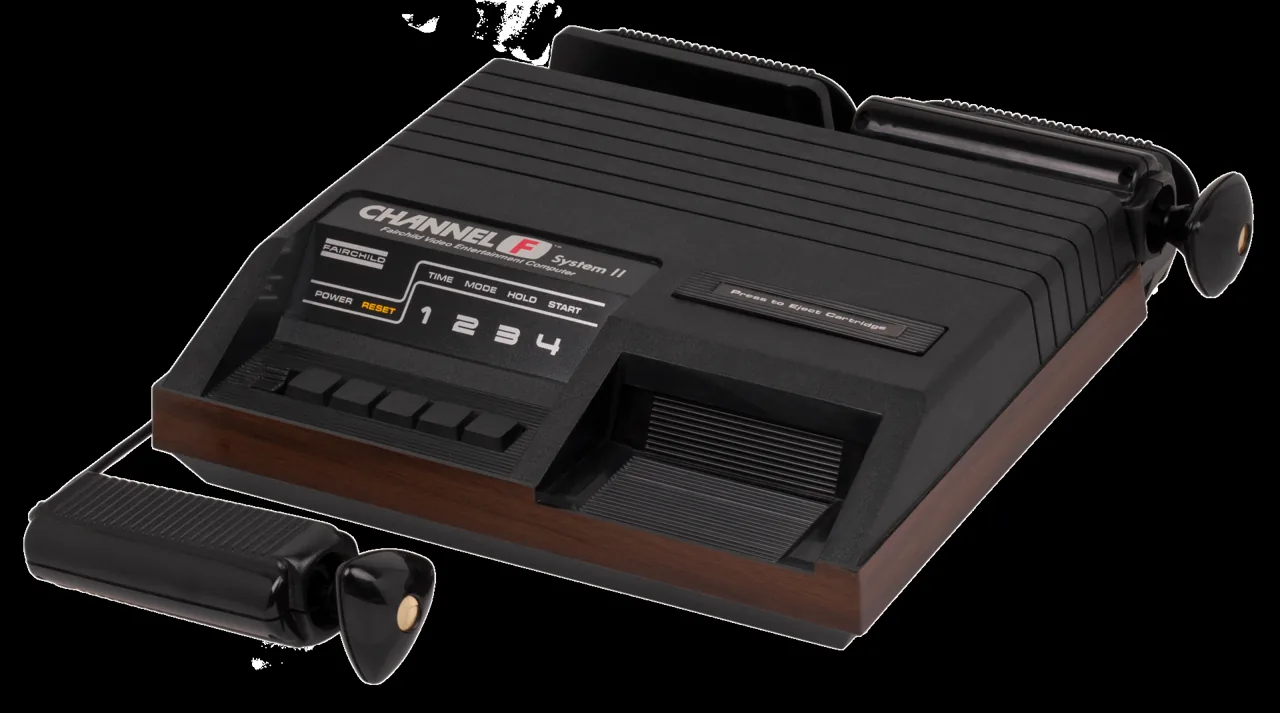
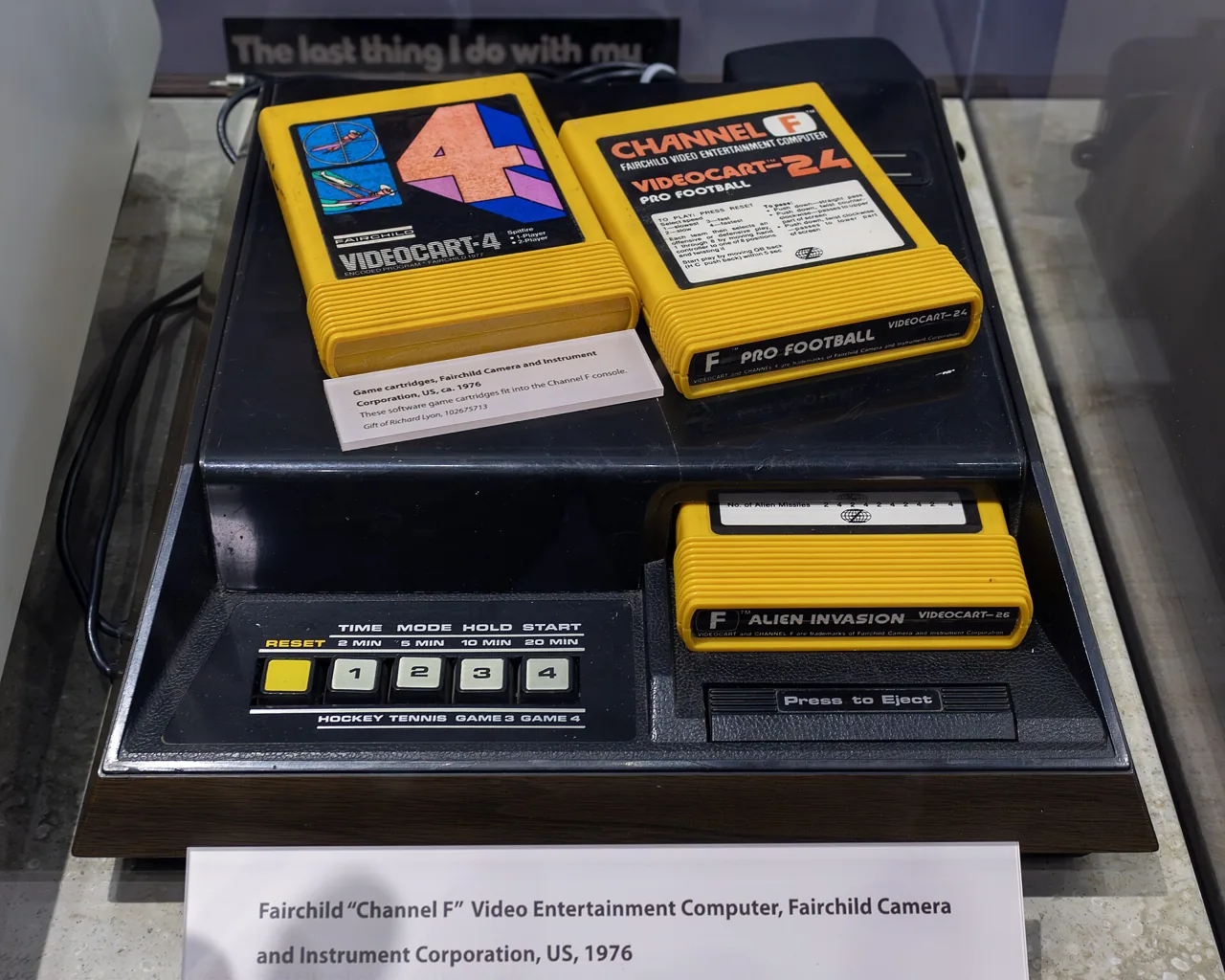
Fairchild's Channel F stands as one of the earliest programmable video game systems, a title it shares with the Magnavox Odyssey in the annals of commercial video game hardware1112. Unlike its contemporaries relying on fixed logic, the Channel F introduced the concept of swappable cartridges, software on solid-state media, granting players a modicum of choice beyond the built-in games of earlier consoles. This shift was foundational, though the machine itself was burdened by limitations that kept it from capitalizing on its own innovation. The system reportedly utilized a crude graphics mapping technique, a constraint that manifested in visuals more schematic than expressive11.
The controllers remain one of its more curious artifacts: hybrid paddle-joystick units that attempted to unify two dominant input paradigms of the era into a single device5. Whether this was elegance or compromise depends on the user’s tolerance for a control scheme that excelled at neither function. No technical specifications—processor, memory, display output, or sound generation—are preserved in the surviving documentation, leaving the internal architecture a black box. What is clear is that the system could not withstand the technological surge of later programmables, fading from prominence as more capable machines arrived11.
Fairchild soon relinquished control of the platform, selling off its assets or winding down operations; an incomplete note in the record suggests as much11. By the 1980 gift-giving season, Zircon, Inc., had revived the system, marketing revised hardware developed just before Fairchild shelved the project5. The Zircon-era Channel F was offered at a list price of $99.95, or $69.95 with a trade-in of an original Channel F unit14. This trade-in program allowed existing owners to upgrade under the same terms14.
Zircon claimed to be restoring the extensive Channel F game library to distribution and promised new titles in the near future5. In practice, the company released fewer than five new games since acquiring the system several years prior11. Despite this stagnation, the software roster included curiosities absent from other platforms. Whizball, in particular, stood out: a competitive two-player game where paddles did not block an incoming ball but instead fired “whizballs” to nudge a floating block toward the opponent’s goal12. The mechanic, described as compulsive and uncopied, offered a rare spark of originality in an otherwise conservative library11. Cartridges during the Zircon period retailed between $20 and $3014, with a complete list, including new releases, available directly from the company14.
The Channel F’s software catalog leaned heavily on solitaire and electronic board games, with only a limited selection of arcade or sports titles12. Zircon continued to produce cartridges, signaling a commitment to the platform long after its commercial relevance had expired12. Remarkably, the hardware itself was noted to have aged well, holding up despite the passage of years and the rise of more advanced systems5. This durability speaks less to forward-looking engineering than to the simplicity of its construction—fewer parts to fail, even if those parts were never quite enough.
Its legacy is one of near-miss significance. The Channel F was not merely early; one contemporary account stated it was “10 minutes ahead of its time,” a characterization that may reflect both its innovative timing and its awkward execution11. It pioneered the cartridge-based model later perfected by competitors, yet failed to establish a lasting foothold. Like Magnavox before it, Fairchild experienced serious growing pains in the nascent video game market, launching a vision without the follow-through to sustain it12. The system endures not for its technical prowess, on which the record is silent, but for its role as a prototype of the future, flawed and forgotten, yet fundamentally first.
References
- Electronic Games Issue 01 Vol 01 01 1981 Winter Premiere (1981)
- Electronic Games Issue 36 Vol 04 01 1985 Mar (1985)
- Electronic Games Issue 21 Vol 02 09 1983 Nov (1983)
- book how to win at video games complete guide
- Electronic Games Issue 06 Vol 01 06 1982 Aug (1982)