Atari 7800
The Atari 7800, produced by Atari Corporation, was a video game console released with built-in compatibility for Atari 2600 cartridges and a graphics architecture derived from the company’s 8-bit computer line.
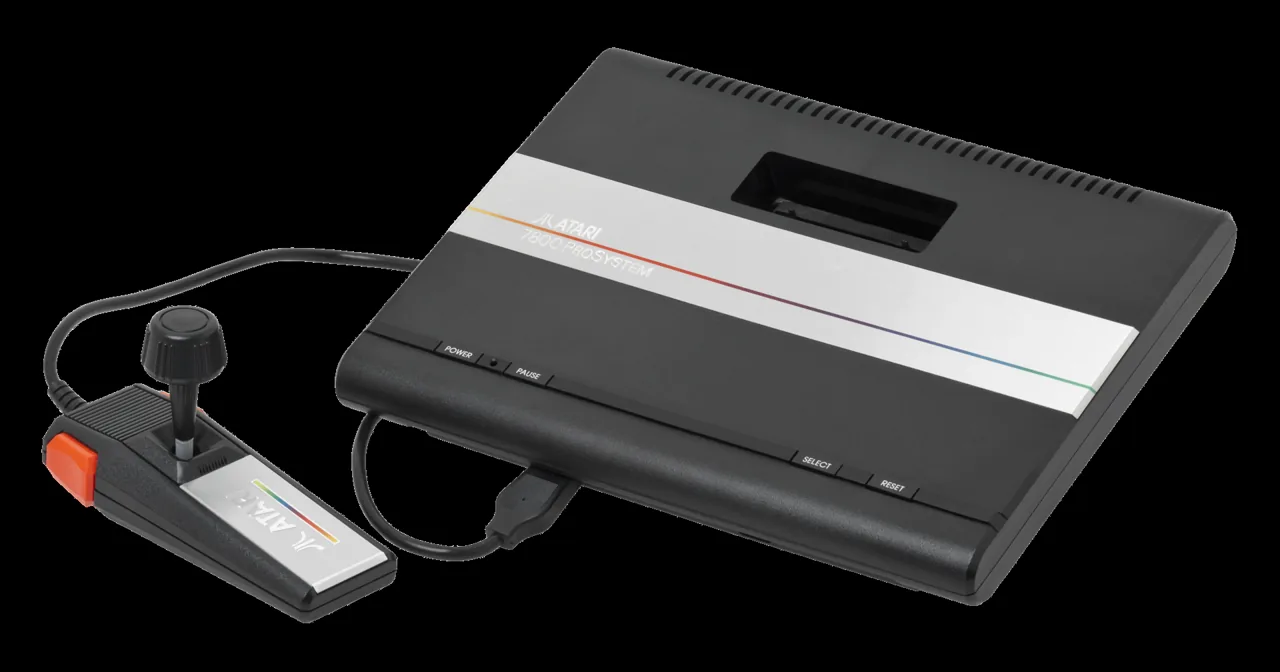
The 7800 was positioned as a direct response to criticism that Atari had abandoned its core gaming audience in favor of its more expensive ST series computers7. Marketed as a reaffirmation of the company’s commitment to games, it promised improved graphics and gameplay over the 2600 while maintaining backward compatibility, requiring no adapter71. This integration was not cosmetic: when a 2600 cartridge was inserted, the system disabled the Maria graphics chip entirely, routing video output through the TIA chip with all Maria signals held low7.
The system used a 6502 processor running at 1.79 MHz5, supported by what one source described as "4k each of ram and rom"5. The Maria graphics chip, originally intended for Atari’s 8-bit computer range, delivered a resolution of either 320 by 200 pixels5 or 320 by 1927, a discrepancy unexplained in surviving documentation. It supported up to eight colors on screen simultaneously from a palette of 2565. Notably, the system lacked hardware sprites; instead, it relied on software-managed "sprites," with support for up to 645.
Video output could originate from either the TIA or Maria chip7, and audio was primarily handled by the TIA, possibly augmented by an EAUD signal from the cartridge7. Cartridges were available in 64k or 128k configurations5, and development tools for these were offered by Atari, running on the ST platform5. The machine operated in three distinct modes: internal, Maria, and 2600 compatibility. Mode selection occurred automatically at power-on based on the inserted cartridge7.
Despite its technical merits, the 7800 faced turbulent circumstances. Jack Tramiel’s acquisition of Atari, following his tenure at Commodore International, cast uncertainty over the system’s future1. Its UK release was delayed until mid-1987, despite initial expectations of a Christmas availability5. Priced at an expected £69.957, it entered a market where European consumers showed stronger interest in 8- and 16-bit computers than consoles8. In the U.S., it struggled against the dominant Nintendo Entertainment System8. Even the budget relaunched Atari 2600 Jr. undercut its appeal8.
The console’s expansion potential was minimal. The Highscore Cartridge, a planned accessory, was canceled, leaving the final product "sin posibilidades de expansión"8. Though development kits were displayed at trade shows, and Atari claimed a good number of games would be available by the time the unit launched5, the system did not achieve broad market success. Nevertheless, new software continued to appear in the UK from companies like Red Rat Software, which released titles such as Laser Hawk, Domain of the Undead, and Screaming Wings on tape (£7.95) and disc (£9.95)5.
Contemporary U.S. reviewers were enthusiastic: one declared it "the best video game there is"1, while another called it the top-of-the-line programmable videogame player1. Yet this acclaim did not translate into market dominance. The 7800 lingered in circulation until Atari discontinued support for its 8-bit line in the early 1990s8, after which it "entró en un profundo sueño"8. Its legacy resurfaced decades later with the release of the Flashback, a plug-and-play console styled after the 7800 and preloaded with 2600 and 7800 titles12.
References
- Electronic Games Issue 33 Vol 03 09 1984 Nov (1984)
- AtariUser21-Jan87
- AtariUser20-Dec86
- RetroManiac 7 single
- vgc03
- EpyxProductCatalog1988 (1988)