Atari Jaguar
Atari Corporation's 64-bit video entertainment system, marketed as the world's only 64-bit system, launched with a complex multi-processor architecture and ambitions to dominate the high-end game market, but struggled with developer adoption, retail confidence, and a fragmented software pipeline.
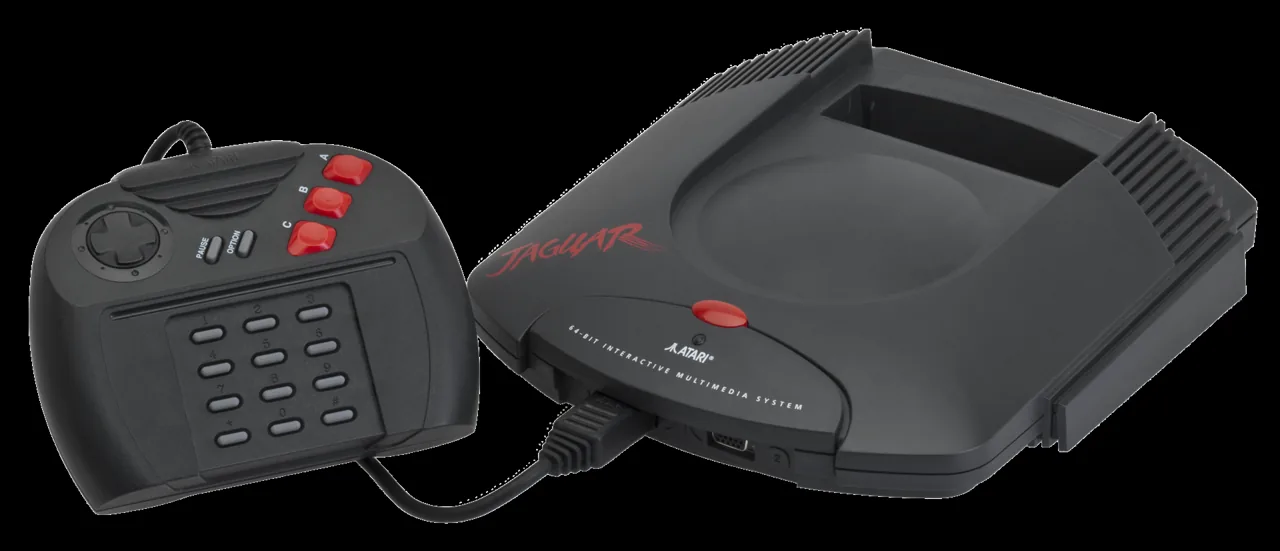
The Jaguar emerged from Atari Corporation’s Sunnyvale headquarters at 1196 Borregas Avenue as a self-described 64-bit system8, though its internal structure defied conventional classification. Five processors were distributed across three chips14, anchored by the "Tom" chip housing the GPU, Blitter, and Object Processor14, and "Jerry", a 32-bit DSP with 8-KByte RAM buffer14. A 68000 processor, labeled a 16-bit CISC chip and the weakest on board, was retained for backward compatibility potential with Amiga and Mega Drive titles14, though no ST software could be ported34, and previous product compatibility was entirely absent34.
Atari claimed the system delivered 24-bit true colour video with access to 16 million colours on a standard TV79, supported 3-D image processing and real-time texture mapping79, and featured a DSP audio system capable of 16-bit CD-quality sound79. Software was initially released on cartridges79, with a CD peripheral in development79. The Jaguar CD would later plug directly into the console12, and its development system reportedly used a Falcon030 with DSP12.
Manufacturing was initially handled by IBM, but Comptronix in Colorado Springs joined as a second manufacturer by mid-199434. Atari intended a New York-area holiday season launch with national distribution within a year79, pricing the unit below $20079 before cutting it to $150 (US)56 in a bid to enter the low-end mass market56. Despite this, Atari lacked the resources to compete with Sega and Nintendo56.
Developer support was uneven. Over 125 third-party licensees were signed8, and Atari assembled a technical team that traveled globally to assist developers4. The development system itself included a Jaguar on a PC card12. Attention To Detail, advising on hardware specifications, prompted Atari to incorporate a couple of new instructions13. Atari’s own team contributed directly to level design in Cybermorph13, the pack-in title included with the console8. Its sequel, Battlemorph, was developed by ATD and listed among the first CD titles413, though it was also rumoured to be the CD pack-in4.
By late 1995, Atari had sold over a quarter of a million units in two years56, but retail confidence was fragile. While 8,500 U.S. outlets carried the Jaguar, including Wal-Mart and Radio Shack12, some smaller stores dropped it, and Babbage’s staff reportedly hid stock12. False rumours circulated that Atari was bankrupt or that the Jaguar CD would never release12. Microplay dropped the system, believing Atari had abandoned them56. A BusinessWeek review unit failed to function56, and Newsweek referred to Atari as “now defunct”56.
Despite these setbacks, signs of resilience appeared. By mid-1995, units were being delivered in quantity to dealers12. Individual stores reported selling 1–3 consoles weekly, with about ten games sold per week, comparable to 3DO sales11. A secondary market for used Jaguars and games remained strong, with few used units available11. A dedicated magazine, The Jaguar’s Edge, was slated for July publication, edited by Travis Guy and published by John Marcotte11.
Press reactions were mixed but not uniformly hostile. GamePro declared the system “worth the price of admission”10, while Game Players praised its design potential10 and VideoGames gave it a “Recommended” rating10. Atari co-marketed titles and maintained online support through CompuServe (GO JAGUAR)1012 and GEnie (JAGUAR)1012, alongside a paid hotline for game tips at 1-900-737-ATARI1012.
The Jaguar’s complexity, described as less clean than the Sony PlayStation’s architecture, and its failure to achieve critical mass in a crowded 32/64-bit market ultimately limited its reach. The high-end game market proved smaller than expected, and profitability elusive outside Japan56. Publishers reportedly required one to two million units for a viable market56, a threshold the Jaguar never approached. Rumours persisted that Atari would abandon the system at the first convenient moment56, and speculation arose about Microsoft considering acquisition due to Atari’s work on an undisclosed interface11.
References
- XIO3 Garden City Atari Computer Enthusiasts Newsletter September - October 1995 (1995)
- XIO3 Garden City Atari Computer Enthusiasts Newsletter September - October 1995 (1995)
- XIO3 Garden City Atari Computer Enthusiasts Newsletter March - April 1995 (1995)
- XIO3 Garden City Atari Computer Enthusiasts Newsletter March - April 1995 (1995)
- XIO3 Garden City Atari Computer Enthusiasts Newsletter November - December 1995 (1995)
- XIO3 Garden City Atari Computer Enthusiasts Newsletter November - December 1995 (1995)
- XIO3 Garden City Atari Computer Enthusiasts Newsletter July - August 1993 (1993)
- STR1020.TXT.generated
- XIO3 Garden City Atari Computer Enthusiasts Newsletter July - August 1993 (1993)
- Electronic Games 1995-06 (1995)
- XIO3 Garden City Atari Computer Enthusiasts Newsletter July - August 1995 (1995)
- Electronic Games 1995-03 (1995)
- Atari ST User Issue 097 1994-02 Europress GB (1994)
- MANIAC.N022.1995.08-DURiAN Searchable (1995)
- TIBUG-1996-11-12 (1996)
- Electronic Games - 199210 - Volume 1 Issue 3 (1992)