Atari Pong
Atari released Pong in November 1972 as an arcade cabinet, establishing the first commercially successful video game and catalyzing the modern video game industry.
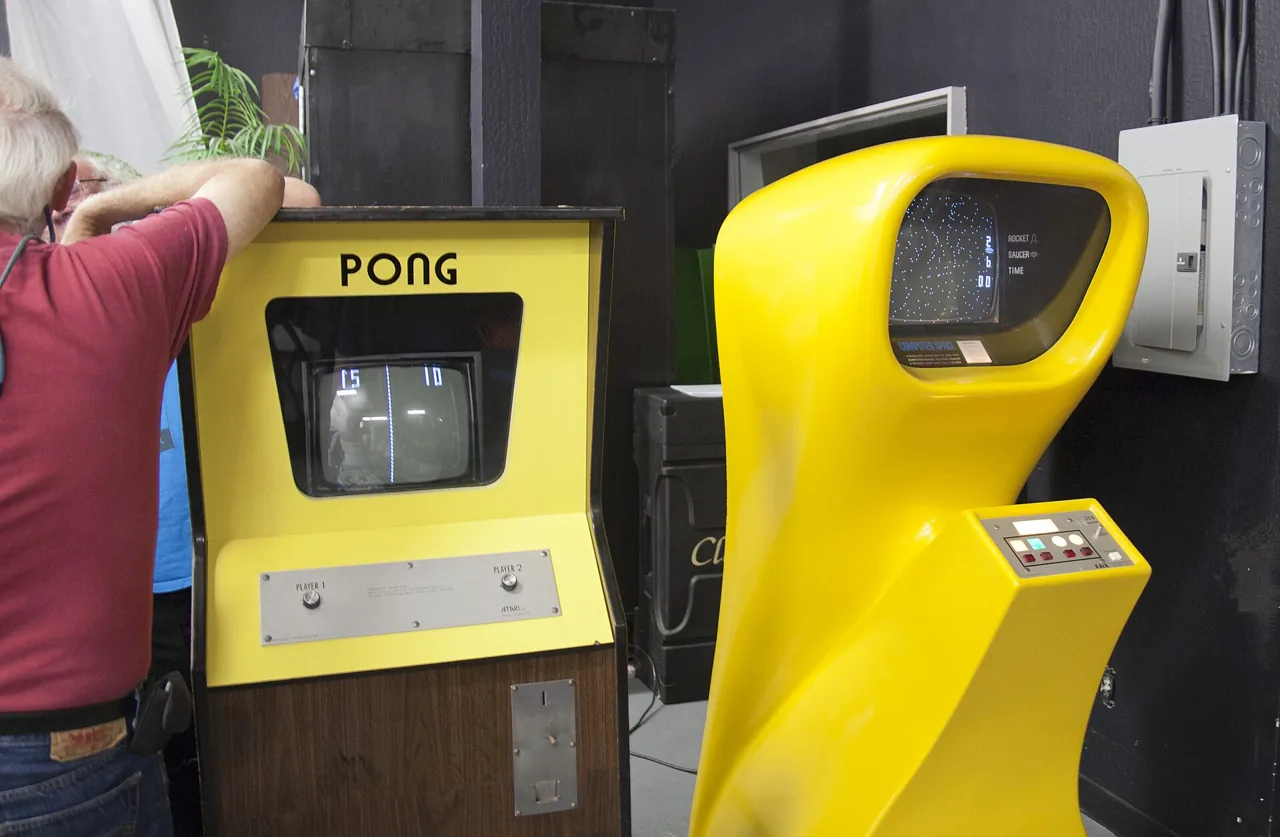
Atari did not begin with a grand vision of digital entertainment but with a sawed-off plastic milk container overflowing with quarters. The company, founded in 1972, entrusted engineer Al Alcorn with building a simple video tennis game as a training exercise23. Nolan Bushnell, Atari’s founder, had previously failed to license the concept to established arcade manufacturers and opted instead to manufacture and deploy the machine himself23. The prototype was installed in Andy Capp’s Tavern in Sunnyvale, where, within days, it malfunctioned. This was not due to a technical fault, but because the coin box, a repurposed plastic milk jug, jammed from excess quarters1.
The game’s name, Pong, derived from the sound effect produced when the ball struck the edge of the screen23. Visually, the display was minimal: two vertical paddles on opposing sides and a central line demarcating the court1. The arcade version launched commercially in November 19721, and by 1973, Atari recorded $3.2 million in sales, a direct result of Pong’s dominance in coin-op arcades13.
Imitation followed swiftly. Between 1972 and 1974, approximately 100,000 Pong-style machines entered the market, though only 10 percent were genuine Atari units1. Magnavox sued Atari, asserting that Pong infringed on the Odyssey’s table tennis game. The dispute ended in a settlement, with Atari licensing video game rights from Magnavox23. Despite the legal cloud, Pong’s cultural and commercial impact was irreversible. It marked, in the assessment of many gaming historians, the true birth of the video game industry8.
Atari expanded into the home market in 1974 with Home Pong, a dedicated console version designed for television play2311. This single-game system, though crude by later standards, replicated the arcade experience in living rooms and became a commercial hit11. By 1975, Pong had become a fixture in the electronics market, with competitors rushing to produce their own ball-bouncing variants45. Atari’s company-wide sales reached $40 million that year11, climbing to over $500 million by 198045, and exceeding $2 billion in 198213.
The name "Atari" itself originated from the game of Go, where it signals imminent capture. This is a fitting metaphor for a company that captured the public’s imagination with a single, elegantly simple game8. George Opperman, a freelance artist hired to design the company’s visual identity, created the now-iconic "Fuji" logo, a stylized "A" that also drew inspiration from Pong’s gameplay1. PONG is a registered trademark of Atari Inc.12, and the game remains classified as a "Ball & Paddle" title in official documentation10.
Legacy arrived in waves. While Pong itself was soon considered outdated amid the cartridge-based sophistication of later consoles45, its foundational role was never in doubt. Atari went on to produce 180 distinct games by March 1997, with Pong standing as the progenitor of them all9. Pong was included for free in Atari’s iOS application, which also offered additional games for purchase14.
References
- atari-2600-connection-015
- vgc03
- vgc03
- The Blue Book
- The Blue Book
- Catalogo Consolas UPV 4 de mayo de 2021 (2021)
- Computer für Anfänger (Bastei-Lübbe)
- Sega Saturn Encyclopedia vol2
- Coin Cascade Ltd - Time Out Magazine - July 1997 (1997)
- Basic Programming (Atari 2600)(US)
- AtariUser38-Jun88
- BYTE Vol 03-04 1978-04 Robot Simulation (1978)
- STFormat00-Bundled
- RetroManiac 4 single
- Electronic Games Issue 01 Vol 01 01 1981 Winter Premiere (1981)
- Electronic Fun Computer and Games Vol 01 03 1983 Jan (1983)