Atari 5200
Atari released the 5200 SuperSystem in January 1982 as a technically enhanced successor to the VCS, built on the architecture of the Atari 400 computer but stripped of programmability and keyboard, priced at \$299 at launch.
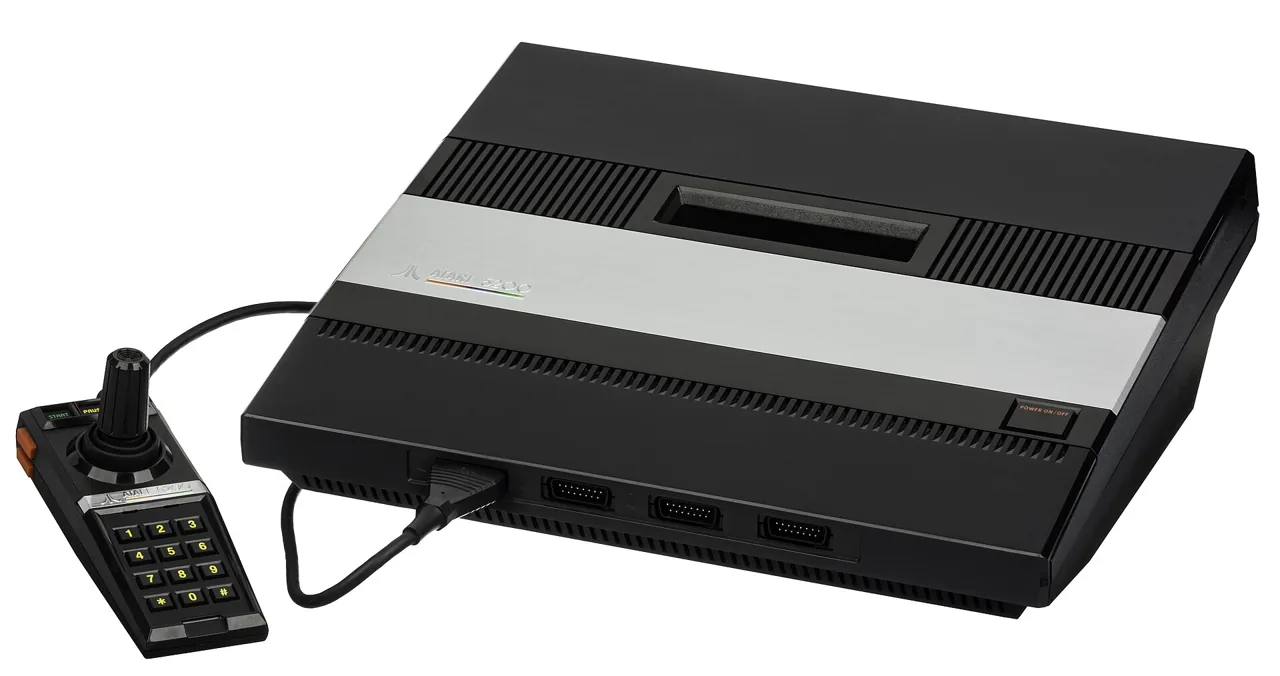
The 5200 arrived not as a clean break but as a repackaged computer, effectively an Atari 400 without the keyboard or user programming capability9. It shared the same memory footprint as the factory-equipped 400 (reportedly 16K10, though one source cites 128K9) and drew from the existing 400/800 software base, allowing developers to adapt proven titles with relative ease14. This architectural continuity was a cost-saving design decision, reducing development overhead compared to platforms like the Colecovision14.
Its most notorious flaw was the controller: an analog joystick without self-centering mechanics2. This design proved maddening in fast-paced arcade translations such as Pac-Man, Centipede, and Robotron, where precision was paramount2. Though third-party manufacturers like Wico, High Score, and Coin Controls offered self-centering replacements, the response came too late to repair the console’s reputation2. The controller’s keypad, pause, start, and reset functions were integrated into the unit itself, eliminating the need to touch the console during play1.
Atari promised a VCS cartridge adapter to bridge the gap with its massive 2600 library, allowing owners to play 2600 games on the 5200 with superior controllers36. The adapter was confirmed for release by springtime 19836, though it would not enhance the visual or gameplay fidelity of 2600 titles6. Despite this, the redesigned cartridge slot rendered 2600 cartridges physically incompatible with the 5200 without the adapter310.
The console was marketed as a leap forward in home gaming, offering “true arcade graphics” and a “high tech design”1. Games such as Star Raiders6, Pole Position4, and an arcade-accurate Pac-Man with intermissions13 demonstrated its capabilities. By 1984, it had overtaken the Colecovision in sales2, but Atari abruptly halted production to focus on the 7800 and its new graphics technology2. The 7800’s price was expected to be only slightly higher, making the business case for discontinuation2.
Users expressed disillusionment. One wrote to Electronic Games in 1984: “I was really hoping that the 5200 would be the best, but it now seems that Atari doesn't care about 5200 owners. I feel now that I should have bought a ColecoVision”2. The sentiment reflected a broader sense of abandonment, even as the console led in sales2. The Wico Analog Joystick with Keypad was later awarded “BEST NEW ACCESSORY” in 19844, underscoring the market’s rejection of the stock controller.
A dedicated carrying case, retailing for \$29.95, held the console, nine cartridges, AC adapter, and TV switch box5. Constructed with double-walled walls, metal latches, and a luggage-style handle, it mirrored the 5200’s “sleek, futuristic-looking” aesthetic511. Other accessories included a Trakball and a voice synthesizer10.
The 5200 was designed explicitly to compete with the Colecovision15, which had launched the same year and boasted superior graphics to both the VCS and Intellivision15. Atari positioned the 5200 as a technological upgrade over the VCS, with better graphics and more sophisticated games3. The console’s design reduced clutter (fewer cords and no white noise during cartridge changes), marking a refinement in user experience13.
References
- Atari 5200 Super System brochure 1983 (1983)
- Electronic Games Issue 33 Vol 03 09 1984 Nov (1984)
- Introducing IBM PCjr
- ComputerEntertainer 2-10
- logical gamer novdec83
- Joystik Vol1-5 83-Apr
- Electronic Games Issue 22 Vol 02 10 1983 Dec (1983)
- Electronic Games Issue 19 Vol 02 07 1983 Sep (1983)
- Electronic Fun Computer and Games Vol 01 03 1983 Jan (1983)
- Electronic Fun Computer and Games Vol 01 07 1983 May (1983)
- ComputerEntertainer 1-8
- Electronic Games Issue 35 Vol 03 11 1985 Jan (1985)
- Joystik Vol1-3 82-Dec
- Joystik Vol2-1 83-Sep
- atari-2600-connection-013
- Electronic Fun Computer and Games Vol 01 04 1983 Feb (1983)