Sega Game Gear
Sega's handheld game system, released with a suite of power and connectivity accessories and marketed alongside the Master System and Genesis, offered compatibility with 8-bit Sega cartridges through a converter but shipped without technical specifications for CPU, RAM, or display in surviving documentation.
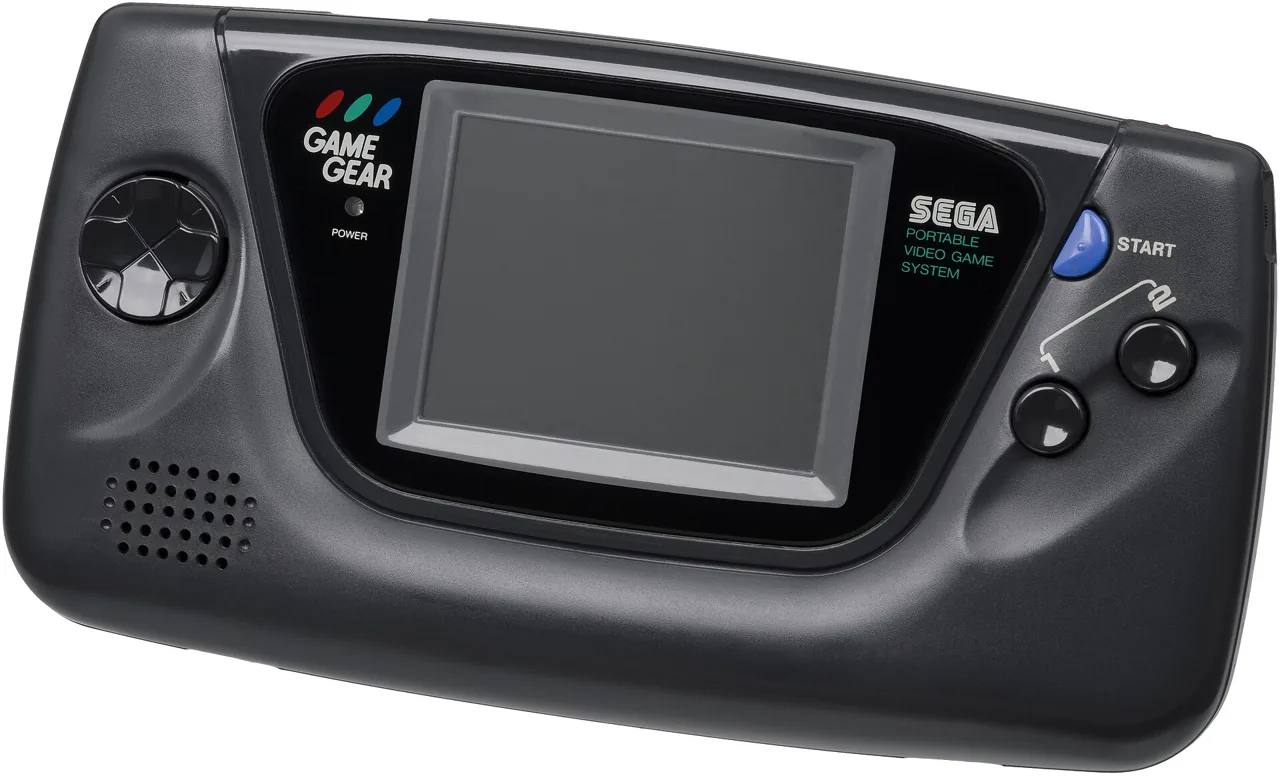
The Sega Game Gear entered the market as a portable game system designed to support a range of power sources, including four AA batteries, with alkaline cells being recommended. It also supported the optional rechargeable Battery Pack Sega, an AC adapter (listed as "adaptador de CA del Game Gear SEGA" or "adattatore di allacciamento alla rete"), and vehicle adapters for both European ("adaptateur pour voiture") and international ("adaptador para automóviles") use12. This multi-source flexibility suggested an intent for extended mobile play, though surviving documentation does not specify battery life under any configuration. The system was classified as a Class B digital device under FCC Part 15, indicating it was tested for residential radio frequency interference compliance, and the manual explicitly warns that the unit "generates, uses and can radiate radio frequency energy"3. Patents cited in the manual span multiple jurisdictions, including U.S. Nos. 4,442,486, 4,454,594, and 4,462,076, with additional filings in Europe, Canada, Hong Kong, Singapore, and Japan (the latter marked as pending at time of publication)3.
Software support was initially sparse, drawing criticism in early 1993 for Sega's slow release cadence5. However, the arrival of Sonic the Hedgehog II and the ability to play Master System titles via an adapter (referred to in period materials as the "SMS convertor" or "Master System convertor") significantly improved its appeal5. By 1993, reviewers noted that access to the library of "eld SMS carts" combined with titles such as Golden Axe, Outrun, and Shinobi positioned the Game Gear as "the portable system of choice"5. Titles such as Columns, Pengo, Super Monaco GP, and Chase HQ were among those available at launch or shortly thereafter12. Later additions included Sonic Blast, a single-player title licensed for the Game Gear15. Codemasters, among other third parties, produced licensed software under agreement with Sega Enterprises Ltd69.
Sega marketed the Game Gear as part of an integrated ecosystem that included the Genesis (known as Megadrive outside North America), Master System, and Sega CD47. Publications such as Mega Play billed themselves as "The All-Sega Genesis, Master System and Game Gear Magazine", underscoring a unified branding strategy4. Accessories expanded functionality and convenience: the Gear-to-Gear Cable, a registered trademark of Sega, was among the available peripherals3. Other available peripherals included the Master Gear (priced at £27.99), a carry case (€4.99), a rechargeable battery pack (£24.99), and a television tuner marketed as "a plus"135. Some accessory names in retailer listings appear garbled: “WDE GEAR” likely refers to “Wide Gear”, while “SUDER” remains unidentifiable13.
Pricing in the UK market showed variation across sources: one 1991 listing advertised the system bundled with a game at £149.95, while another from the same year noted a standalone price of 99.99 (currency unspecified, though context suggests GBP)12. A separate archive item records the price as £15014. The discrepancy between £149.95 and £150 may reflect rounding, while the 99.99 figure could indicate a promotional or regional variant, though the documentation does not clarify this. The system accepted cartridges via a dedicated slot labeled "Game Gear cartridge slot"8, and was described as compatible with "Sega 8-Bit games"5.
The Game Gear drew mixed reactions. One 1993 assessment conceded that "the hardware is not very impressive" yet acknowledged its growing software strength, particularly with Sonic 25. The reviewer added, "Personally, I'm not impressed with the system, although Sonic on the go is fun", capturing a sentiment of qualified endorsement5. Comparison to the Atari Lynx suggested that with better software optimization, the Lynx could overtake the Game Gear, a forecast that did not materialize in the available record5.
Notably absent from all source documents are technical details now considered standard: no mention of CPU type, clock speed, RAM, ROM, display resolution, color depth, sound hardware, or I/O beyond the cartridge slot and power inputs. Dimensions, weight, and production figures are also unrecorded in the provided materials. The system’s architecture, while clearly derived from Sega’s 8-bit lineage, remains undocumented in these primary sources. What endures is a portrait of a device positioned not by raw specs, but by ecosystem integration and incremental software gains, with its viability staked on access to older carts and flagship franchises rather than disclosed engineering.
References
- sega-game-gear
- sega-game-gear
- Sega Game Gear Instruction Manual
- Electronic Games - 199210 - Volume 1 Issue 3 (1992)
- Electronic Gaming Monthly's 1993 Video Game Buyer's Guide (1993)
- Computer and Video Games Issue 146 1994-01 EMAP Images GB (1994)
- Electronic Games 1994-06 (1994)
- Video Games and Computer Entertainment - Issue 40 - May 1992 (Compressed) (1992)
- Computer and Video Games Issue 146 1994-01 EMAP Images GB (1994)
- Video Games 1993-12 (1993)
- MeanMachines 07 Apr 1991 (1991)
- MeanMachines 16 Jan 1992 (1992)
- Archive item #CVG110199101
- Sonic Blast GG US Manual