Amiga CD32
Commodore’s final consumer hardware release, the Amiga CD32, shipped in 1993 as a full 32-bit CD-ROM console built on AGA chipset technology, positioning itself as a games-focused evolution of the A1200 with expandability through third-party upgrades.
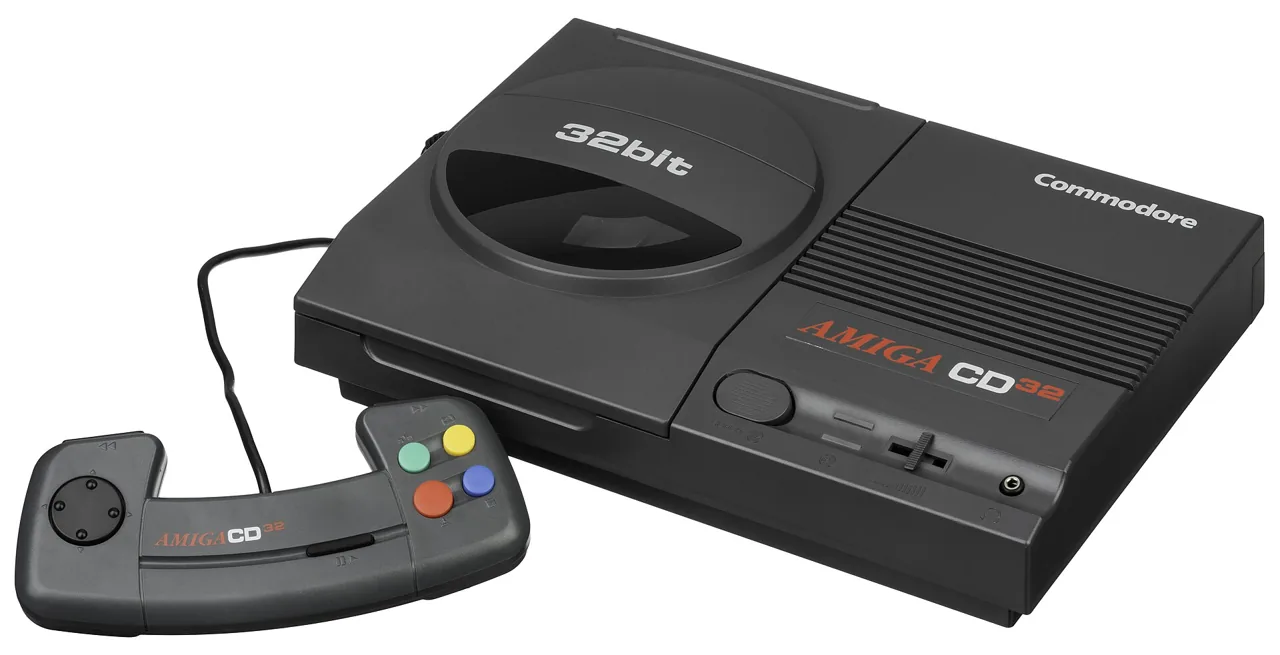
Marketed as a stonkingly powerful CD-ROM-based Amiga console2, the CD32 was Commodore’s direct response to the rising dominance of Japanese and American console manufacturers2. Unlike the ill-fated CDTV, which attempted to sell as a multimedia appliance, the CD32 was unapologetically targeted at the games market, leveraging the established Amiga architecture in a dedicated form factor2. It ran on a Motorola 68EC020 32-bit microprocessor clocked at 14 Mhz7, featured 2 Meg of RAM27, and relied on the AGA chipset (comprising the custom chips Paula, Lisa, and Alice) for graphics and audio12. This configuration delivered up to 256,000 colors on screen from a palette of 16.8 million127, with output support for PAL and NTSC via composite or S-Video17.
The system housed a top-loading double-speed CD-ROM drive12, capable of reading discs with over 600MB of data, as demonstrated by the CDPD and CDPD II software collections1. These discs included Fred Fish disks 1–760 and extensive public domain archives, highlighting the platform’s roots in the Amiga software ecosystem1. The CD32 launched in Europe by the end of August 1993 at £2998, with a planned North American release in preparation5. The US price was set at $3991, while Dutch listings showed a special introductory price for the console7.
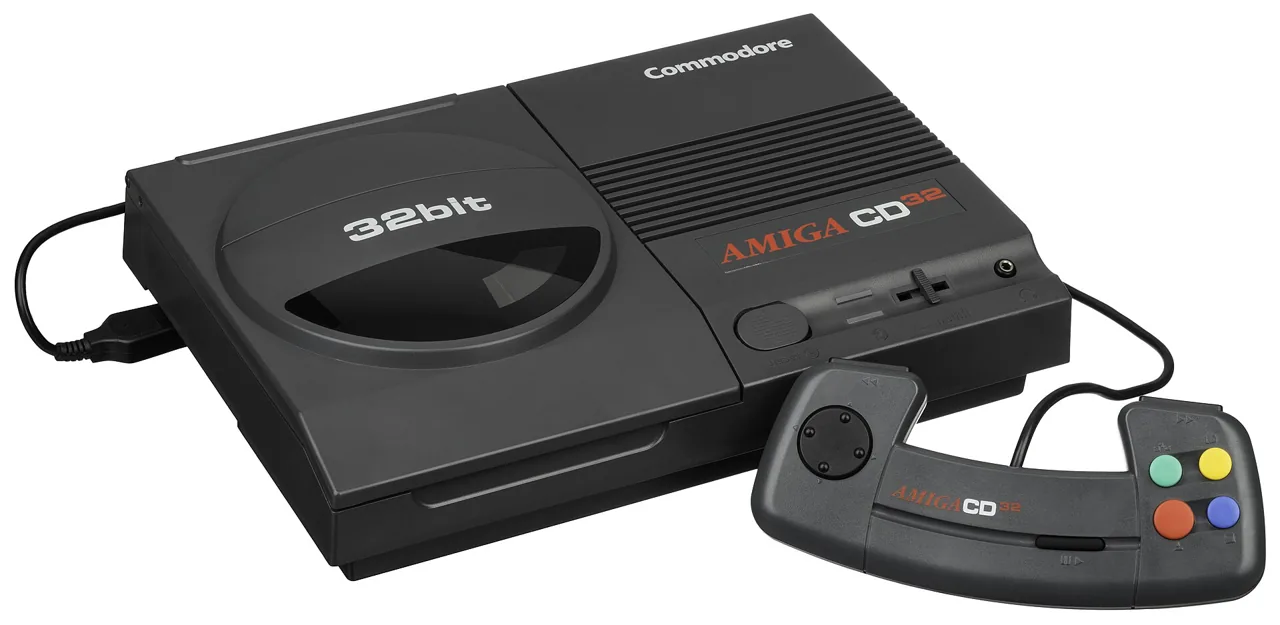
Despite its consumer orientation, the CD32 retained surprising technical continuity with the broader Amiga line. Most titles were expected to run on any AGA-equipped Amiga with a SCSI-2 CD-ROM drive, thanks to the shared CD.device and file system5. The ROM included low-level.library and CD.device components, with plans to release these as disk-loadable libraries upon the eventual launch of Workbench 3.15. The machine shipped with a 11-button control pad and TV cable714, and bundles often included free software such as Oscar, Diggers, and Lemmings14.
Expandability emerged as a key narrative post-launch. While Commodore announced no official expansions5, third parties moved quickly. The SX1 upgrade transformed the CD32 into a fully expandable A1200 equivalent with support for hard drives and additional RAM9. Networking was possible via the Network CD, which allowed the CD32 to act as a remote drive for another Amiga6, sold with a cable priced at £19.956 or £18.9512. Dutch firm Eureka offered the Communicator and Communicator Lite for connecting the CD32 to an Amiga, with the latter priced at f 185,-1011. A galvanically isolated ser-link product, advertised at f 199,-, also enabled safe Amiga connectivity7.
Commodore promised a Full Motion Video module to enhance playback of movies and FMV games like Microcosm6, with an initial September 1993 release target and a price of £1998, later revised to £2298. Bundles such as the 1994 Spectacular Voyage pack, which included Microcosm, Chaos Engine, and four games from Dangerous Streets, were offered at the original £299 price point8.
The CD32’s software library drew from both new titles and CDTV compatibility. 26 CDTV games reportedly worked on the system14. Notable releases included Defender of the Crown II, Bump'n'Burn, Sensible Soccer International, Worms, and Oh YesMore Worms134. Reference discs like The Grolier Electronic Encyclopedia and The Guiness Disc of Records 2nd Edition were also available1. Yet the platform’s fate was sealed not by technical shortcomings but by corporate instability.
Though short-lived, the CD32 earned praise as a technological wonder and an awesome powerhouse of high-speed graphics and stunning sound capabilities2. Its design reflected a clear pivot from the CDTV’s missteps, embracing gaming with purpose-built hardware and aggressive pricing. That it could be upgraded into a full Amiga via the SX1 reveals its hybrid identity: a repackaged slice of Commodore’s broader vision, released too late to save it.
References
- ACs Guide To The Commodore Amiga Summer 94 1994 PiM Publications US (1994)
- CUAmiga 046 Dec 1993 (1993)
- Amiga Magazin 1996-07 (1996)
- Amiga Magazin 1996-09 (1996)
- ACs TECH For The Commodore Amiga Volume 3 Number 4 1993-11 PiM Publications US (1993)
- Amiga Computing Issue 079 Nov 94
- Amiga Magazine-25 met Cognition en Metins Software Story
- Amiga Computing Issue 100 Jun 96
- Amiga Computing Issue 082 Jan 95
- Amiga Magazine-28 met Metins artikel over demos
- Amiga Magazine-28 met Metins artikel over demos
- Amiga Computing Issue 105 Nov 96
- Computer and Video Games Issue 146 1994-01 EMAP Images GB (1994)