Mattel Intellivision
The Intellivision, released by Mattel Electronics, was a video game console marketed as the most advanced T.V. game in the world, featuring a 16-bit microprocessor and 16-color graphics, with software ranging from action titles to educational BASIC programming modules.
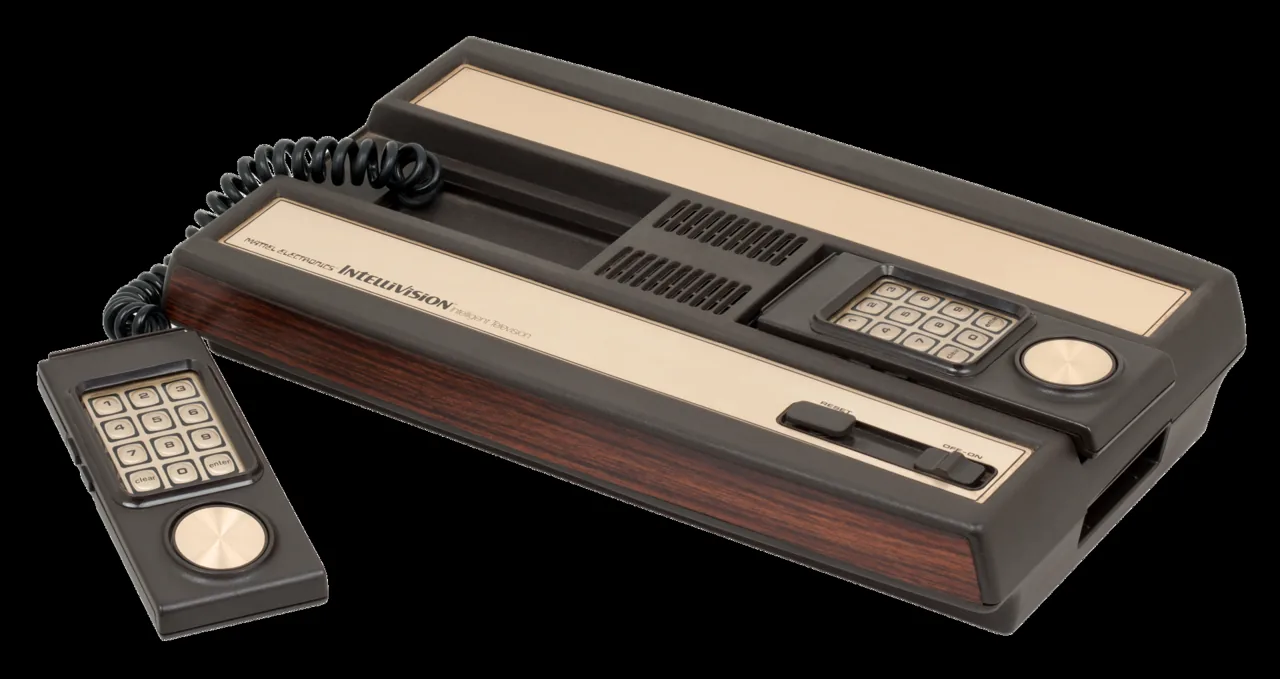
The Intellivision bore the full weight of its name, Intelligent Television, as both a branding exercise and a technical claim1113. The Master Component stood as the central unit, designed around a "GI 16 bit microprocessor"1, though a German-language source later cited an "8088" as the 16-bit main processor, a contradiction not resolved in surviving documentation9. Whether the GI processor was a custom design or a misattribution remains unclear; the service literature offers no clarification. The system allocated 7K of memory to internal ROM, RAM, and I/O structures, leaving the remainder of a 64K address space open for external cartridges1. Video output supported 16 colors11516, and one document specifies a resolution of 192x160 pixels for the German-market model9, though it is unknown whether this applied universally. Audio was handled by a generator capable of three-part harmony, a feature repeatedly emphasized in promotional materials as a leap beyond the bleeps of competitors115169.
Control was mediated through two hand units, each equipped with a 12-button numeric keypad, four action keys, and a 16-direction disc for object movement, a design that traded the simplicity of a joystick for precision, albeit at the cost of a steep learning curve1. The disc, while innovative, was a distinctive feature of the controller. Cartridge compatibility was absolute within the Mattel Electronics ecosystem: the console accepted all video ROM cartridges produced for it, and by mid-1982, a library of over 25 titles was available, with six new releases imminent1612141516. Games spanned genres, including Armor Battle11, B-17 BOMBER5, and TRON: DEADLY DISCS5, while third-party developers like Imagic produced titles such as Atlantis and Demon Attack, which were credited with highlighting the "drastic difference" between Intellivision and VCS graphics9. Imagic was later described as the highest-quality software provider for the platform9.
At introduction, the U.S. price hovered around $250, a figure widely regarded as a market barrier4. The Atari VCS, cheaper and earlier to market, captured the bulk of consumer interest, with price cited as the decisive factor in early adoption4. In the UK, the system launched at £229.95 with a free soccer cartridge, later discounted to £179.95 inclusive of VAT612141516. By 1983, the original model sold in the $150–$175 range, and a redesigned Intellivision II (smaller, cosmetically updated, and software-compatible) was expected to retail for well under $2004. Despite hardware revisions, Mattel eventually abandoned plans for a new console generation, shifting focus entirely to software development for existing systems10.
The ambition to transcend gaming was explicit. A keyboard add-on, slated for spring 1982, promised to convert the Intellivision into a "full home computer" with 16K RAM, expandable memory, and Microsoft Basic612141516. This evolved into the Intellivision Entertainment Computer, a modular system attaching directly to the Intellivision II and supporting educational software like THE JETSONS WAY WITH WORDS and programming tools such as MR BASIC MEETS BITS 'N' BYTES7. The peripheral ecosystem also included Intellivoice5, and SuperGraphics, a programming technique claimed to enhance graphical definition10. Yet for all its technical breadth, the platform never achieved mass computing adoption.
After Mattel exited the game industry, former engineers founded INTV, a small company that acquired the rights to the brand and released titles like Thin Ice in 1986, years after mainstream support had ceased8. These late releases are now among the rarest in the library, and some of the best8. The Intellivision’s reputation as the most advanced T.V. game of its era612141516 held until the arrival of the Colecovision, which displaced it in technical stature9. Its internal modules were described as graphically excellent, and its hardware (printed in Hong Kong, with 1978 and 1973 copyrights on documentation) bore the marks of a company projecting longevity139. That projection failed, but not for lack of ambition.
References
- 1981 Intellivision Catalog (1981)
- 1981-10-30 Intellivision Television Ad Breakdown 1 (1981)
- Imagic - Video game cartridges
- Electronic Fun Computer and Games Vol 01 06 1983 Apr (1983)
- logical gamer aug83
- ComputingToday198206 (1982)
- logical gamer jul83
- vgc03
- MANIAC.N022.1995.08-DURiAN Searchable (1995)
- Electronic Games Issue 22 Vol 02 10 1983 Dec (1983)
- Armor Battle 1978 Mattel (1978)
- ComputingToday198203 (1982)
- Archive item #6357401
- ComputingToday198204 (1982)
- ComputingToday198205 (1982)
- ComputingToday198207 (1982)