Nintendo Game Boy
A stubbornly monochrome, barely-specced rectangle that conquered portable gaming by refusing to evolve too quickly—and selling Tetris with every unit.
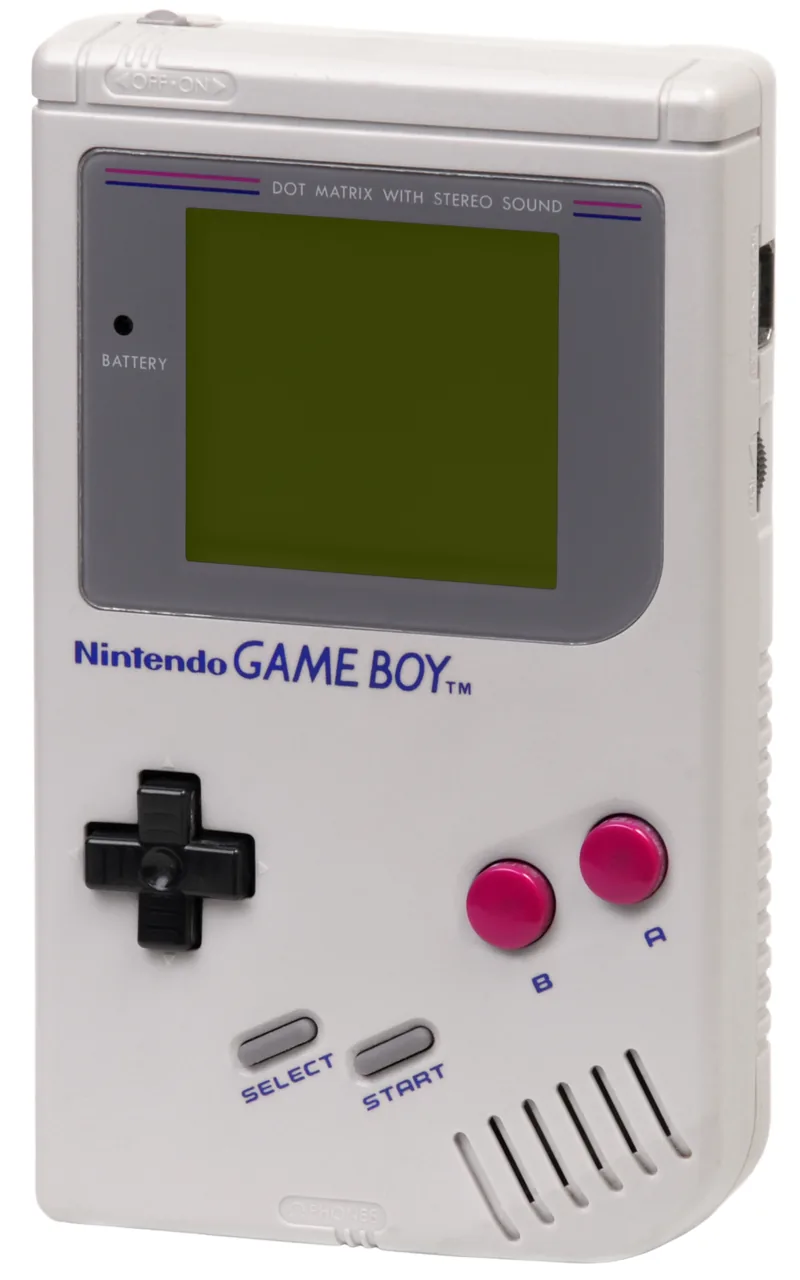
The Game Boy defied the era’s obsession with color and horsepower by offering something rarer: endurance, durability, and a library anchored by the atomic-level addictiveness of Tetris891013. Its 8-bit Sharp LR35902 CPU14 powered a system with only 8kB of working RAM14 and 8kB of graphics memory14, a footprint so lean it bordered on ascetic. Yet this minimalism enabled battery life measured in dozens of hours. Two AAA cells powered the Game Boy Pocket Colors7. The display, limited to four shades of greenish monochrome14, was not a flaw but a design anchor: readable in direct sunlight, legible after years of drops and scrapes, and perfectly matched to the tile-based graphics system that rendered backgrounds and sprites in 8×8 or 8×16 pixel blocks14.
Nintendo never advertised raw specs. Instead, they sold portability as a lifestyle. “You can play anywhere”1 was not a feature claim but a cultural reset. The original Game Boy’s bulk gave way in 1997 to the Game Boy Pocket Colors, a smaller, lighter revision offered in red, yellow, green, silver, black, and transparent7. Priced at $54.957, it repackaged the same aging architecture with cosmetic flair, a move that underscored Nintendo’s confidence in the installed base. That confidence was justified: by 1997, Nintendo claimed over 1.5 million units sold in the prior year alone, capturing more than 80 percent of the U.S. handheld market7.
Software drove adoption as much as hardware. While the system supported at least 32kB of ROM per cartridge14, its success was built on titles like Super Mario Land891013, Dr. Mario8910, and Metroid II: Return of Samus13, alongside multiplayer-focused Game Paks7. These served as a silent salesforce that converted skeptics into devotees. Other titles like F1 Race8910, Alleyway13, and Hunt for Red October10 filled niches, but none matched the gravitational pull of falling blocks.
The system’s longevity was neither accidental nor inevitable. It survived not by out-spec’ing rivals but by outlasting them, its technical stagnation becoming a virtue. The core appeal remained the handheld’s autonomy. Peter Main, Nintendo of America’s executive vice president for sales and marketing, declared in 1997 that “Game Boy just gets better with age”7, a statement that rang true less for technical evolution than for the deepening catalog and entrenched user base.
By the time the Game Boy Pocket Colors launched on April 28, 19977, the device was no longer just a console but a cultural artifact, its design language reduced to essentials. The Virtual Boy’s $200 launch price and description as “four times as much” as Game Boy is noted1. Whether that math holds, the value proposition did: a durable, game-filled rectangle that asked only for two batteries and a few free minutes.
The Game Boy’s legacy is not measured in pixels or clock cycles, but in the sheer ubiquity of its presence—on buses, in classrooms, under desk lamps—its greenish screen glowing like a pilot light on a generation’s idle hands.
Specifications
| CPU | 8-bit Sharp LR35902 CPU14 |
| RAM | 8kB working RAM14 |
| Graphics Memory | 8kB14 |
| ROM (per cartridge) | At least 32kB14 |
| Display Drawing Area | 256×256 pixels14 |
| Colors | Four14 |
| Graphics System | Tile-based with 8×8 or 8×16 pixel sprites14 |
| Power | Two AAA batteries (Game Boy Pocket Colors)7 |
| Colors (Game Boy Pocket Colors) | Red, yellow, green, silver, black, transparent7 |
| MSRP (Game Boy Pocket Colors) | $54.957 |
References
- Electronic Games 1995-03 (1995)
- Video Games 1993-05 (1993)
- Video Games 1995-04 (1995)
- Video Games Sonderheft 1
- Electronic Games - 199210 - Volume 1 Issue 3 (1992)
- Video Games 1995-09 (1995)
- Nintendo 1997 E3 Press Kit (1997)
- Power.Play.N038.1991.05-kultpower (1991)
- Power.Play.N038.1991.05-kultpower (1991)
- Power.Play.N045.1991.12-kultcds (1991)
- High Heat Major League Baseball 2003 (USA) (2003)
- High Heat Major League Baseball 2003 (USA) (2003)
- Power.Play.N052.1992.07-kultcds (1992)
- MagPi118
- Amiga Joker 1992 05 (1992)
- Power.Play.N36.1991.03-kultpower (1991)