Nintendo Super Famicom
Nintendo’s 16-bit home video game console, launched in Japan as the Super Famicom and later released internationally as the Super NES, used a modified 65C816 processor and specialized graphics hardware to deliver sprite-scaling and rotation effects unmatched by many contemporaries.
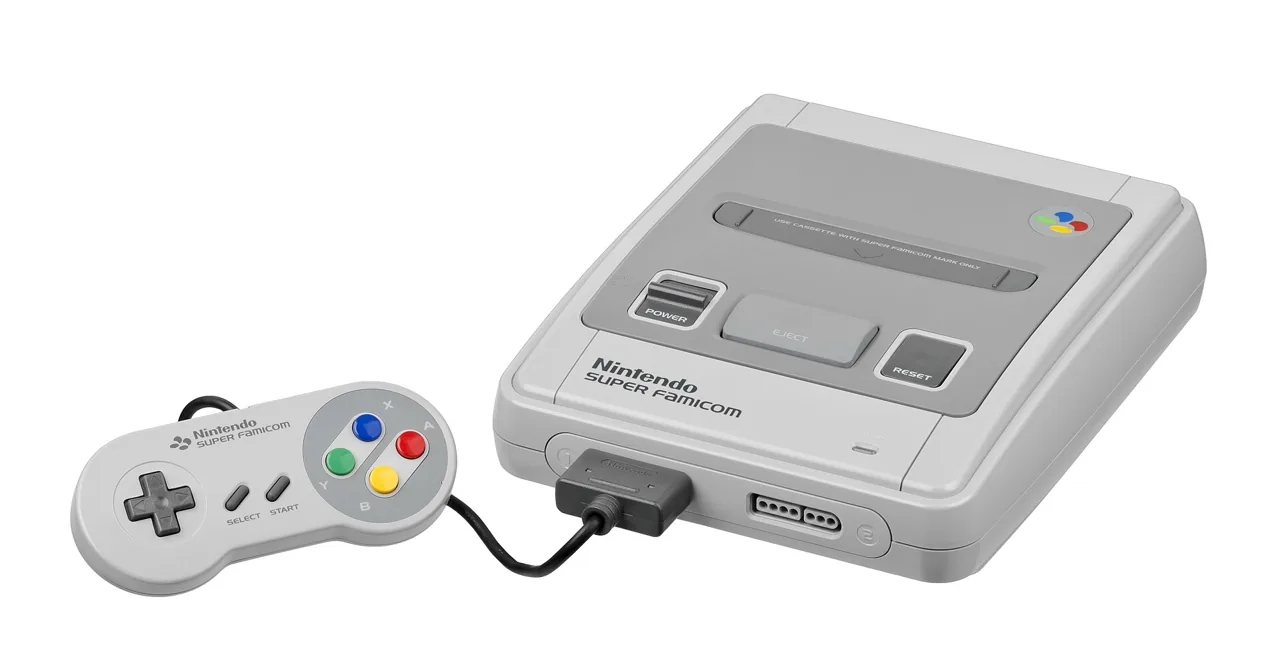
The Super Famicom emerged not as a clean break from its 8-bit Famicom predecessor, but as a calculated evolution. It was Nintendo’s answer to the demand for richer graphics and sound while preserving backward design sensibilities. Though the machine’s Rockwell 65C816 processor operated at switchable speeds of 2.6MHz and 3.58MHz, making it technically a 16-bit architecture. It was not the rawest chip in the console race. Compared to the 68000 used by Sega and SNK, the 65C816 was less powerful on paper1213. Yet the system compensated with an array of dedicated support hardware: chips capable of rotating the screen and flipping and zooming sprites14.
Physically, the unit was a compact 200mm x 240mm x 60mm in size, finished in sleek grey with a cartridge slot, power switch, reset button, and a dedicated cartridge eject mechanism14. It shipped in Japan with a suite of launch titles including Super Mario World, which was explicitly marketed as the official Super Mario Bros. 45. The system’s graphics chip supported a maximum resolution of 2048x256 pixels and could display up to 32,768 colors14. Audio was handled by chips employing digital and PCM sound synthesis, with 64K of dedicated music RAM121314.
Memory architecture was modest: 128K of program RAM and 64K of video RAM1213. Yet developers exploited the system’s co-processors aggressively, later evidenced by the inclusion of the “SUPER FX STAFF” credit in some game manuals15. Not all software was universally compatible: code began appearing in new games that detected the host machine type, with Super Mario All Stars cited as an example2.
Launch pricing remains partially obscured in the record. A German magazine noted a “Zirka-Preis” of 150 Marks, suggesting an approximate retail figure5. In the UK, a SCART-equipped bundle was priced at £299.99 including two games4. Official UK release was announced months earlier than expected, with Nintendo positioning it competitively9. Initial scarcity was acute: Japanese stocks sold out almost instantaneously, and units were being charged £300 cost price, with hopes to bring the price down to about £200 after Christmas14.
In the United States, the Super NES arrived in September 199110, becoming the flagship pillar of Nintendo’s domestic business10. The company reported a 12.5 percent sales increase to ¥507.5 billion for fiscal 1991–92, with profits rising to ¥156.25 billion (\$1.61 billion)10. Despite this, US sales growth lagged expectations, and Nintendo reportedly lost ground to rival market operator Sera Enterprises Ltd during the 1991 Christmas season10.
The console was marketed under different names regionally: as the “超級任天堂” (Super Nintendo) in Taiwan with packaging nearly identical to the Japanese version, and as the “ヒュンダイ コムボーイ” (Hyundai Comboy) in South Korea1. The name “Super Famicom” itself was registered as a trademark of Nintendo15.
| Processor | Rockwell 65C816 (switchable 2.6MHz / 3.58MHz) |
| Architecture | 16-bit extension of 6502 |
| Program RAM | 128K |
| Video RAM | 64K |
| Audio RAM | 64K |
| Graphics resolution | 2048 × 256 pixels maximum |
| Color palette | 32,768 colors |
| Sound | Digital and PCM synthesis |
| Dimensions | 200 mm × 240 mm × 60 mm |
| Product type | 16-bit home video game console |
| Manufacturer | Nintendo |
Its legacy lies not in brute computational power, but in the ingenuity of its layered design: a mid-tier CPU elevated by purpose-built graphics logic, enabling a generation of games that pushed sprite-based presentation to its limits. The Super Famicom was never the fastest chip on the block, but it was among the most cleverly orchestrated.
References
- superfamicomperfectcatalogue0001
- Super Pro #10
- Power.Play.N047.1992.02-kultcds (1992)
- MeanMachines 07 Apr 1991 (1991)
- Power.Play.N36.1991.03-kultpower (1991)
- Power.Play.N038.1991.05-kultpower (1991)
- Power.Play.N038.1991.05-kultpower (1991)
- MeanMachines 16 Jan 1992 (1992)
- LeisureLinejun1992 (1992)
- The One (1991-02) (1991)
- The One (1991-02) (1991)
- Archive item #CVG110199101
- CLV-P-VADGJ