Nintendo 64
Nintendo released the Nintendo 64 in 1996 as a 64-bit home video game console, marking its entry into the fifth generation with a proprietary cartridge format and a partnership with Silicon Graphics for its graphics architecture.
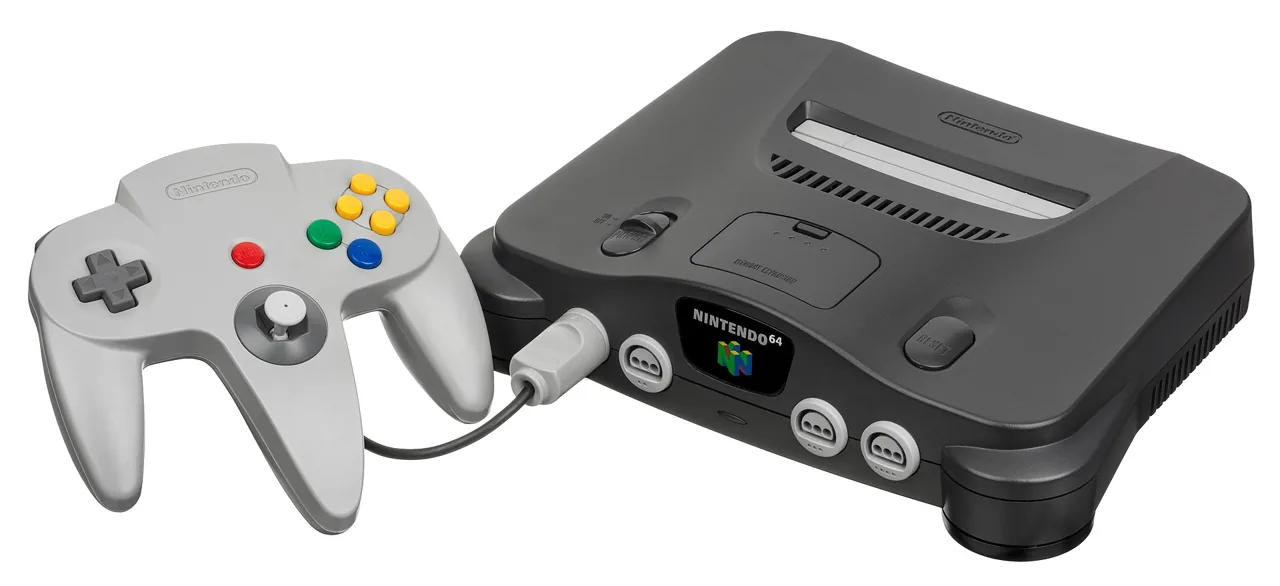
The console launched in the United States on September 29, 19962, following a Japanese release on June 23 of the same year5. Initially announced under the name "Nintendo Ultra 64"511, the system was rebranded before launch, with Nintendo confirming the final product name as "Nintendo 64" for all markets5. The U.S. MSRP was set at $149.952, though a price reduction was later implemented, sparking consumer backlash documented in a 1997 issue of 64 Extreme13. One disgruntled buyer noted, "I waited a long time for the N64 to launch... I now feel that Nintendo let me and many others down very badly with their actions"13.
The system features the R4300i processor from MIPS, a 64-bit RISC CPU clocked at 93.75 MHz69. The chip, reportedly the first mass-produced 64-bit CPU9, operated in conjunction with a custom 64-bit co-processor from Silicon Graphics handling graphics and sound6. This co-processor, officially named the "Reality Immersion Graphics Processor"9, ran at 62.5 MHz and supported features including Z-buffering, anti-aliasing, tri-linear mip-map interpolation, and flicker-free interlaced video output6. The system included 4 MB of internal RAM11, expandable to 8 MB via an official upgrade611, which was conceived during early design stages to support the 64DD peripheral11.
Memory was implemented using Rambus D-RAM, with a total capacity of 36 Mbit and a maximum transfer speed of 4,500 Mbit/second6. The system supported resolutions from 256 x 224 up to 640 x 480 pixels6, with a 21-bit color video output and a 32-bit RGBA pixel color frame buffer6. According to the 1995 German magazine MANIAC, Nintendo claimed seven co-processors on the board alongside the main CPU, including the patented graphics processor and a 24-bit DSP9.
The console measured 260 x 190 x 73 mm and weighed 1.1 kg6. Model numbers for the Japanese variant include NUS-001 for the console, NUS-002 for the AC adapter, and NUS-005 for the controller4. The controller, model NUS-005, featured an analog joystick and was available in six colors: grey, yellow, blue, red, green, and black6. Accessories included the Rumble Pack, which plugged directly into the controller6, and Official Memory Cards8. Third-party peripherals such as the Blaze Memory Card, Blaze Rumble Packs, Blaze RGB Scart Cable, and N64 V4 Converter were also available in the UK market8.
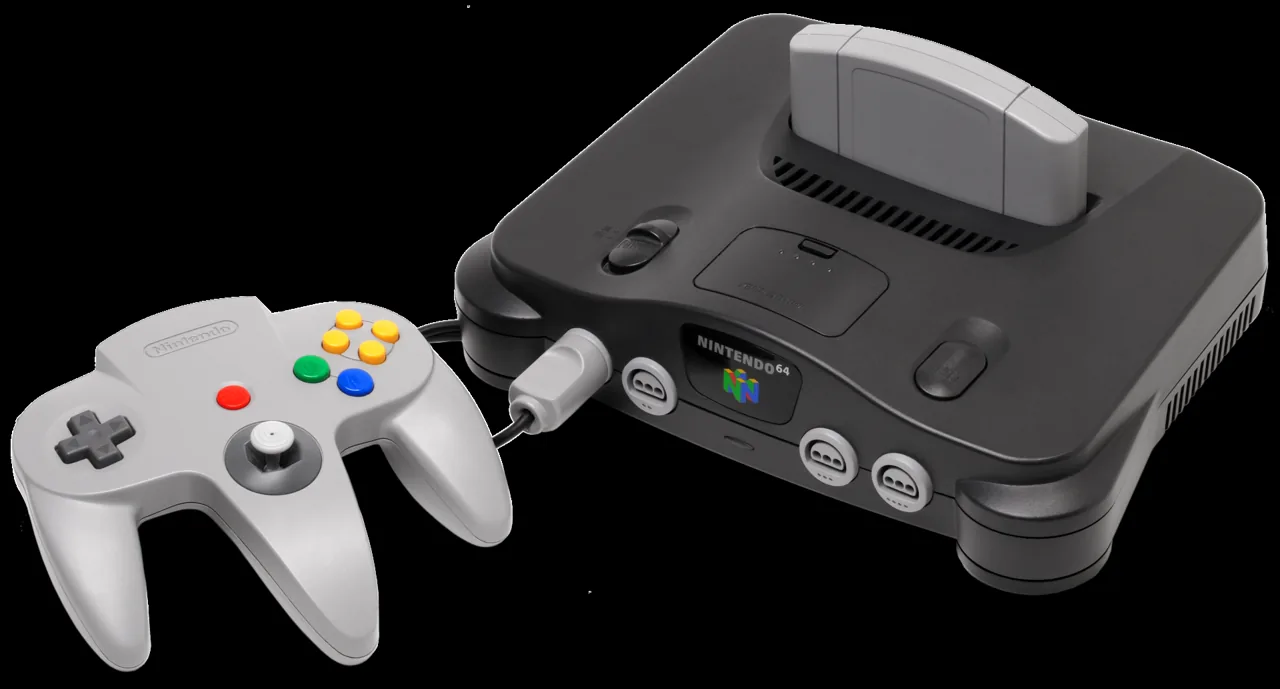
Games were distributed on "Game Pak" cartridges31012, a format that distinguished the N64 from competitors using optical media. The Nintendo 64 Disk Drive, an add-on accessory, was developed to expand storage capacity and enable new software possibilities2. Titles under development for the Disk Drive in Japan included Sim City, Mother 3 (Earthbound), Mario Paint, and Pocket Monsters2. The expansion was reportedly essential for the 64DD to function11.
By 1997, the system had sold more than 2.8 million units in the U.S.2. Prominent titles included Super Mario 641, FIFA-993, Asteroids Hyper 647, NFL Blitz 200110, and NFL Quarterback Club 200112. Nintendo Power Magazine published strategy guides for GoldenEye and Star Fox 642, underscoring the system's early focus on first-party and licensed deep-dive content. In FIFA-99, the Control Stick was used for player movement3.
Marketing materials emphasized the technological pedigree of the platform, citing a joint development agreement between Nintendo and Silicon Graphics, whose visual computing technologies had been used in blockbuster motion pictures2. The collaboration extended to Rambus and other firms in developing new memory chips and bus systems9. The massive initial order volume, estimated at over five million units in the first year, helped reduce the cost of the RISC processor to consumer levels9.
Contemporary European promotional literature from Bergsala described the system as "Världens snabbaste och mest kraftfulla maskin" (The world's fastest and most powerful machine)6, while the same source declared, "Nintendos krutpaket är vassast på marknaden!" (Nintendo's powerhouse is the sharpest on the market!)6. These claims reflected the aggressive positioning of the N64 as the only true 64-bit platform in the industry, expected to launch in April 1996 in North America and Europe before being delayed11.
References
- Super Mario 64 Complete Guide Book
- Nintendo 1997 E3 Press Kit (1997)
- FIFA-99-1998Ucolor (1998)
- Nintendo 64 Manual (Japan)
- Next Generation 1996-05 (1996)
- nintendo64bergsala1998 (1998)
- Asteroids-Hyper-64-1999Ucolor (1999)
- 64 Solutions UK 06
- MANIAC.N022.1995.08-DURiAN Searchable (1995)
- NFL Blitz 2001 - 2000 - Midway Games (2001)
- RetroManiac 5 single
- NFL Quarterback Club 2001 - 2000 - Acclaim Entertainment (2001)
- 64 Extreme - Issue 4 - Jul 1997 (1997)