Atari Lynx
Atari Corp. sold this handheld color game system originally developed by Epyx engineers Dave Needle and R.J. Mical, positioning it as the first of its kind despite lagging market adoption.
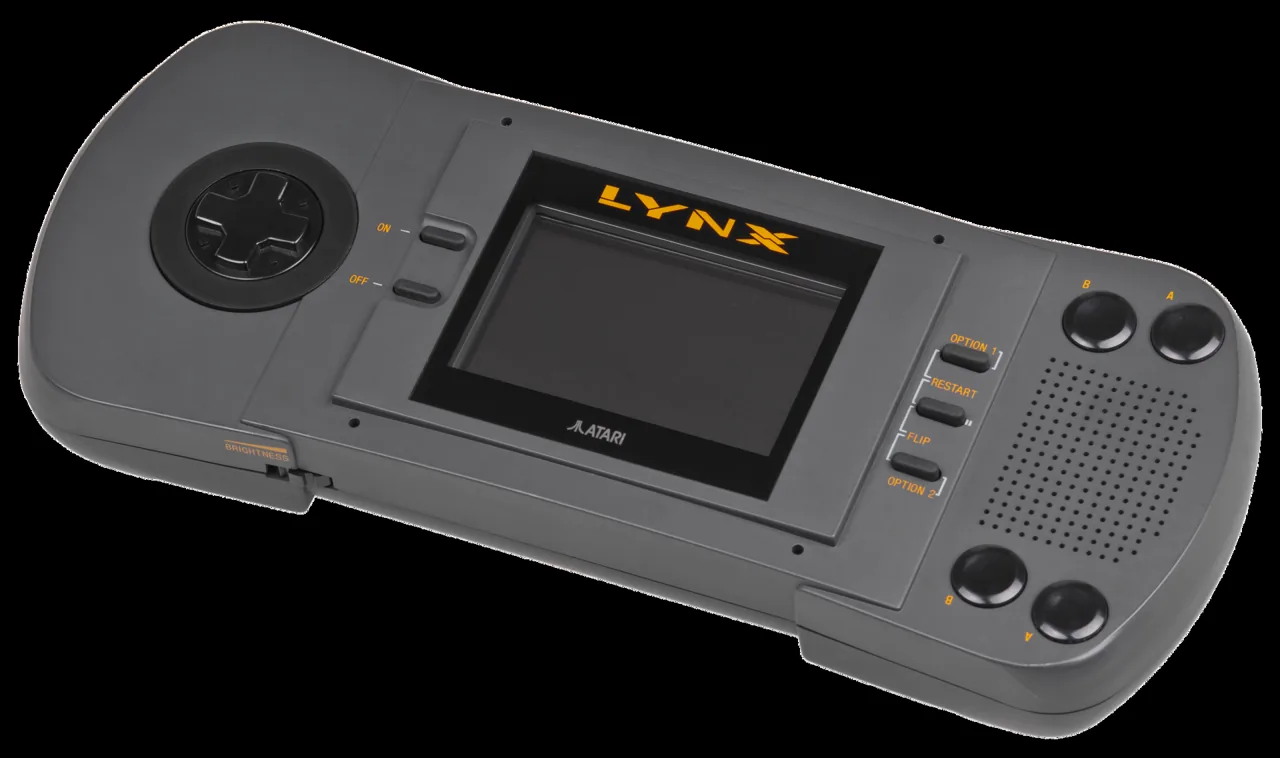
The Lynx emerged from a 1987 concept at Epyx, where engineers Dave Needle and R.J. Mical began work on what would become the world's first hand-held color video game system1. When the design neared completion, Epyx sought a buyer; Atari Corp. acquired the rights and took over production, relocating Lynx operations from Chicago to Sunnyvale1. Despite the technical ambition, Epyx remained contractually obligated to provide technical support post-acquisition1.
Marketed with 16-bit graphics and reversible controls, allowing left- or right-handed play, the Lynx supported true multi-player competition via the ComLynx cable1. It ran on six AA alkaline batteries, with optional accessories including a mains adaptor (UK-made), car adapter, sun shield, belt pouch, carrying case, stereo earphones, and a cleaning kit priced at £7.99311. Game cards included several hundred bytes of encrypted data, a rare hardware-level protection measure for the era1. Card storage sleeves, holding 18 games each and costing $5.95, were sold separately1.
The original package launched as a "Deluxe Package" at $129.95 and a "Base Package" at $89.951, with European variants listed at 197–199 Deutsche Mark and £129.99, often bundled with California Games246911. A price cut of £50 was later implemented in the UK, reflecting sluggish retail momentum7. In 1992, the Lynx II arrived: a smaller, cheaper, and "sexier" revision, priced at $99 and distributed as both a new model and a $50 repair-replacement option (plus $5 shipping) for broken units113.
By the end of 1992, Atari projected over 80 games would be available, with 24 shipped in summer and 15 more scheduled for fall and winter15. Notable titles included Desert Strike, Battlewheels, Malibu Bikini Volleyball, Batman Returns, POPULOUS, and Empire Soccer91014. Despite these efforts, the Lynx trailed competitors: one 1993 review noted the difficulty of finding Lynx games on high street shelves and contrasted its sparse release schedule against the denser libraries of the Game Gear and Game Boy58.
Atari claimed sales of Lynx systems and software were on track to double 1991 volumes15, and some reviewers saw potential, calling it "a machine which has a big future" if the quality of new releases held7. The Lynx shared branding and user attention with the Atari Falcon and later the Jaguar, with Atari Entertainment Magazine emerging as the first publication dedicated to both Lynx and Jaguar, evolved from Lynx User5810. Atari Corp. once operated a Lynx game tips hotline at (708) CRY-LYNX (708-279-5969), now defunct1.
The Lynx was a technical standout, first to market with handheld color, and carried design flair and engineering ambition. Yet it failed to achieve market leadership, hamstrung by cost, battery consumption (unspecified in surviving documentation), and limited retail visibility. Its legacy rests not in volume but in audacity: a handheld that dared to be complex, encrypted, and reversible in an era increasingly favoring simplicity and scale.
References
- ZNET9307.TXT.generated
- Amiga Joker 1992 05 (1992)
- atari st review-issue 13
- ST-Computer 1991-06 (1991)
- ST Applications #30, June 1993 (1993)
- ST-Computer 1991-06 (1991)
- Archive item #CVG110199101
- ST Applications #30, June 1993 (1993)
- Archive item #CVG112199103
- Computer and Video Games Issue 146 1994-01 EMAP Images GB (1994)
- MeanMachines 16 Jan 1992 (1992)
- ZNET9201.TXT.generated
- Archive item #6489137
- ZNET9225.TXT.generated