Magnavox Odyssey
Magnavox released the Odyssey in August 1972 as the first home video game system, using plug-in modules and screen overlays to simulate games on standard television sets.
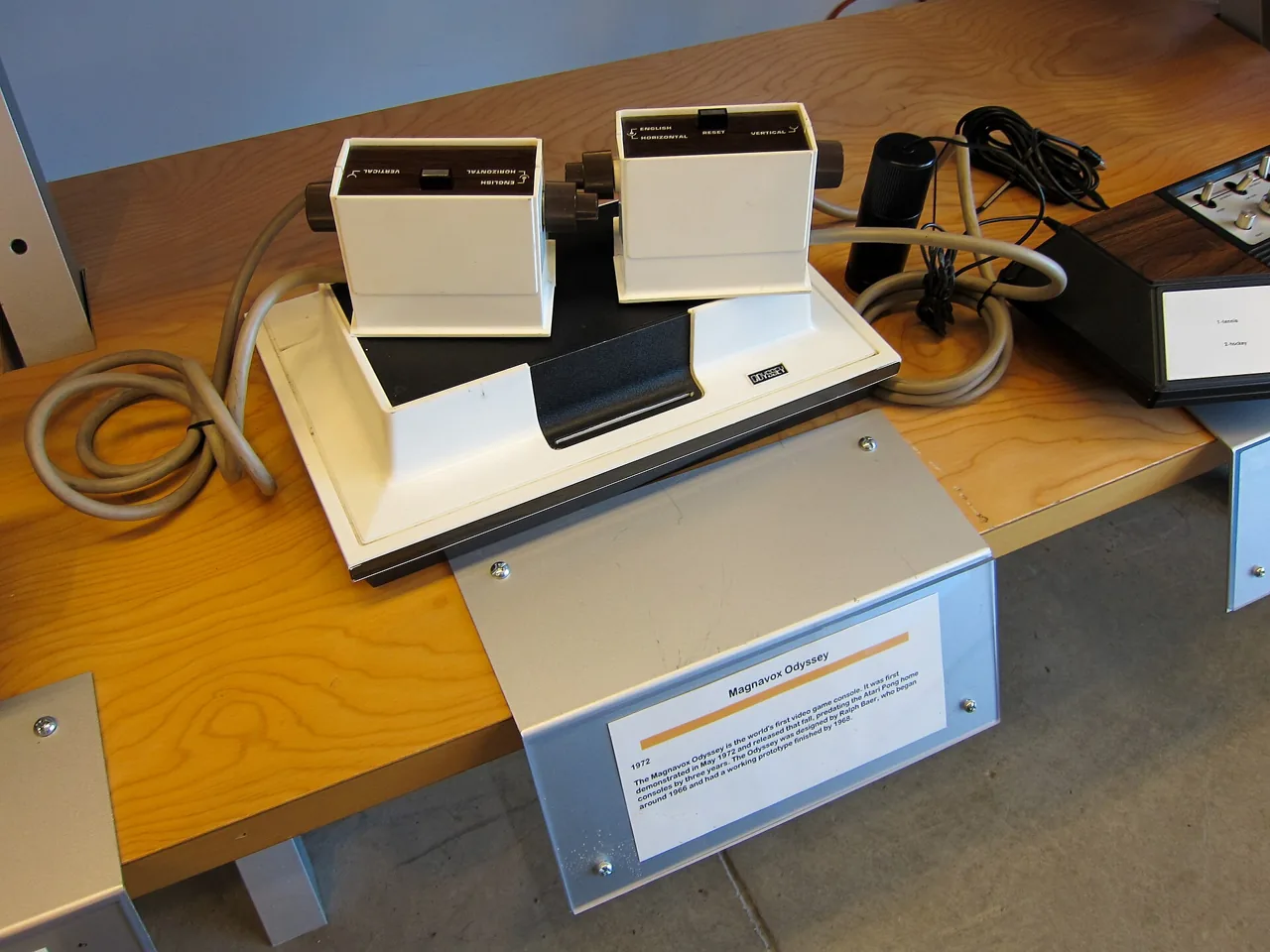
The Odyssey did not compute game logic in software or store programs in memory; instead, its "electronic game simulator" architecture relied on a master board with twelve solid-state plug-in modules456. These behaviors were selected by inserting a "Game Card" into the Master Control Unit, a physical action required before play could begin289. The system produced two player paddles, a ball, and a wall, primitive graphical elements that output video, sync, and RF signals directly to the television through VHF terminals456.
Game variety depended on external aids: overlays clipped to the TV screen to simulate environments like tennis courts or ski slopes, while physical accessories included poker chips456. The manual emphasized Table Tennis as the foundational experience, designed to acquaint users with the controls1. Additional games, each sold with a new Game Card, overlay, and play aids, were available through dealers289. Marketing materials evoked "the thrills of Wimbledon" and "the exciting casino action of Monte Carlo," though the actual gameplay remained abstract and minimal1216.
The console attached to any 18- to 25-inch television, color or black-and-white12. Early packaging led many to believe the Odyssey only worked with Magnavox televisions, a misconception that suppressed initial sales until the company revised its labeling to clarify compatibility16. Approximately 10,000 units were exported to Europe in late 1974 and early 197515.
The system came with a three-month warranty: inoperative units, including the Master Control Unit, Player Control Units, Antenna-Game Switch, Game Cord, and Game Cards, were to be returned to the dealer for replacement, not repair289. Optional accessories included the Rifle, available as an option456.
The Odyssey originated from the "Brown Box" prototype, which he demonstrated to Magnavox; the company licensed the design to produce the "Odyssey Home Entertainment System" for release in 197216. Its commercial impact was amplified by litigation: Magnavox sued for copyright infringement and won a $700,000 settlement related to the new Atari Pong system16. By 2012, the system had reached its 40th anniversary, celebrated as both a technical milestone and the "Holy Grail" of early home video consoles1112.
Despite its historical status, the surviving documentation is silent on key technical details: no original price is recorded, nor are specifications for power, dimensions, weight, or internal components such as chips or circuitry. The service manuals describe the system’s modular construction and signal paths but do not name individual integrated circuits or provide schematics with part numbers456. Later models like the Odyssey² are mentioned in promotional material, but the relationship between them and the original Odyssey is not defined in the source documents7.
References
- Magnavox Odyssey (Export-1974) (1974)
- Magnavox Odyssey (IB-2622-2)(US-1973) (1973)
- Magnavox Odyssey (France-1974) (1974)
- Magnavox Odyssey 1TL200 BLAK & BK12 Service Manual
- Magnavox Odyssey 1TL200 BLAK & BK12 Service Manual
- 6500 MagnavoxOdysseyService May75
- Odyssey 2 - Magnavox advertisement
- Magnavox Odyssey (US-1972) (1972)
- Magnavox Odyssey (IB-2622)(US-1972) (1972)
- Magnavox Odyssey (Export-1974) (1974)
- OLD-OdySim Manual
- OLD-OdySim Manual
- thank-you
- thank-you
- Archive item #6489137
- Vintage Technology magazine Issue 3