Digital Research CP/M-86
Digital Research's 16-bit successor to CP/M, designed for Intel 8086 and 8088 systems, launched with a split pricing strategy and struggled to gain traction against MS-DOS despite architectural continuity with its 8-bit predecessor.
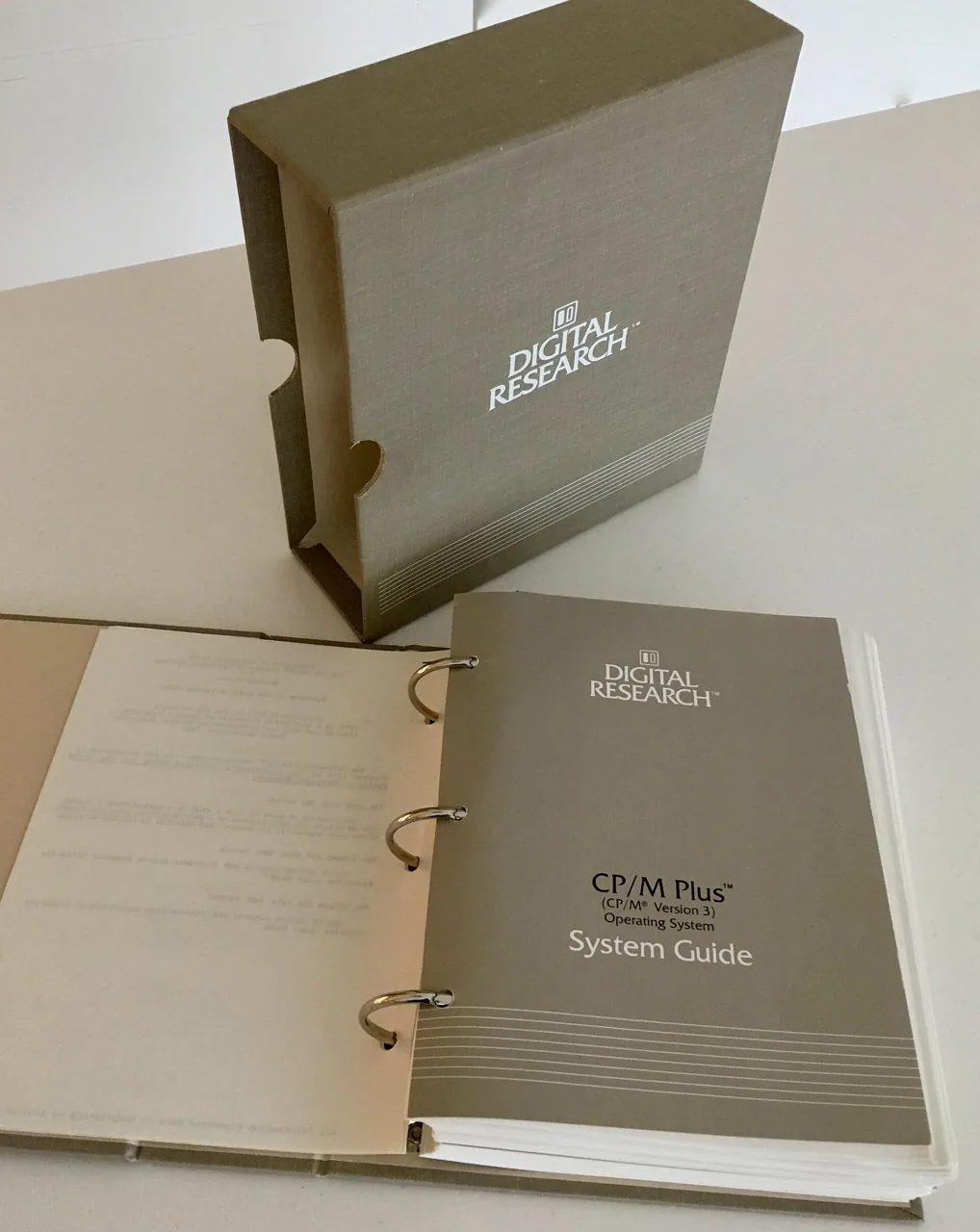
CP/M-86 arrived as a direct extension of Digital Research’s dominant 8-bit operating system, restructured for 16-bit processors without discarding the familiar tripartite architecture of Console Command Processor (CCP), Basic Disk Operating System (BDOS), and Basic Input/Output System (BIOS)15. It retained the file format of CP/M 2, preserving a degree of software compatibility while demanding new compilation for the 8086/8088 platform5. Targeted at single-user, single-task environments, its design focus was interactive applications such as program development, debugging, and word processing2. The system supported both 8-inch single-density and 5¼-inch diskette formats, with the latter tailored specifically for the IBM Personal Computer4.
Despite Digital Research’s claim of “dramatic user acceptance” and a projected 2.8 million CP/M-86–based systems by 1986, actual adoption lagged far behind projections7. The IBM PC version shipped in “Installation Kit B,” a bundle that included not only CP/M-86 but a third-party conversion utility authored by Mr. Watzman to adapt it for the Zenith Z-100 platform, which reflects a fragmented and reactive distribution strategy11. Programmers found the transition manageable: the BDOS function calls were documented in detail (Table 7-4 in the Osborne guide), and developers familiar with CP/M reported high similarity in interface and behavior4.
Pricing inconsistency undermined its commercial positioning. One source lists the base price at $608, while another cites $50012, a discrepancy suggesting either market segmentation or reporting error. Digital Research later announced a $40 increase, raising the IBM PC version from $60 to $10011. This shift came amid a broader software ecosystem that included professional tools like CBASIC 86 ($200), Pascal/MT+ ($400), and CIS COBOL-86 ($850), all marketed toward commercial software developers8. The GSX-86 graphics extension, the Digital graphics extension package, was included on certain CP/M-86 distribution disks6.
Documentation was comprehensive: owners received four manuals (the User’s Guide, Programmer’s Guide, Operating System Guide, and Command Summary) with IBM PC users getting a specially compiled set4. The system’s modularity allowed adaptation to custom hardware, a capability detailed in the CP/M-86 Operating System Guide14. It could also function as a slave node in a CP/NET network, linking it to Digital Research’s broader ecosystem5.
CP/M-86 was not alone in Digital Research’s 16-bit lineup. Concurrent CP/M-86 allowed single-user multitasking and, in version 3.1, included PC-DOS emulation to run multiple MS-DOS programs simultaneously46. MP/M-86 and CP/M-68K were part of the same strategic push into 16-bit markets7813. Yet CP/M-86 itself became a cautionary tale: technically sound, architecturally consistent, and well-documented, but hobbled by pricing confusion, delayed IBM PC support, and the overwhelming momentum of MS-DOS. Its legacy is not in market share (which remains undocumented in the surviving material) but in the clarity of its design lineage and the specificity of its failure.
Specifications
| Manufacturer | Digital Research |
| Product type | Single-user, single-task operating system |
| CPU support | Intel 8086, 8088, µPD8086 |
| Architecture | CCP, BDOS, BIOS |
| Memory addressing | Extended addressing for >64K |
| Disk formats | 8-inch single-density, 5¼-inch diskettes |
| Networking | Slave node in CP/NET |
| Graphics extension | GSX-86 |
| Version noted | 1.11 |
References
- 1984 08 BYTE 09-08 Modula-2 (1984)
- 014-000751-00 The Desktop Generation
- CPM86 Operating System Mar82
- OsborneCPMUserGuideSecondEdition 1982 ThomHogan (1982)
- 1981 02 BYTE 06-02 The Computer and Voice Synthesis (1981)
- 1984 12 BYTE 09-13 Communications (1984)
- 1982 01 BYTE 07-01 The IBM Personal Computer (1982)
- 1984 06 BYTE 09-06 Computers and Education (1984)
- profiles v2n1
- IBM Personal System 2 and IBM Personal Computer Product Reference Ver 4.0 Sep88
- remark-volume6-issue5-1985 (1985)
- Computer Language Issue 06 1985 Feb (1985)
- 1982 12 BYTE 07-12 Game Plan 1982 (1982)
- NEC APC CPM86 System Reference Guide Aug83
- 210341-004 How to Select a VLSI Operating System Jun83
- Tektronix Terminals 1969-1993 (1969)