NeXTSTEP
NeXT Computer Inc. developed NeXTSTEP as an object-oriented operating system built on the Mach kernel and BSD 4.3 utilities, shipping initial versions in 1989 with a tightly integrated development environment centered on Objective-C and Display PostScript.
NeXTSTEP shipped in incremental releases starting from version 0.8, with Release 0.9 expected by April 1989 and Release 1.0 to follow by late Q2 of that year7. The system combined a multitasking Mach Unix kernel with the UNIX™ BSD 4.3 utilities, forming a 4.3BSD-compatible operating system716. By version 2.0, it ran on Mach 2.1, though earlier versions' Mach revisions remain undocumented16. Its architecture demanded orderly shutdowns; failure to comply triggered an automatic disk check labeled "Checking disks" that could last several minutes3. Upon successful verification, the system marked the file state as clean, displaying "Pile system clean" during boot, a quirkish typo preserved in the initialization sequence3.
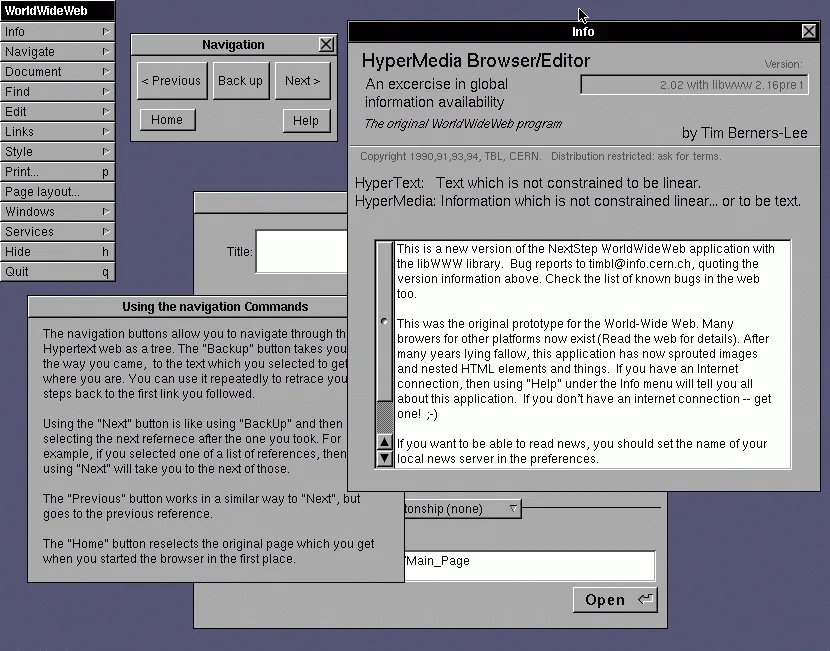
The operating system comprised four core components: the Window Server, which managed low-level display functions; the Workspace Manager™; the Application Kit™; and Interface Builder™, a visual development tool8. Display PostScript® was part of the NeXT system software7. Development was anchored in Objective-C®, using Version 2.2 of the GNU C Compiler for C, C++, and Objective-C code6. Free Software Foundation tools like gcc and gdb were included, reinforcing its Unix heritage16. All applications featured built-in network capability, a design decision that extended connectivity to the application layer by default11.
NeXTSTEP’s user environment included bundled software such as WriteNow™, Digital Librarian™, and Mathematica®7. Release 1.0 introduced a Mathematica Math Object, enabling Objective-C programs to call Mathematica functions directly, an early example of cross-toolkit integration7. The help system operated as a separate, launchable documentation application rather than context-sensitive tooltips, reflecting a modular approach to system utilities11. System halting required a specific key sequence: holding the right Alt key, pressing Num Lock, then pressing h3.
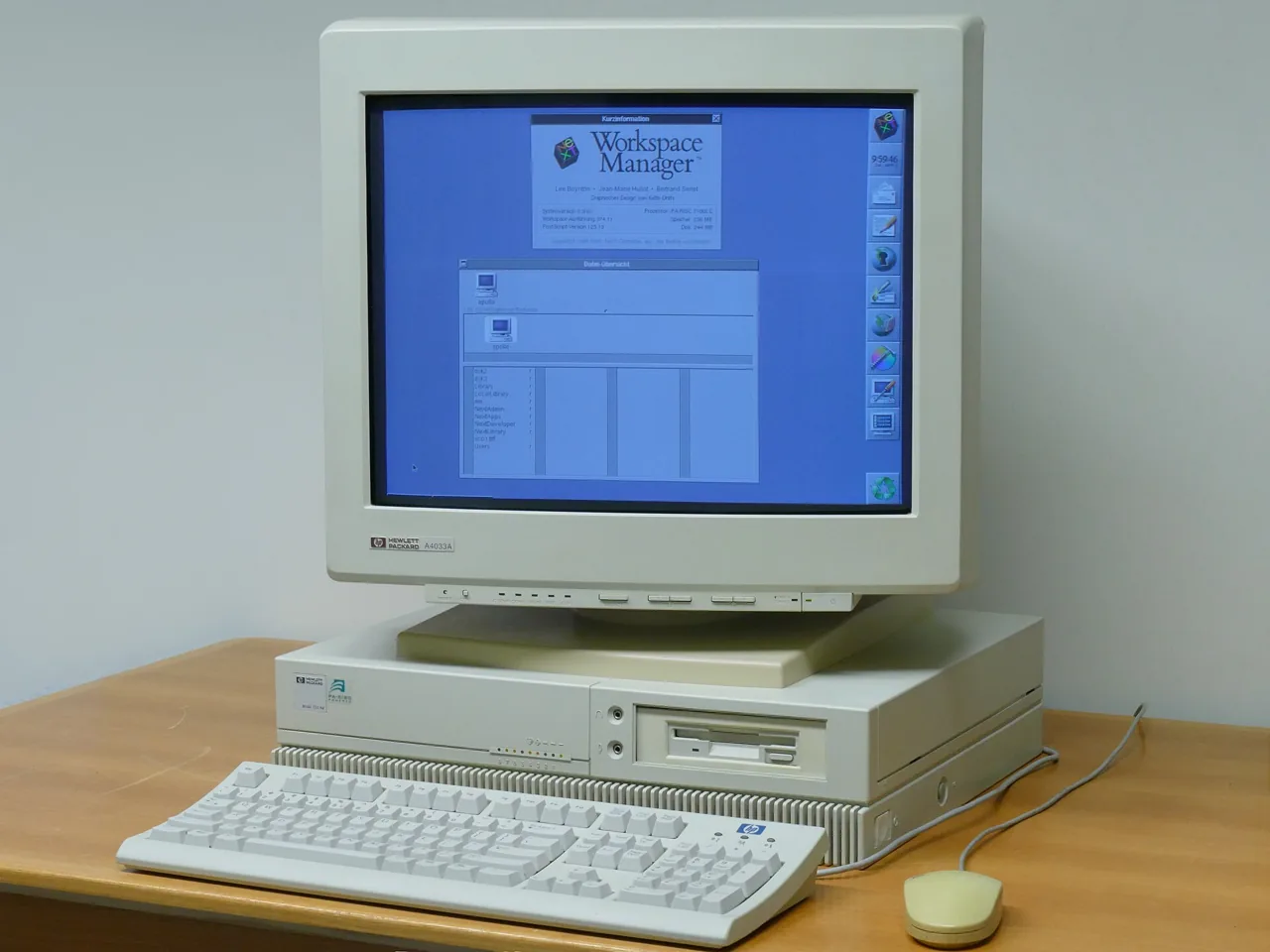
By the mid-1990s, NeXTSTEP had expanded beyond Motorola 68k-based hardware to support Intel and PA-RISC platforms, with documented versions including NeXTSTEP for Intel 3.1 and NextStep 3.2156. Hewlett-Packard planned to launch PA-RISC NEXTSTEP workstations5, and SunSoft licensed the application environment for integration with Solaris10. The OpenStep API emerged as an open specification derived from the operating system-independent subset of NeXT'Step 3.2, jointly published with Sun10. IBM also received a license for NextStep, though the scope and outcome of that arrangement are not detailed in surviving documentation9.
NeXTSTEP’s technical legacy lies in its early commercial deployment of the Mach kernel, a distinction noted in industry analysis as pushing the state of the art14. Its object-oriented design, interprocess communication via ports, virtual memory model with memory-mapped files, and threading support formed a cohesive environment that influenced later systems816. Error messages such as "RDP exception" or kernel panics at boot indicated underlying hardware or software misconfigurations, pointing to the system’s sensitivity to platform stability1. Third-party extensions like NEBULA FOR NeXTSTEP indicate niche adoption beyond NeXT’s own ecosystem13.
Despite its sophistication, NeXTSTEP remained a niche product, with user and developer packages priced at $795 and $2,995 respectively for version 3.2, costs that limited accessibility6. The surviving documentation is silent on sales figures, system requirements, and discontinuation timeline. What endures is its role as a crucible for modern development practices: Interface Builder’s drag-and-drop UI design, the tight coupling of Objective-C and runtime introspection, and the ambition of a uniform, networked application framework prefigured elements now standard in contemporary operating systems.
References
- epnx ps
- DOSPowerTools PaulSomerson
- epnx u1
- SunExpert-v05n10-1994-10 (1994)
- SunExpert-v05n05-1994-05 (1994)
- SunExpert-v05n07-1994-07 (1994)
- NeXT 0.9-1.0 Release Description
- 1989 03 BYTE 14-03 Mac Supplement 286 vs 386sx Object Oriented Programming (1989)
- NeXT Third Party Programs and Products
- SunExpert-v05n02-1994-02 (1994)
- Byte Magazine Atari Articles
- STR818.TXT.generated
- PC Home (1994-06) (1994)
- cryptolog 116
- 1989 12 BYTE 14-12 5 New Laptops and Sound Image Processing and Case Tools (1989)
- AUUGN-V12.45