Sega Saturn
Sega’s dual-CPU game console, released with fanfare in the mid-1990s, featured a complex architecture that prioritized 2D performance and surround sound, though its reliance on HDTV for full-color output limited accessibility.
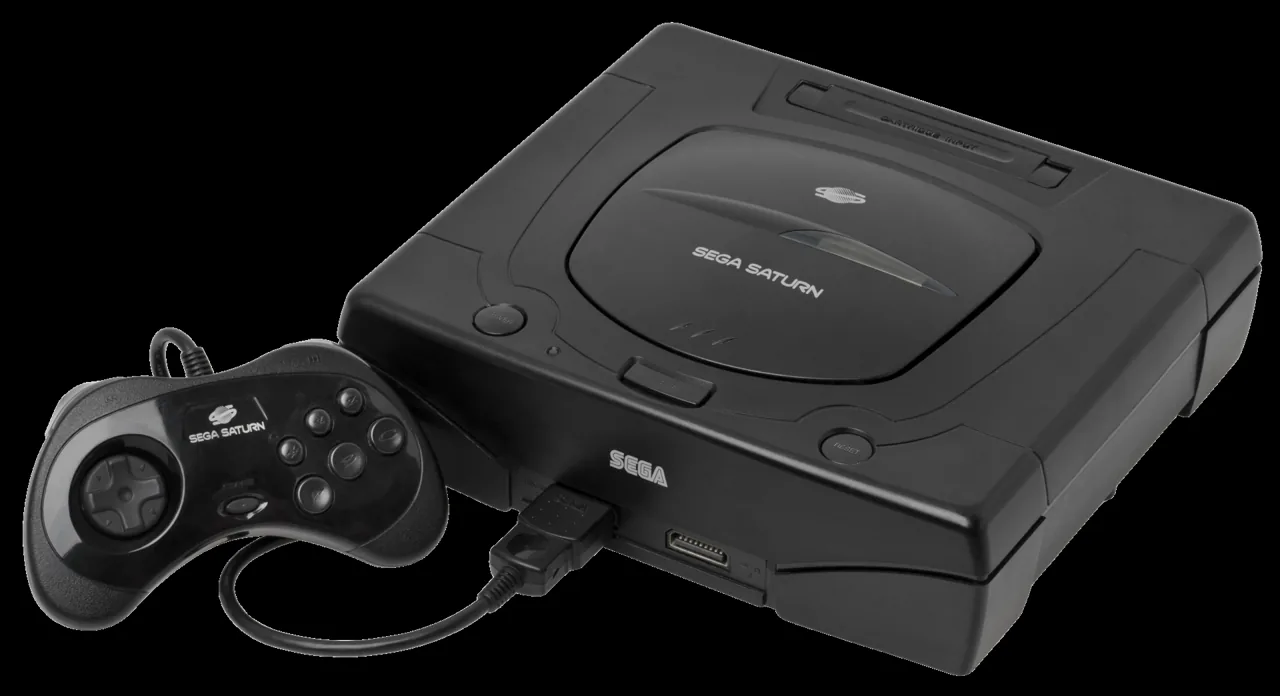
The Sega Saturn distinguished itself from contemporaries not through simplicity, but through architectural density. Its design incorporated three 32-bit processors into a system requiring intricate coordination4. The master and slave CPUs shared all external devices and used identical programs and reset vectors, yet each required independent initialization via boot ROM to operate correctly6. This dual-CPU configuration, while capable, presented a steep learning curve for developers accustomed to more linear control6.
Originally conceived around the 16MHz NEC V60, a CISC-type CPU, the final hardware diverged significantly from these early plans, though the sources do not specify what replaced it5. What remained unchanged was the inclusion of an MC68000 as a dedicated sound control CPU, capable of operating independently of the master processor9. This secondary CPU communicated with the main system through a shared "command buffer" in RAM, enabling asynchronous handling of PCM audio and CD-based soundtracks9. The result was described in one period publication as "connoisseur-class surround sound"4.
Visually, the Saturn rendered at a base resolution of 320 x 224 on standard televisions4. While it could access a color palette of either 16.7 or 16.8 million colors (sources conflict within the same document), the full 16.8 million-color display required an HDTV connection, a rarity in the mid-1990s4. In contrast, the competing Atari Jaguar achieved the same color depth on regular TVs, highlighting a key constraint on the Saturn’s consumer appeal4. Both the 3DO and Sega CD, by comparison, offered lower resolutions, settling at 320 x 2004.
Development tools for the Saturn were distributed across three 3½" HD disks: the first containing Psy-Q System software including SH2 and 68000 assemblers and a debugger, the second an archive of the Freeware SH GNU C compiler, and the third documentation for that compiler11. Additional libraries, specific to the Saturn, were available through Sega’s DTS CD and other official channels11. These materials reflect Sega’s effort to provide developers with direct, low-level access, though the complexity often overwhelmed smaller studios.
Peripherals followed a standardized ID system across all regional hardware versions, ensuring compatibility regardless of market6. Supported input devices included the standard Control Pad, the 6Player multitap, and the Saturn Mouse3. A Backup Memory Cartridge was available separately, supplementing the internal backup RAM already present in the console3. Future expansion was anticipated through external devices like a floppy disk drive or hard disk drive, connected via an expansion port and recognized by the boot ROM as "External Devices"3. The Saturn Keyboard and Floppy Disk Drive were listed as forthcoming in developer materials, though their availability remained limited3.
In Japan, the Saturn found niche productivity use through the Sega Saturn-you Word Processor Set, a package sold by Koei that included the EGWORD software, a Canon BJC-210J printer, and interface cable (though not the keyboard or floppy drive it required)1. This repurposing suggested ambitions beyond gaming, yet no broader office functionality emerged.
The console’s name emerged late in development: what was once known as the GigaDrive was rebranded to Saturn during the latter stages of testing5. The shift coincided with a crisis of confidence at Sega. When then-president Hayao Nakayama reviewed the technical specifications of Sony’s upcoming PlayStation, announced in December 1993 with 3D capabilities rivaling Sega’s arcades, he summoned the entire R&D department to headquarters for an emergency meeting5. Witnesses recalled Nakayama as "the maddest I have ever seen him," signaling a frantic pivot in response to Sony’s threat5.
Despite these internal tremors, pre-launch sentiment in Western markets remained bullish. One 1995 issue of Electronic Games declared the Saturn "a lock to make the Final Three" among next-generation consoles, noting it had "already surmounted most of its potential obstacles" on the eve of its late-summer debut4. Yet consumer uncertainty lingered: a reader of Sega Saturn Magazine expressed concern in 1995 that Lockheed Martin was developing a "Saturn 2," potentially rendering their new console obsolete2.
Legacy development continues through SSF, a Windows-based emulator by Shima capable of running most Saturn titles from CD or virtual drive1. The emulator also supports Sega Titan Video, indicating shared architectural foundations between the arcade and consumer systems1. For all its complexity, the Saturn remains a machine defined by contradictions: technically audacious, commercially strained, and architecturally opaque, yet capable of feats like Treasure’s acclaimed 2D action titles that still draw admiration5.
References
- Sega Saturn Encyclopedia vol2
- Sega Saturn Magazine Issue 02 1995-12 EMAP Images GB (1995)
- Archive item #7444955
- Electronic Games 1995-06 (1995)
- EDGE.RETRO.N3.2003.Guide.collecting-DURiAN (2003)
- Sattechs
- Sega Developers Conference - Conference Proceedings - March 5-7, 1996 (1996)
- MegaMan 8 1997 Capcom US (1997)
- Archive item #237r1
- Archive item #7427924