Tandy TRS-80 CoCo 2
Tandy sold the CoCo 2 as model 26-3128 with 64K RAM for $219.95 in late 1985, positioning it as a direct-video variant within a three-model family sharing Extended Basic and software compatibility.
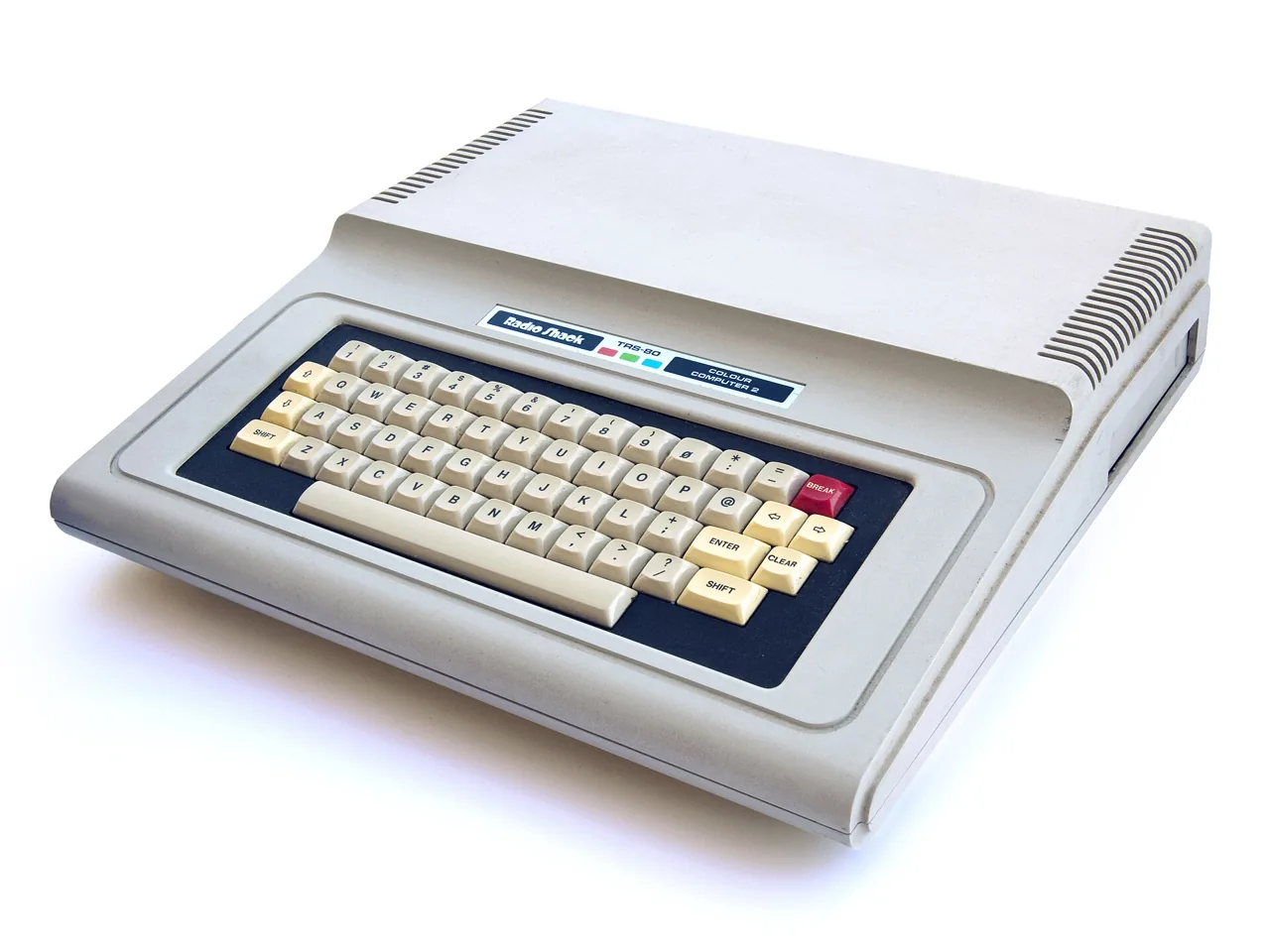
The machine known officially as the 64K Direct Video CoCo2 carried the model number 26-3128 and shipped with 64K of RAM, distinguishing it within the CoCo lineup by its video circuitry while retaining full compatibility across the series1416. It belonged to a family that included the CoCo I, II, and III, referred to collectively as CoCo 1, 2, and 3 in contemporary documentation91012. Despite variations in hardware, all models could run the same software provided they had 32K Extended Basic, the minimum requirement cited for program execution unless otherwise specified91012.
Under the hood, the CoCo 2 relied on the 6809 cpu, a component common to the broader TRS-80 Color Computer family, though the surviving documentation does not specify clock speed, bus width, or supporting chipset7. The system booted into Extended Basic, the standard firmware environment referenced across multiple issues of The Rainbow, a periodical dedicated to the platform91012. This version of Basic served as both a programming language and the de facto interface, expected by users and developers alike as the baseline runtime.
Radio Shack marketed the CoCo 2 under its TRS-80 brand, a trademark held by Tandy Corporation, and listed the 26-3128 at $219.95 in November 1985, a price point reaffirmed the following month, suggesting stable availability during that window1416. The "Direct Video" designation in its full name likely indicated a hardware revision aimed at improving display reliability, a known pain point in earlier CoCo models, though the documentation does not elaborate on the technical nature of this change. What is clear is that the strategy emphasized continuity: software written for the original CoCo ran on the CoCo 2, and peripherals such as the Joystick remained compatible across generations9.
The CoCo 2 did not redefine the platform, nor was it intended to. It was a transitional product, more capable than the original, yet simpler and more affordable than the CoCo 3 that followed. Its value lay in its adherence to a compatibility contract: if a program ran under 32K Extended Basic, it would run here. That promise, repeated across official channels, became the anchor of its ecosystem. The surviving record is silent on release year, dimensions, weight, storage, I/O, and operating system, leaving the machine defined by its role rather than its specs.
Specifications
| Model Number | 26-3128 |
| RAM | 64K |
| CPU | 6809 |
| BASIC | Extended Basic |
| Minimum RAM for Software | 32K Extended Basic |
| Price | $219.95 |
| Compatibility | CoCo 1, 2, 3; Joystick |
References
- The Rainbow Vol. 10 No. 07 - February 1991 (1991)
- The Rainbow Vol. 10 No. 06 - January 1991 (1991)
- The Rainbow Vol. 10 No. 01 - August 1990 (1990)
- The Rainbow Vol. 10 No. 03 - October 1990 (1990)
- The Rainbow Vol. 09 No. 03 - October 1989 (1989)
- The Rainbow Vol. 09 No. 09 - April 1990 (1990)
- gccc12 8nl
- The Rainbow Vol. 02 No. 06 - December 1982 (1982)
- The Rainbow Vol. 06 No. 10 - May 1987 (1987)
- The Rainbow Vol. 08 No. 10 - May 1989 (1989)
- The Rainbow Vol. 03 No. 09 - April 1984 (1984)
- The Rainbow Vol. 08 No. 08 - March 1989 (1989)
- The Rainbow Vol. 10 No. 09 - April 1991 (1991)
- The Rainbow Vol. 05 No. 04 - November 1985 (1985)
- The Rainbow Vol. 03 No. 12 - July 1984 (1984)
- The Rainbow Vol. 05 No. 05 - December 1985 (1985)