Tandy TRS-80 Model II
Radio Shack’s first serious business microcomputer, the TRS-80 Model II, shipped in October with 32K or 64K RAM, a Z-80A CPU at 4 MHz, and built-in 8-inch floppy drives, positioned as a high-end sibling to the consumer-focused TRS-80 line.
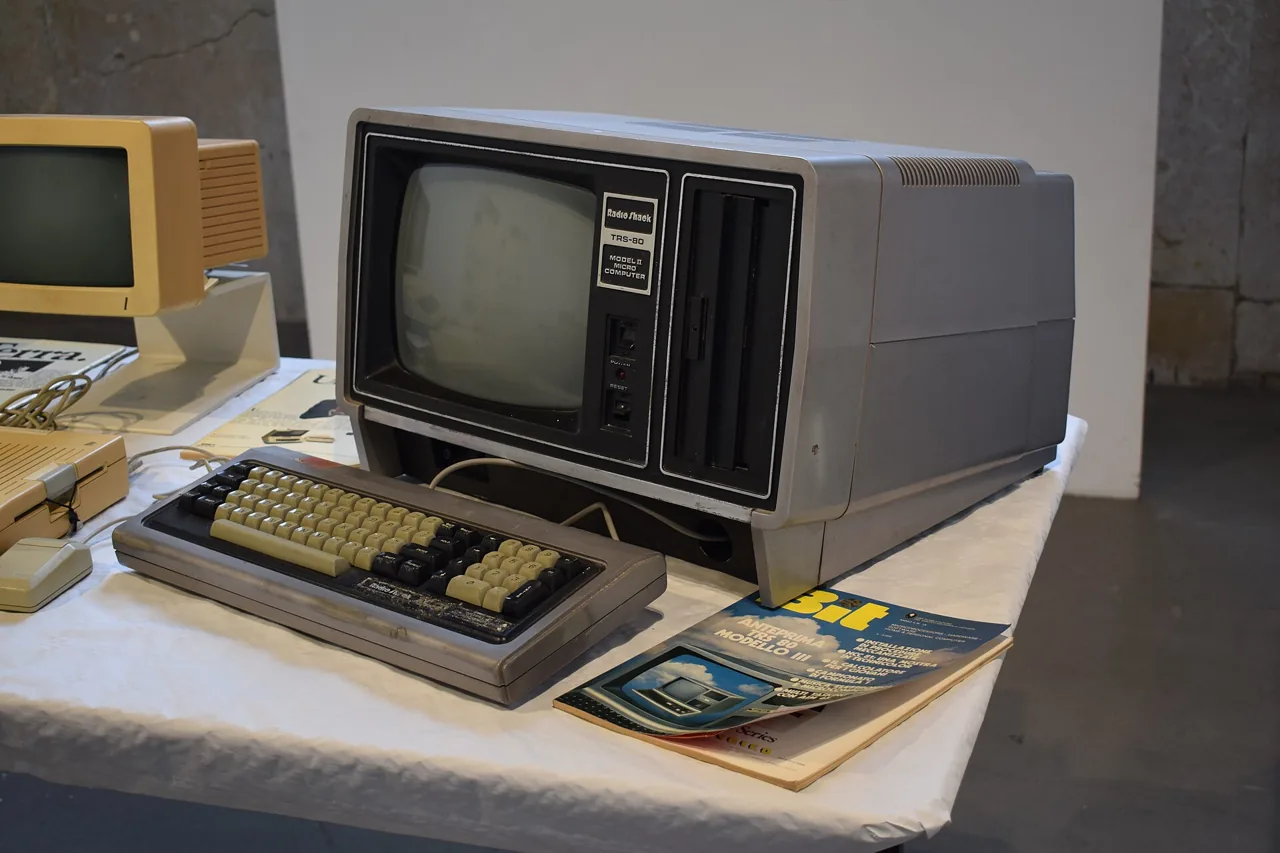
Radio Shack introduced the TRS-80 Model II as a “completely new microcomputer” and the “powerful 'brother' to the TRS-80 family,” distancing it from its earlier hobbyist machines13. Marketed as “TRS-80's Big Brother!”, it targeted small businesses with a professional build, integrated storage, and expandable architecture13. Unlike the original TRS-80 Model I, the Model II featured a separate keyboard processor and dual RS-232C serial ports, signaling a shift toward multitasking and peripheral integration8. Shipping began in October, with approximately 1,000 units delivered by year’s end13.
Pricing was steep for the era: a 64K 1-disk configuration carried a list price of $3,899.00, with a cash price of $3,299.003. A fully equipped 4-disk system was listed at $6,5998. These figures contrast with an alternate report of a $3,100 price for the 64K Model II, suggesting either a configuration difference or promotional pricing not otherwise documented13. The Model II Hard Disk System, based on Winchester technology with two 8-inch platters in a sealed enclosure, was priced at $4,49535. The system supported up to four floppy drives, offering a theoretical maximum of 2 megabytes of storage8.
The system centered on a Z-80A processor running at 4 MHz, paired with either 32K or 64K of RAM8. The inclusion of DMA and vectored interrupts improved throughput, particularly under disk-intensive workloads8. The machine shipped with TRSDOS, which retained backward compatibility with existing library commands while adding new utilities: Save and Restore56. Architectural differences between the Model I and Model II resulted in distinct software ecosystems. Third-party operating systems emerged quickly: Pickles and Trout offered CP/M 2.2e10, and DOSPLUS II promised performance improvements of fivefold or more over the OEM DOS, supporting both floppy and hard disk configurations16.
One of its most ambitious features was the Model 16 Enhancement Option, priced at $1,499 plus installation5. This add-on introduced a Motorola MC68000 16-bit CPU alongside the existing Z-80A, enabling dual-processor operation, a multi-user operating system, and expandable memory up to 256K5. This configuration effectively transformed the Model II into a minicomputer-class system, allowing simultaneous program execution, a capability rare in microcomputers of the period. The service manual for RSCobol, licensed from Ryan-McFarland Corporation, confirms enterprise language support was available by early 19806.
Connectivity included a Centronics parallel port and two RS-232C serial ports, the latter using a DB-25P male connector810. The Model II could interface with Houston Instrument's DMPL Intelligent Plotters via appropriate cabling, and printer connections to devices like the Radio Shack 26-4401 were supported1011. Despite its capabilities, the surviving documentation is silent on display specifications, sound hardware, physical dimensions, and expansion bus architecture, critical omissions for a machine marketed as expandable and business-ready.
Radio Shack chief Lewis Kornfeld projected sales of 15,000 Model II units in 1980, a significant increase over initial shipments13. This ambition reflected the company’s broader momentum: TRS-80 sales had already reached nearly 150,000 units, with computer equipment contributing over $100 million in annual revenue and an estimated 35% share of the personal computer market13. Yet the Model II remained a niche product. Its high entry cost, reliance on 8-inch floppies (already aging by 1980), and lack of clear consumer positioning limited its reach. The machine’s legacy lies in its transitional role: a bridge between hobbyist micros and true business systems, technically capable but hampered by pricing and timing. The Model 16 upgrade path demonstrated foresight, but the complexity and cost of dual-processor operation kept it from widespread adoption. The documentation is silent on whether there were later revisions or successor models within this lineage.
Specifications
| CPU | Z-80A at 4 MHz8 |
| RAM | 32K or 64K8 |
| Storage | Built-in 8-inch floppy (500K bytes); supports up to four drives (2 MB total)8 |
| Hard Disk | Winchester system with two 8-inch platters, sealed enclosure5 |
| Operating System | TRSDOS; CP/M 2.2e (third-party); DOSPLUS II561016 |
| Programming Languages | Interpreter BASIC; COBOL via Ryan-McFarland86 |
| I/O Ports | 2 RS-232C (DB-25P male), 1 Centronics parallel810 |
| Special Features | DMA, vectored interrupts, separate keyboard processor8 |
| Upgrade | Model 16 Enhancement Option: adds MC68000 CPU, multi-user OS, up to 256K memory5 |
References
- The Rainbow Vol. 02 No. 02 - August 1982 (1982)
- 1982 01 BYTE 07-01 The IBM Personal Computer (1982)
- Interface Age-1982-05 (1982)
- RSCobol v1.3 1980 Ryan McFarland Corporation (1980)
- 1980 01 BYTE 05-01 Domesticated Computers (1980)
- HI InterfaceNotes DM-PL Plotters
- MX-80 and MX-100 Training Mar83
- 1980 04 BYTE 05-04 Printed Software Becomes a Reality (1980)
- two-sixteen magazine 1 3 Sep-Dec 1982 (1982)