Tandy TRS-80 Color Computer
Tandy Corporation introduced the TRS-80 Color Computer in 1980 as a low-cost home machine built around the 6809 processor and sold through Radio Shack stores, where it competed for attention among calculators and stereos.
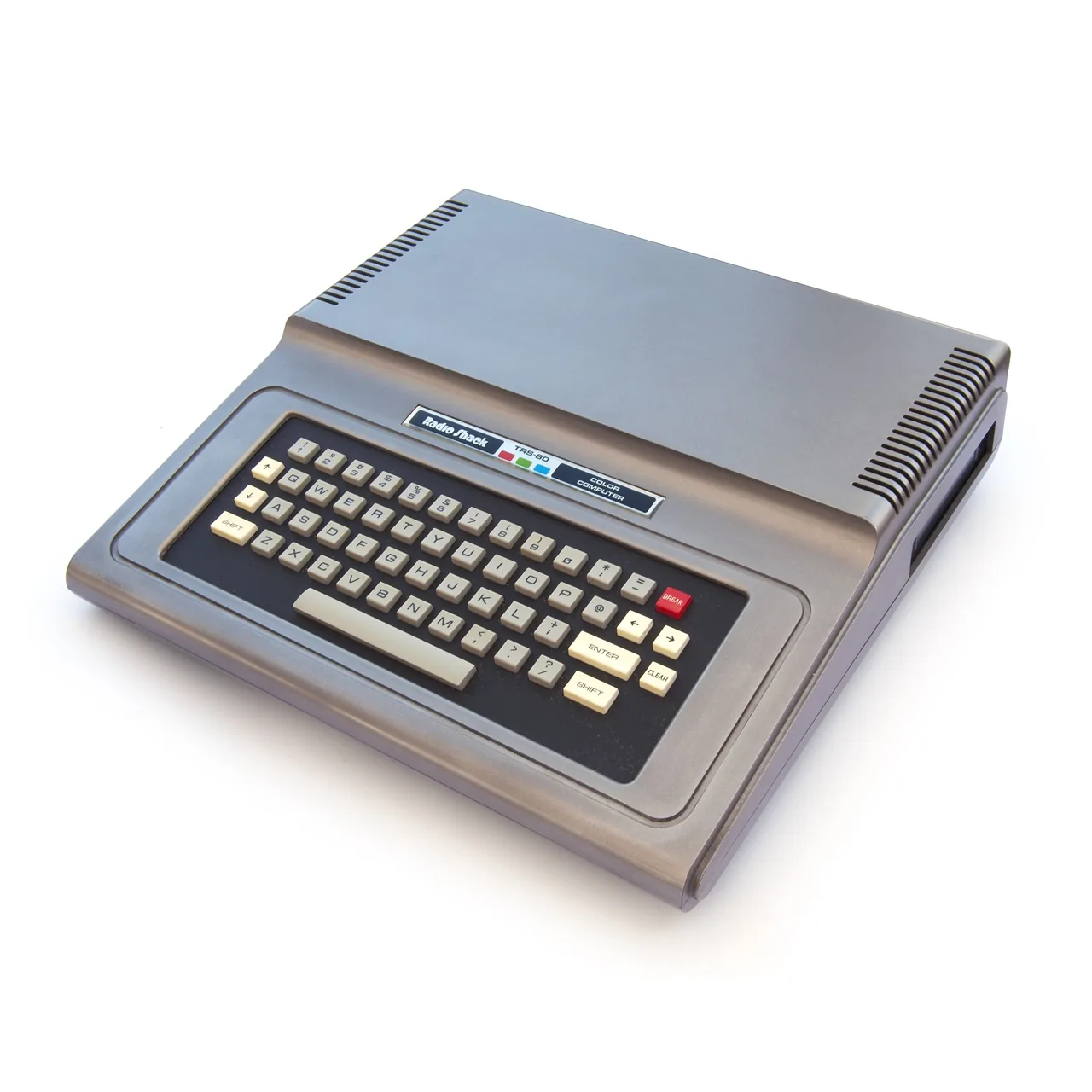
Publicly unveiled on July 31, 1980, alongside the TRS-80 Model III and a pocket computer, the Color Computer began appearing in Radio Shack retail locations by September8. It shipped with 4K of RAM and 8K of ROM holding Microsoft Color BASIC 1.0, priced at $399.008. Higher configurations followed: a 16K model listed at $399.95 (catalog number 26-3002, previously $499.95), and a 32K version at $549.95 (26-3003, down from $649.95)7. The machine’s 53-key calculator-type keyboard108, flat, rubbery, and ill-suited for touch typists, became an immediate point of criticism, though its integration into a compact, television-compatible unit reflected Tandy’s growing competence in consumer electronics10.
The Motorola 6809 processor powered the system10, an advanced 8-bit CPU for its time, though the surviving documentation does not specify clock speed. Memory could be expanded beyond factory configurations; users were explicitly advised on installing additional 16K blocks4, and third-party upgrades allowed for up to 64K4. The ROM contained either 8K Color BASIC or 16K Extended Color BASIC10, with disk-based variants later supported through third-party operating systems like FLEX and OS-956. The FHL Color FLEX system notably enabled use of standard Disk Extended Color BASIC under FLEX, broadening hardware and software compatibility beyond Radio Shack’s baseline offerings56.
Video output supported eight colors10 and connected directly to any television via a built-in RF modulator810. A garbled OCR reading of “192$ screen resolution” in one source likely indicates a 192-line display13, though pixel dimensions and text modes remain unspecified in the record. Audio was limited to a five-octave, 12-note scale10, generated without mention of a dedicated sound chip in the available materials.
Peripherals and expansion included a ROM cartridge slot for Program Paks813, such as the Editor/Assembler13; joystick connectors8; a 1500-baud cassette interface for storage813; and a built-in RS-232C serial interface813. Software shipped on ROM cartridges included titles like Chess, Quasar, Pinball, Checkers, Math Bingo, and Music10.
Radio Shack published the 71-page TRS-80 Color Computer Technical Reference Manual in 1981, priced at $14.95, supporting Level I and Level II designations referenced in service literature2. The machine spawned a product line including the TRS-80 Color Computer 2, Tandy Color Computer 2, and Tandy Color Computer 33, though the documentation does not clarify the engineering lineage between them. A non-Radio Shack retail variant, the TDP-100, represented Tandy’s attempt to distribute the platform more widely1. Unofficial clones emerged globally, including the Dragon 32, Dragon 64, Tano Dragon, Matra Alice, Prologica CP400 Color II, Varixx VC50, LZ Color64, Dynacom MX1600, Codimex CD6809, Micro-SEP, Sampo Color Computer, Sysdata Tclor, Tomcat TC-9, and TC-703.
References
- BBOA Tandy TRS-80s Computer Club Newsletter 1987-08 BBOA Tandy TRS-80s Computer Club US (1987)
- BYTE Vol 07-05 1982-05 Japanese Computers (1982)
- gccc36 3nl
- MICRO Vol49-06 82
- The Rainbow Vol. 03 No. 12 - July 1984 (1984)
- The Rainbow Vol. 04 No. 01 - August 1984 (1984)
- The Rainbow Vol. 02 No. 07 - January 1983 (1983)
- gccc12 7nl
- Electronic Games Issue 01 Vol 01 01 1981 Winter Premiere (1981)
- The Rainbow Vol. 02 No. 06 - December 1982 (1982)