Dragon 64
The Dragon 64, produced by British parent company Dragon Data Ltd., was a 64K home computer fully compatible with the earlier Dragon 32 and marketed as a more professional alternative to the TRS-80 Color Computer, featuring built-in serial and parallel ports and support for the Unix-like OS-9 operating system.
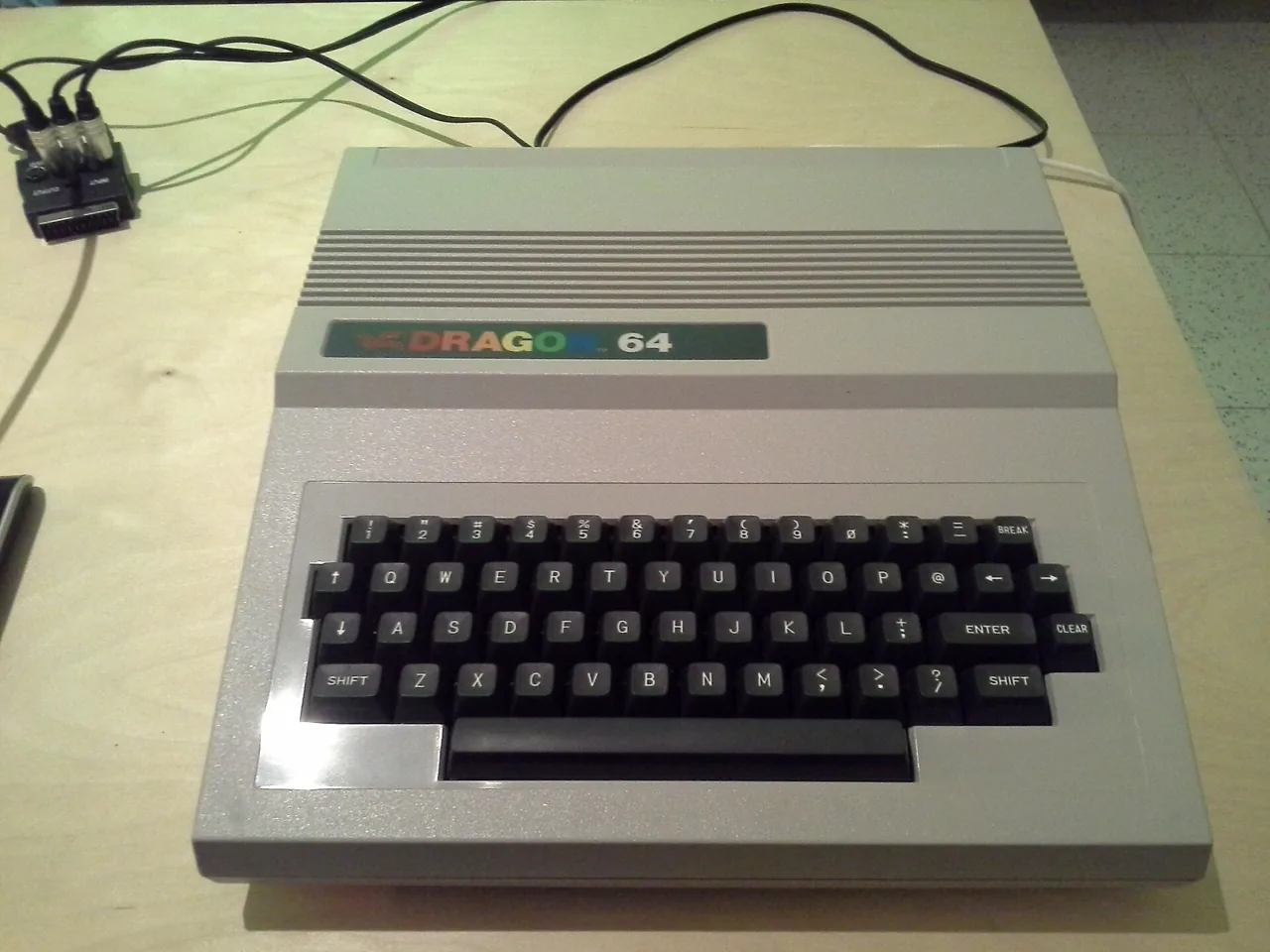
The Dragon 64 was positioned as a direct successor to the Dragon 32, with full compatibility between the two models1. Owners of the Dragon 32 could upgrade to the 64K model by returning their original machine and paying £140, though the OS-9 operating system required an additional £502. This arrangement marked a retreat from an earlier promise of an expansion box including OS-9, editor/assembler, and O9 BASIC for under £150, a commitment withdrawn amid financial strain2.
Physically, the machine measured 474 mm wide, 219 mm deep, and 135 mm high, with a mains power requirement of 220 or 240 V AC at 50 Hz1. Its internal layout featured a connector along the top edge for plug-in modules, suggesting a modular expansion design1. The keyboard was notably minimal, lacking function keys entirely1. Despite this austerity, the system included a built-in hardware serial port and a cleverly engineered parallel printer port derived from the keyboard circuitry12.
Graphics capabilities were described in terms of character resolutions: 96, 192 x 128, or 256 x 192 characters1. The system shipped with a version of Microsoft's Color Basic1, and documentation included a ROM conversion table for Color Basic 1.1, underscoring its architectural kinship with the TRS-80 Color Computer3. The Dragon 64 shared indirect memory addresses at $A000–$A00C with the CoCo, a deliberate bid for compatibility3. However, it diverged by integrating hardware interfaces absent on the CoCo, notably the serial and parallel ports12.
One of its most significant differentiators was support for OS-9, a Unix-based operating system1. This capability, elevated the Dragon 64 beyond a mere home computer, positioning it as a system for professional users1. The supplementary manual dedicated two full pages to accessing the RS-232 interface, either directly or via BASIC, indicating its importance in the machine's intended use cases1.
Peripherals supported included disk drives, EPSON printers, Mark Data keyboard kits, Wico and Kraft joysticks, and cassette recorders113. Cartridge slots allowed for ROM expansion, and Nelson Software's Super 'Color' Writer was adopted as the official word processor3. A modest library of Spanish-language software was documented, including titles on graphics, sound, machine language, artificial intelligence, and educational games13, alongside UK-published guides such as The Working Dragon and Dragon 32 Games Master, both priced at £5.958.
Despite its technical merits, Dragon Data Ltd. faced financial instability even before the Dragon 64 reached the market, suffering a cash crunch during a slow summer that necessitated a £2.5 million shareholder bailout2. Ultimately, the British parent company entered receivership3. TANO, the U.S. distributor, later reduced the price to $149.003, a move suggesting attempts to clear inventory amid declining fortunes.
The machine was praised in promotional materials as "a very serious consideration to anyone in the market for an inexpensive yet powerful computer with high resolution graphics capabilities"3, and its hardware was described as "proven"1. The addition of OS-9 was seen not as a minor upgrade but as a transformation, turning the Dragon 64 into a professional system1. That ambition, however, outpaced the company's stability, leaving the Dragon 64 as a technically capable machine whose legacy was constrained by corporate fragility.
Specifications
| Manufacturer | Dragon Data Ltd. |
| Memory | 64K |
| Graphics Resolutions | 96, 192 x 128, or 256 x 192 characters |
| BASIC | Microsoft Color Basic-compatible |
| Keyboard | Very simple, without function keys |
| Power Supply | 220 or 240 V AC / 50 Hz |
| Dimensions | 474 mm (W) x 219 mm (D) x 135 mm (H) |
| Data Buffer | 500 bytes |
| I/O Ports | 2 joystick ports, cassette interface, ROM cartridge slot, TV output, external power transformer, RS-232 serial, parallel printer port |
| Operating System | OS-9 (Unix-based, optional) |
| Compatibility | Fully compatible with Dragon 32 |
References
- ComputerPersoenlich 84 15
- Computers that made Britain v1
- gccc13 1nl
- Archive item #198308
- The Rainbow Vol. 03 No. 05 - December 1983 (1983)
- The Rainbow Vol. 09 No. 09 - April 1990 (1990)
- ES - Juegos Dinamicos Para el ZX Spectrum