Dragon 32
Dragon Data Ltd. released the Dragon 32 in the early 1980s as a 32K RAM home computer built around the 6809E microprocessor, positioned as a more powerful alternative to contemporary machines through aggressive memory and BASIC language specifications.
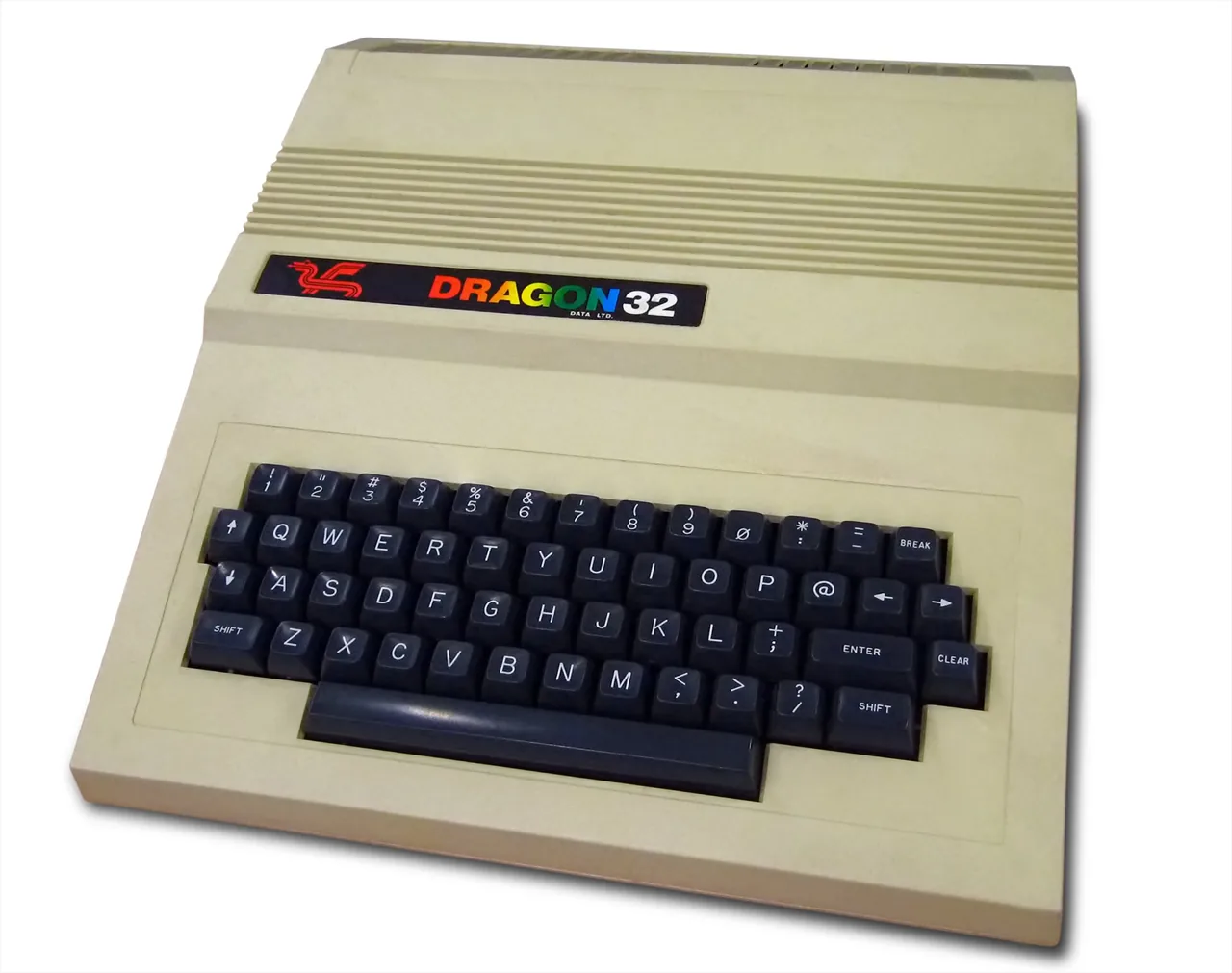
The Dragon 32 shipped with 32K RAM as standard, a figure repeatedly emphasized in marketing materials as a competitive advantage15910. This capacity was not part of the original design: early units were developed as the Dragon 16, but two weeks before mass production, Mettoy, involved in the decision-making, mandated an upgrade to 32K to compete directly with Sinclair’s newly launched Spectrum4. The legacy of this last-minute change is visible inside early production models, where a daughterboard adds the second 16kB bank4.
The system centered on the 6809E microprocessor, described in German-language documentation as “one of the most powerful 8-bit processors currently available”7. It came equipped with Extended Microsoft Color BASIC, featuring built-in graphics commands such as SET, LINE, CIRCLE, PAINT, PRINT, and DRAW7. This implementation distinguished it from contemporaries by offering higher-level drawing primitives directly in ROM, reducing the burden on beginner programmers.
Priced at £199.50 at launch26, the system was advertised as costing “under £200”15910. Accessories included a cassette recorder for £39.95, cassette cable for £7.95, and a pair of joysticks for £19.9926. Third-party expansions emerged, including a sprite graphics board supporting 16 colours and a voice synthesiser11.
Upgrade Promises and Broken Plans
Owners of the Dragon 32 were initially told they could upgrade to a Dragon 64 via an expansion box that would include the OS9 operating system, an editor/assembler, and O9 BASIC for less than £1504. This promise was not fulfilled. Instead, a later official upgrade path required returning the Dragon 32 and sending a cheque for £140, but notably excluded OS9, which carried an additional £50 fee4.
Market Presence and User Sentiment
Marketing copy from the period framed the machine as uniquely accessible: “The Dragon 32 is so userfriendly, it practically licks your hand”5, and “a computer so easy to understand, you won’t understand why all the others seem so difficult”15910. The keyboard was praised as “beautifully-designed” and typewriter-like in usability510.
By late 1984, used systems retained strong resale value. Classified ads listed complete setups (including joysticks, software, books, magazines, and peripherals) at prices matching or exceeding the original retail cost, with several offers at £200 ono11. One listing included a boxed voice synthesiser, 46 games, and multiple issues of Dragon User magazine11.
Software Catalog
Commercial software offerings included titles such as Berserk (£17.35–£19.95), Meteorids (£17.35–£19.95), Cosmic Invaders (£17.35–£19.95), and Ghost Attack (£21.70–£24.95)26. Budget collections like Special Selection 1 and 2, Quest, and Graphic Animator sold for £7.9526. The used market in 1984 saw cartridges like Cyrus Chess and Sprite Magic selling for £8 or less11. Other known software includes The Hobbit, Pimania, Centipede, and Strategic Command15.
The magazine Dragon User served as a key publication for the platform, with issues circulating at least through early 1985316.
Specifications
| Manufacturer | Dragon Data Ltd. |
| Model | Dragon 32 |
| Also known as | Dragon 32 Family Computer, Dragon 32 (32K Micro), Dragon 32k Colour Computer |
| CPU | 6809E |
| RAM | 32K (standard) |
| ROM | Extended Microsoft Color BASIC |
| Storage | Cassette interface (cable £7.95) |
| Expansion | Cartridge slot, RS-232 interface, daughterboard-based memory expansion (early units) |
| Peripherals | Cassette recorder (£39.95), joysticks (£19.99), sprite graphics board (16 colours), voice synthesiser |
| Keyboard | Full-travel, typewriter-style |
| Original price | £199.50 |
References
- ComputingToday198210 (1982)
- ComputingToday198211 (1982)
- The Rainbow Vol. 03 No. 08 - March 1984 (1984)
- Computers that made Britain v1
- YourComputer 1982 12 (1982)
- ComputingToday198211 (1982)
- ComputerPersoenlich 83 14
- CPU 1983-09 (1983)
- ComputingToday198210 (1982)
- ComputingToday198212 (1982)
- PersonalComputerNews085-03Nov1984 (1984)
- Computer Gaming World - 199301 - Number 102 (1993)
- Computer Kurs 12
- Computer Gaming World - 199209 - Number 98 (1992)
- HomeComputer 8403
- The Rainbow Vol. 04 No. 07 - February 1985 (1985)