Tandy TRS-80 Model III
Tandy’s TRS-80 Model III, a ROM-based Z-80 computer system sold through Radio Shack’s retail network, shipped with Model III BASIC and TRSDOS, supporting cassette and Tandom disk storage with expandable memory up to 48K.
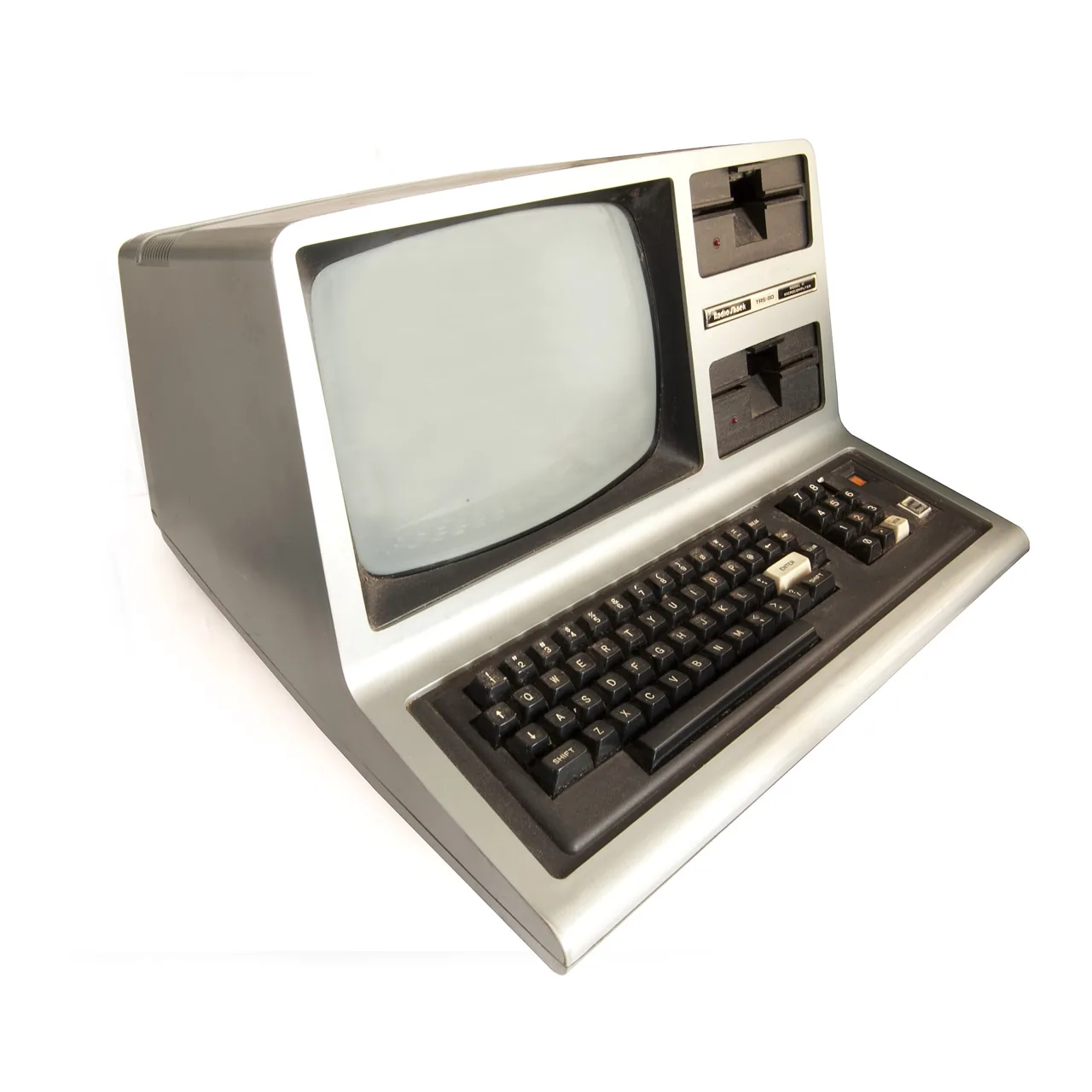
The TRS-80 Model III was a ROM-based computer system built around the Z-80 microprocessor, marketed by Radio Shack, a division of Tandy Corporation 810141516. The system’s firmware included the Model III BASIC language, stored in ROM and copyrighted in 1980 by Tandy and Microsoft, and designed to be fully compatible with most Model I BASIC programs 18. The operating system, TRSDOS™, was also copyrighted by Tandy Corporation in 1980, with later versions such as TRSDOS 1.3 and 2.3 dated through 1983 17. LDOS, a third-party operating system, was also supported, and the machine was explicitly advertised as completely compatible with both TRSDOS and LDOS 47.
Base configurations varied: a 16K RAM model was listed at $999.00 (Catalog No. 26-1062), while a 4K Level I version sold for $599 45. Higher memory configurations included 32K at $856.50 and $831.50 (a price discrepancy noted across listings), and a 48K version with a partially illegible price 5. A fully expanded system, with 48K RAM, Disk Expansion Kit III, and two 40-track double-density Tandom 5¼" drives, was priced at $1,895.00, while the same configuration with 80-track drives reached $2,145.00 4. The top of the line, Catalog No. 26-1066, carried a price of $2,495 11. A single Tandom disk drive (R.S. Model III 1ST-Drive) was available separately for $679 5. In the UK, the system sold for £619 plus VAT 14.
The hardware featured a 12-inch screen and a 65-key console keyboard 810141516. Long-term storage relied on a cassette interface, though this required a separate, user-supplied cassette recorder 8. For expanded capabilities, the system offered an optional disk upgrade path via an expansion area, which also supported an RS-232-C serial communications interface 8. The inclusion of a real-time clock marked a refinement over earlier models, enhancing its utility for business and time-stamped data applications 8.
Software support extended beyond BASIC: the system could run COBOL programs under TRSDOS, and TRS-80 Pascal was available with minimum system requirements 27. Third-party software such as NEMODS/80 Version 2.0 and the smart terminal program Omniterm were available for Model I/III systems 3. Despite these capabilities, one 1983 review concluded that “TRS-80 is largely a games computer,” though it acknowledged the efficiency of memory use, noting that 16K was sufficient for chess variants, action games, and adventure titles 12. The same review noted that many Radio Shack stores displayed Model IIIs and offered free BASIC courses to acclimate customers 12.
Distribution was a defining strength: backed by 6,100 Radio Shack stores and dealers, 130 Computer Centers, and 135 service centers across the U.S., the Model III had unmatched retail visibility for its era 13. By 1982, availability spanned more than 240 Computer Centers and 6,200 Radio Shack outlets and participating dealers nationwide 11. This infrastructure allowed even the smallest Model III configuration to be upgraded incrementally to the top-tier 48K disk-equipped system 11. The Z-80 processor was described in promotional material as the “Drains” of the system, underscoring its central role in the architecture 8.
While positioned as a balanced machine for general use rather than specialized tasks, the Model III inherited compatibility constraints and design choices typical of its lineage in the TRS-80 line 12. Its cassette-based entry point made it accessible, but expansion required significant additional investment. The surviving documentation is silent on the CPU clock speed, display resolution, sound capabilities, physical dimensions, and exact release or discontinuation dates. No sales figures are recorded in the source material.
Specifications
| Manufacturer | Radio Shack, a division of Tandy Corporation12 |
| CPU | Z-80 Microprocessor810 |
| RAM | Expandable from 16K to 48K8 |
| ROM | Contains Model III BASIC Language8 |
| Display | 12-inch screen810 |
| Keyboard | 65-key console keyboard810 |
| Storage | Cassette interface (external recorder required); optional 40- or 80-track 5¼" Tandom disk drives84 |
| Operating System | Model III TRSDOS™; TRSDOS 1.3; TRSDOS 2.3; compatible with LDOS174 |
| Software | Model III BASIC (Microsoft); supports COBOL, Pascal, NEMODS/80, Omniterm1273 |
| I/O | Printer interface, RS-232-C serial interface (both optional), expansion area8 |
| Other Features | Real-time clock8 |
References
- TRS-80 Model III Disk System Manual
- RSCobol v1.3 1980 Ryan McFarland Corporation (1980)
- 1982 12 BYTE 07-12 Game Plan 1982 (1982)
- 1982 01 BYTE 07-01 The IBM Personal Computer (1982)
- The Rainbow Vol. 02 No. 02 - August 1982 (1982)
- Family Computing Issue 01 1983 Sep (1983)
- 26-2211 TRS80 I III Pascal
- your computer 006
- MX-80 and MX-100 Training Mar83
- ComputingToday198205 (1982)
- BYTE Vol 07-05 1982-05 Japanese Computers (1982)
- Electronic Fun Computer and Games Vol 01 03 1983 Jan (1983)
- 1981 06 BYTE 06-06 Operating Systems (1981)
- ComputingToday198201 (1982)
- ComputingToday198207 (1982)
- ComputingToday198203 (1982)