Creative Sound Blaster
Creative Labs' Sound Blaster line defined PC audio for over a decade, beginning with a card that combined 11-voice synthesized music and 8-bit sampled sound effects into a single, widely adopted expansion peripheral priced at $149 in 1992.
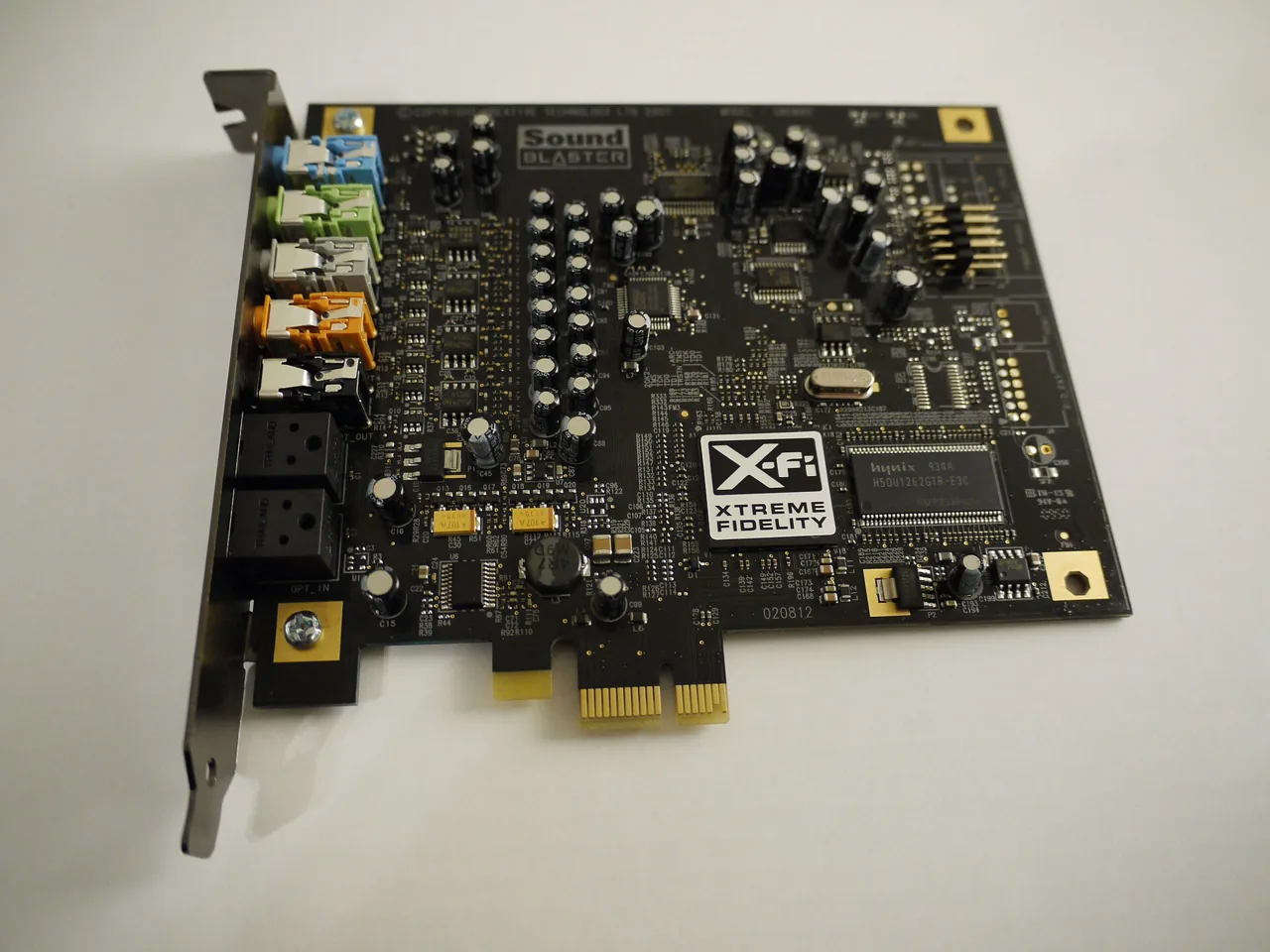
The original Sound Blaster, encompassing models 1.0, 1.5, and 2.0, was not the first PC sound card, but it became the de facto standard by aggressively bundling capabilities that developers could reliably target234. Its design centered on a Digital Sound Processor to interpret commands and a Digital Signal Processor to handle digital audio tasks, with later models introducing an Advanced Signal Processor for real-time compression and enhanced sound manipulation1. This architecture allowed it to support both synthesized music and sampled effects, a dual capability that few competing cards matched at the time.
Creative used bundling as a market strategy. The "Deluxe" designation, applied to models like the Sound Blaster Pro Deluxe, did not signify a different sound card but rather a richer software package, including The Software Toolworks Multimedia Encyclopedia on CD-ROM, First Byte's Monologue text-to-speech engine, Creative Talking Scheduler, and the Creative Soundo'LE wave editor1. This approach turned hardware parity into perceived value dominance, reinforcing its position as "the world's #1 seller" and the card "more gaming software developers write for"234.
Pricing across the family varied significantly by region and bundle. In the UK in 1994, the Sound Blaster II Deluxe listed at £64, while the Sound Blaster Pro Plus (ISA) reached £1595. The Sound Blaster 16 Basic appeared at £108, and the SCSI-2 variant at £1395. In the US, the Sound Blaster 16 Value Edition carried a $139.95 suggested retail price and was called "the best-selling sound card ever"6, while the MultiCD version, capable of interfacing with CD-ROM drives from Sony, Mitsumi, and Creative itself, listed at $199.956. The Advanced Signal Processor upgrade raised the price to $249.956.
The Sound Blaster 16 line proved highly modular: one model was explicitly upgradeable to either a Wave Blaster II or an Advanced Signal Processor6. By 1994, the AWE32 model had expanded the feature set to include a General MIDI Interface, three CD-ROM interfaces, and a microphone, with bundled software like Creative WaveStudio 2.0, QSound Control Panel, and Creative Mosaic8. It delivered 32-voice polyphony and a sampling subsystem, touting "True 16-bit CD Sound" and "Advanced WaveEffects"8.
Late-era models continued the branding momentum. The Sound Blaster AWE64 Gold was promoted via www.SoundBlaster.com/sound/AWE64Gold in 1997, asserting trademarks for E-mu 3D Positional Audio and Creative WaveSynth/WG1011. The Sound Blaster Live! included a broad software suite: AudioHQ, Creative PlayCenter 2, and even novelty applications like Creative Keytar and Creative Rhythmania13. The Audigy 2 ZS supported selectable 48 kHz or 96 kHz sampling rates through its Digital Out connector9, and shipped with tools like Creative Speaker Calibrator, MiniDisc Center, and EAX Console1215.
Creative’s dominance was not due to technical perfection (early models were constrained by 8-bit sampling and limited polyphony), but to strategic saturation. By making "Sound Blaster compatible" a market requirement, and by saturating bundles with software that justified the premium, Creative turned a niche add-on into a PC staple. The surviving documentation is silent on exact release dates, sales volumes, and physical specifications, but the footprint in software catalogs and price lists from 1992 onward confirms its ubiquity.
References
- SoundBlasterTheOfficialBookSecondEdition RidgeGoldenLukSindorf
- Computer Gaming World - 199301 - Number 102 (1993)
- Computer Gaming World - 199303 - Number 104 (1993)
- Computer Gaming World - 199304 - Number 105 (1993)
- PC Home (1994-06) (1994)
- Electronic Games 1995-03 (1995)
- PCMagazine V13N17 19941011 (1994)
- Byte V19N9 Sept1994 (1994)
- Archive item #ec7cd3ef63c048ef894fac2fb4d3f014
- PC Gamer - 199706 - Volume 4 Number 6 (1997)
- PC Gamer - 199705 - Volume 4 Number 5 (1997)
- generalmanual 000010760
- generalmanual 000036195
- PC Gamer - 200211 - Volume 9 Number 11 (2002)
- generalmanual 000010875