NEC TurboGrafx-16
NEC Corporation introduced the TurboGrafx-16 Entertainment SuperSystem as a family of home entertainment products, expanding into the U.S. market14.
The system was marketed under multiple formal designations: "TurboGrafx-16 Entertainment SuperSystem"12345678910111213, "TurboGrafx-16 SuperSystem"1, and more succinctly as "TurboGrafx-16"14 or "TG 16"16. Manufacture was attributed to NEC Technologies, Inc.123567810, NEC Home Electronics (U.S.A.) Inc.49111213, and NEC Corporation14. It was categorized as an "Entertainment SuperSystem"12345678910111213, a "home entertainment" product14, and a "video game system"16.
Game software was distributed on "TurboChip" game cards, a format referenced consistently across promotional and technical documentation2345678910111213. The TurboGrafx-CD unit, also called the "TurboGrafx™-CD Player"1, enabled playback of software in "CD-ROM"16, "Super CD"16, and "Turbo CD software"16 formats. To mitigate latency inherent in optical media, the system employed a "memory buffer, a kind of waiting room for data, where it can be retrieved at cartridge-like speed"16, a hardware-assisted caching technique critical to maintaining responsive gameplay.
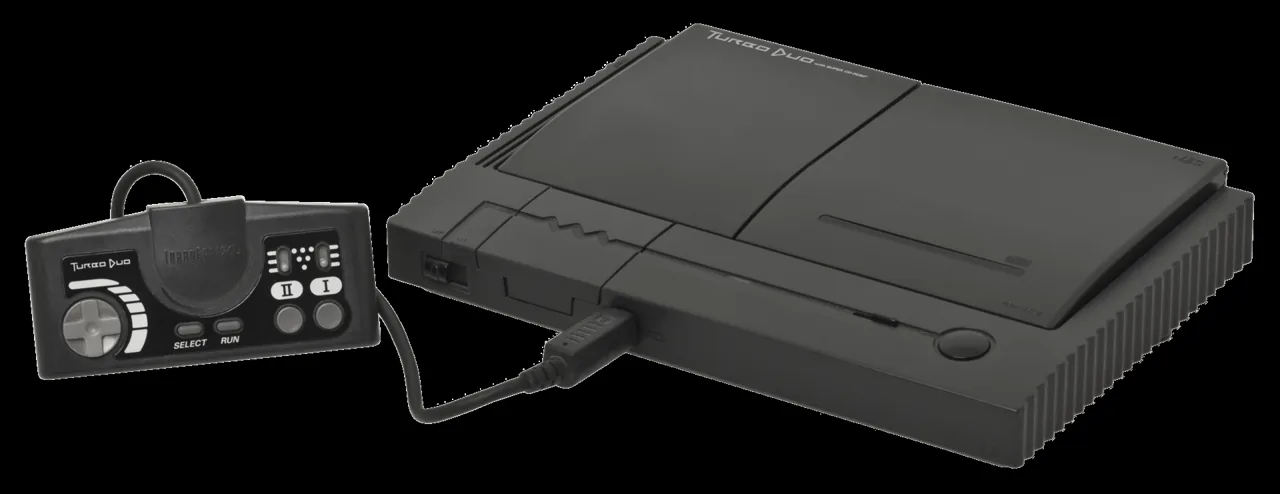
Input was handled via the TurboPad controller, a registered trademark of NEC Technologies, Inc.6. The product family extended to include the TurboExpress Handheld Entertainment System6, a portable variant, and the TurboDuo, a later integrated configuration combining the TG 16 and CD drive into a single unit16.
By 1992, ownership and development of the platform had transitioned to TTI, a joint venture between Hudson Soft (the original creator of the PC Engine) and NEC16. TTI produced both a new, improved CD operating system and the Turbo Duo configuration16. NEC Corporation had shifted U.S. resources toward the TurboGrafx-16 family, moving away from conventional audio/video products after nine years in that market14. The company claimed industry leadership through prior innovations such as Dolby Pro-Logic and digital noise reduction14.
A dedicated publication, TurboPlay, billed as "the only magazine for the TurboGrafx-16 game player," offered six issues for $9.95, with a coupon for a free introductory issue15. The library included titles such as Ys Book I & II1, Fighting Street1, Monster Lair1, Valis II1, Last Alert1, Aero Blasters23, Veigues Tactical Gladiator23, Super Star Soldier2, Legendary Axe II23, Battle Royale2, Tiger Road3, Ninja Spirit3, Power Golf4, China Warrior4, Alien Crush4111213, Dungeon Explorer41113, The Legendary Axe4111213, Blazing Lazers4, Pac-Land510, World Court Tennis5, Galaga '905, Dragon Spirit5, Final Lap Twin510, Bomberman6, Military Madness610, TV Sports Hockey6, Camp California Yo' Bro!6, Silent Debuggers6, Splatterhouse78, Devil's Crush7, Psychosis7, Dragon's Curse78, Bravoman7, Double Dungeons8, Bloody Wolf8, Timeball8, J.J. and Jeff10, Ordyne10, World Class Baseball111213, Victory Run111213, Vigilante111213, and Keith Courage in Alpha Zones12.
References
- Ys Book 1 & 2
- Battle Royale (USA)
- Veigues - Tactical Gladiator (USA)
- Blazing Lazers (USA)
- Final Lap Twin (USA)
- Silent Debuggers (USA)
- Bravoman (USA)
- Dragon's Curse (USA)
- Galaga '90 (USA)
- J.J. & Jeff (USA)
- Victory Run (USA)
- Keith Courage in Alpha Zones (USA)
- Dungeon Explorer (USA)
- ZNET519.TXT.generated
- Video Games and Computer Entertainment - Issue 40 - May 1992 (Compressed) (1992)
- Electronic Games - 199210 - Volume 1 Issue 3 (1992)