Acorn Electron
Acorn Computers released the Electron in September 1984 as a cost-reduced sibling to the BBC Micro, retaining much of its software compatibility while struggling with component shortages that hampered delivery.
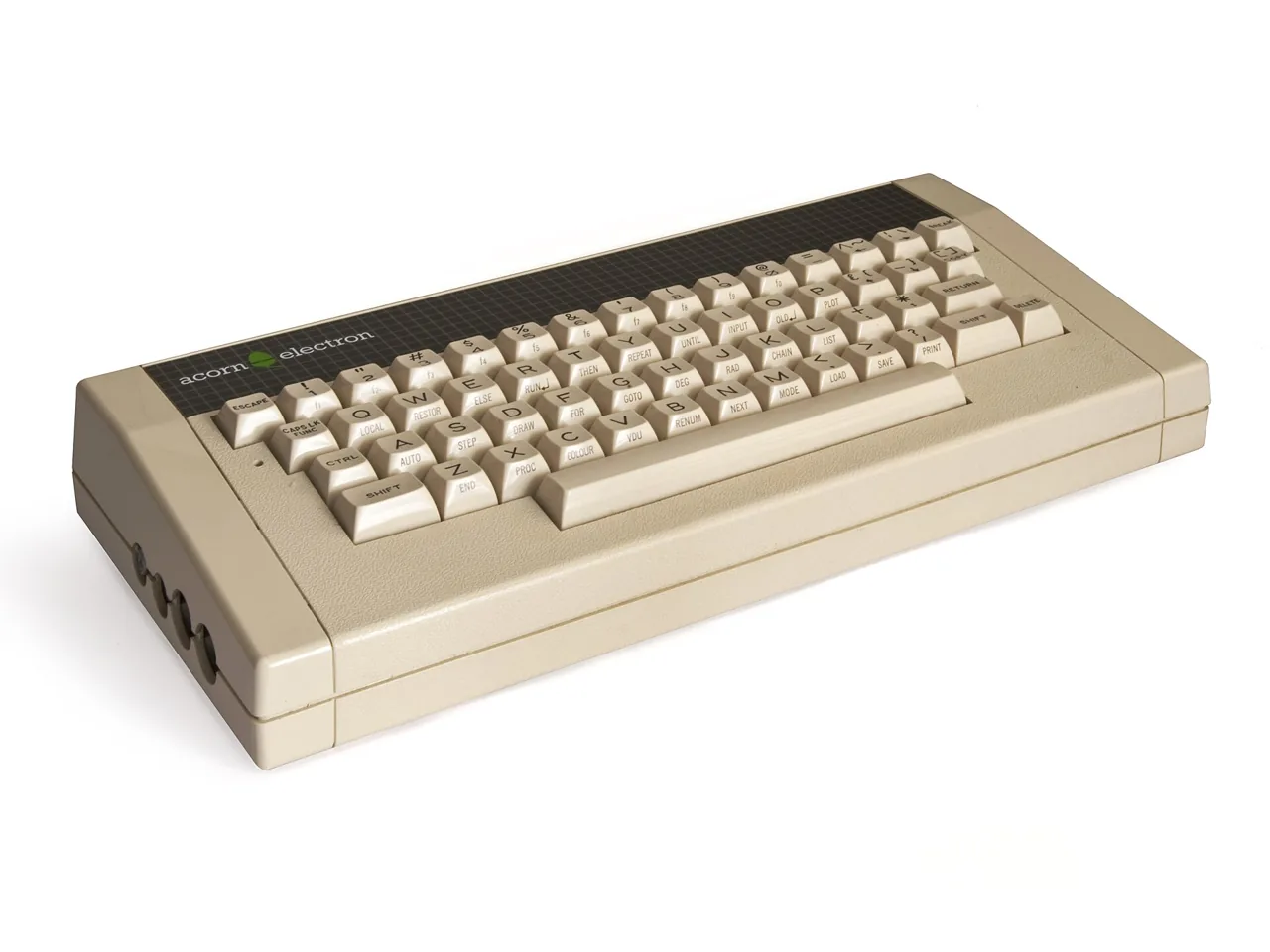
The Electron shipped with a 2 MHz 6502 microprocessor and 64K bytes of memory: 32K ROM holding the Machine Operating System and a BASIC interpreter, and 32K RAM3. Approximately 3½K of RAM was reserved for system use, leaving the remainder for display and programs3. Despite its budget positioning, the machine used a higher discrete component count than typical for its class, with two printed circuit boards: the main logic board and a separate power supply board, a design carryover from the BBC Micro512. The main board centered on a large square-format ULA chip, accompanied by a 6502A CPU, a BASIC ROM identical to the BBC’s Basic II, a 16K EPROM for the operating system, and four 64k-bit dynamic memory chips configured to emulate eight 32k-bit devices, a method that incurred a speed penalty512. This arrangement left users with 17.75K of free memory in display mode 6, dropping to 5.75K in mode 2, identical to the BBC Micro’s constraints512.
Video output was provided in multiple forms: a UHF modulated PAL signal on channel 36, delivered via a phono connector and a two-meter lead for domestic television use3; a composite video phono output for monitors3; and a DIN connector supplying TTL-level R/G/B/sync for direct-drive colour monitors3. Seven display modes were supported, mirroring the BBC Micro’s Modes 0–638. A built-in paddle connector allowed direct attachment of analogue controllers39. The machine launched with BBC BASIC, Assembler, and sound capabilities inherited from the BBC Micro8, and software from Acornsoft, Acorn’s own software division, was immediately available, including games and educational titles39. Future software plans included technical, scientific, and graphics-intensive programs39.
The official launch took place on 23 August 1984, ahead of the Acorn User Show, orchestrated by advertising agency Quentin Bell and featuring television personalities Wendy Craig and Cliff Michelmore5. The event included a themed "Electron Fizz" cocktail and a rock cake inscribed with the machine’s name5. Despite enthusiastic reception, Which Micro? called it "a winner" and "probably, for the price, the most advanced personal computer on the market"11, Acorn faced immediate component shortages, leading to production bottlenecks and forcing retailers like W.H. Smith to display "Out of stock" posters67. By 1985, production was shut down2, though no exact discontinuation date is recorded in surviving documentation.
Though no successor models followed, Acorn developed expansion hardware to extend the Electron’s capabilities. An expansion box, expected by Easter 1985, promised printer, joystick, and ROM cartridge support via the rear edge connector67. A dedicated cartridge ROM socket was also planned, conceptually similar to those on systems like the Atari VCS6. The eventual Plus 1 expansion introduced cartridge slots to the Acorn product line4, and its cartridges, though pin-compatible with minor changes, were often interchangeable with those for the later BBC Master 128, particularly for software not dependent on specific hardware4. A disc interface was under consideration but not released at the time of the sources6.
The Electron was marketed as Acorn’s "home" computer, distinct from the BBC Micro series, though derived from the earlier Proton prototype that became the BBC Microcomputer8. While it lacked the BBC Micro’s institutional foothold, its limitations, particularly the scarcity of compelling games, may have steered users toward programming2. However, by early 1985 it was described as "inadequate in the face of strong competition," and Acorn’s refusal to engage in price-cutting left it vulnerable15. At £602, it offered remarkable technical parity with the BBC Micro for less than half the cost, but supply issues and market dynamics ultimately curtailed its impact.
Specifications
| Release Date | September 1984 |
| Manufacturer | Acorn Computers |
| CPU | 2 MHz 6502 microprocessor |
| Memory | 32K RAM, 32K ROM (16K EPROM + 16K ROM) |
| Display Output | UHF (PAL, channel 36), composite video (phono), RGB/TTL (DIN) |
| Display Modes | 7 (Modes 0–6) |
| Input | Built-in paddle connector |
| Software Environment | BBC BASIC, Machine Operating System |
| Expansion | Rear edge connector for expansion box; cartridge support via Plus 1 |
| Original Price | £60 |
References
- Your Computer Issue 046 (1985 05)(IPC Electrical-Electronic Press)(GB) (1985)
- Computers that made Britain v1
- Archive item #iv07
- full
- beebugv0205
- beebugv0209
- beebugv0209
- Personal Computing Today (1983-11) (1983)
- Archive item #iv07text
- AcornUser037-Aug85
- Creative Assembler (Griffiths, 1984) (1984)
- beebugv0205
- Me & My Micro
- Personal Computing Today Aug 1982 (1982)
- PersonalComputerNews099-16Feb1985 (1985)