Amstrad CPC 6128
Amstrad shipped the CPC 6128 in August 1985 as a disk-equipped 128K home computer with CP/M 3.1, targeting both office tasks and home use across Europe and North America.
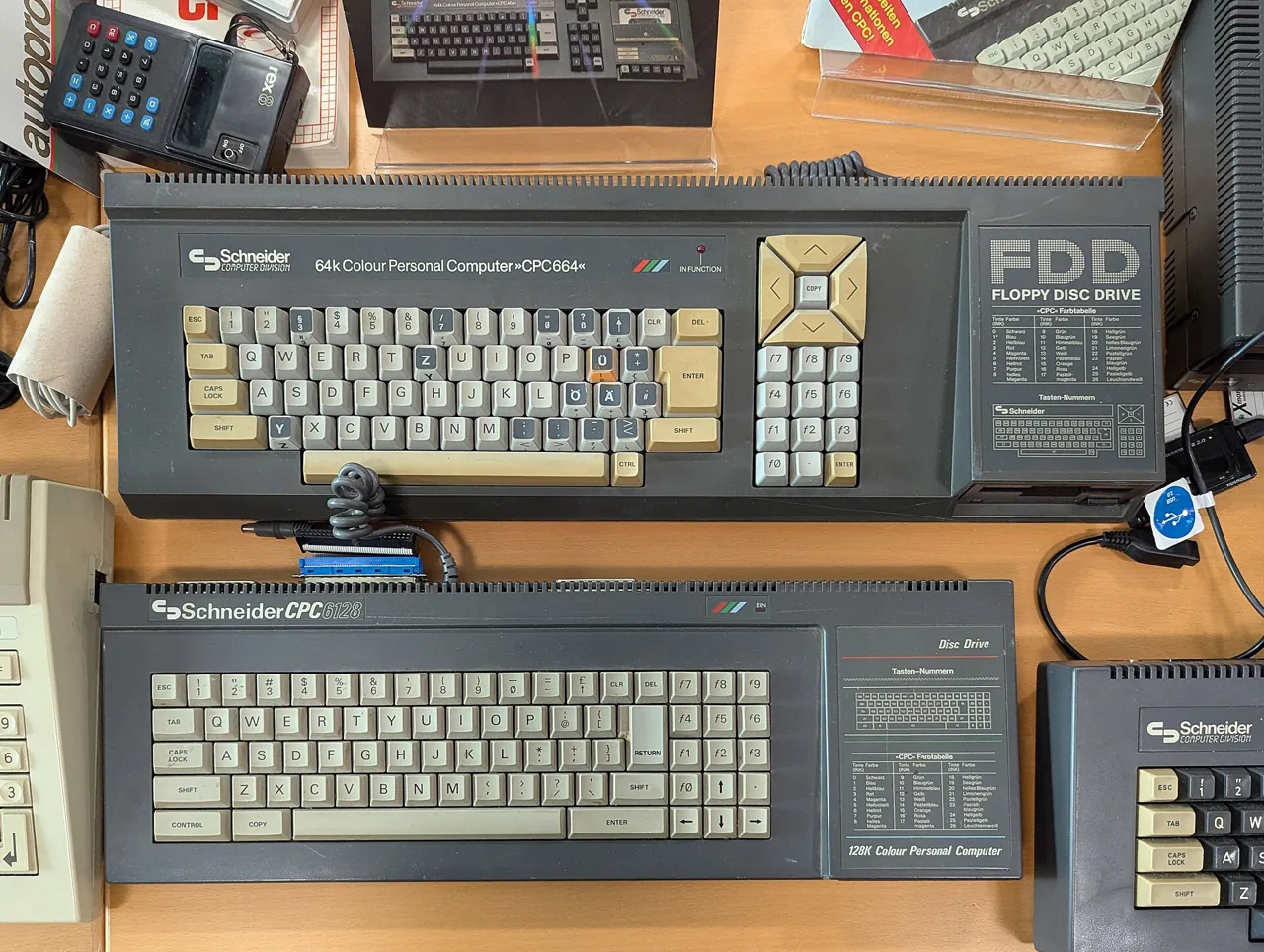
The CPC 6128 arrived not as a clean-sheet design but as the second successor in Amstrad’s CPC line, following the CPC 464 and the short-lived CPC 6641. The 664 featured an integrated 3-inch floppy disk drive, while the 6128 committed fully to disk: a built-in 3-inch floppy drive shipped standard61415. This was no minor upgrade. The drive provided access to nearly 1,000 professional CP/M applications, including dBaseII and Multiplan, which ran without adaptation1015. The machine shipped with CP/M Plus (CP/M 3.1), chosen specifically because it could manage the 6128’s two 64K RAM banks, unlike CP/M 2.2, which was limited to a single bank110.
Despite the Z80A microprocessor’s 64K addressing limit, the system delivered 128K of usable RAM by bank-switching between two 64K segments1. ROM held 48K of resident BASIC and operating system firmware15. The display controller was a 6845, paired with either a green monochrome monitor (GT-65) or a full-colour CTM-644 unit15. Sound came from the AY-3-8912, a three-voice, eight-octave generator15. In France, the keyboard followed AZERTY layout with a separate numeric keypad and cursor block15.
Amstrad initially released the 6128 exclusively in the US in August 1985, priced at $699 or $799 depending on monitor choice6. In the UK, it retailed at £299 with a monochrome screen or £399 with colour6, though one alternate listing priced the monochrome version with disc drive and printer at £299, suggesting bundle variability4. German buyers paid 1,598 Deutsche Mark for the 128K system, a figure hailed at the time as a milestone given the spec10. In France, the base system cost 2,790 or 3,690 francs depending on monitor, while a full "pack familial" with printer and station micro reached 4,395 francs3.
Design & Compatibility
The machine emphasized plug-and-play readiness: "With a single cable to plug into the mains, the 6128 system is ready to operate"1112. It was sold in Germany under the Schneider brand, continuing a distribution partnership1. Backward compatibility was a selling point: every CPC 664 program ran without restriction on the 612810. But forward compatibility faltered. Some later 6128 units shipped with altered connectors, breaking compatibility with existing expansions8. This provoked criticism: owners of CPC 464s considering an upgrade were warned to "think twice" if they already owned peripherals8.
Supply issues plagued the early rollout. Shop availability, especially of colour models, was described as "more than problematic"8. The CPC 664 was discontinued around the same time, a controversial move given its transitional role toward the 61286.
Legacy & Successors
At launch, the 6128 was projected to become the strongest model in the CPC series due to its minimal price premium over the 66410. It bridged markets: marketed as the first micro capable of serving needs "from sixth grade to the office or the shop"15. CP/M Plus support extended its utility, and the CP/M Plus Handbook published by Digital Research in 1987 covered both the CPC 6128 and the PCW 8256, signaling its role in Amstrad’s broader business ecosystem7.
The line evolved again in 1990 with the 6128 Plus, which dropped the "CPC" prefix and added a cartridge slot, shifting focus toward gaming6. That model sold for £329 (mono) or £429 (colour)6. The CPC range, including clones, was discontinued later that year6.
Specifications
| CPU | Z80A microprocessor |
| RAM | 128K total (two 64K banks) |
| ROM | 48K (BASIC and OS) |
| Storage | Built-in 3-inch floppy disk drive |
| Display controller | 6845 |
| Sound chip | AY-3-8912 (3-voice) |
| Operating system | CP/M 3.1 (CP/M Plus) |
| Keyboard | AZERTY with separate numeric keypad and cursor block (FR model) |
| Monitor options | Monochrome GT-65 or colour CTM-644 |
| Release date | August 1985 |
| Initial markets | Launched in US first |
| Manufacturer | Amstrad (Schneider in Germany) |
References
- Der SCHNEIDER CPC6128(Jurgen HUCKSTADT)(acme)
- 24 Schneider PC International 1987-02 (1987)
- AMSTRAD CENT POUR CENT 12 1989-02(acme) (1989)
- AcornUser047-Jun86
- CPC 32(acme)
- Computers that made Britain v1
- 8BIT MART 04[OCR]
- CPC 24(acme)
- AMSTRAD CENT POUR CENT 07(acme)
- 10 Schneider CPC International 1985-12 (1985)
- Amstrad Semanal 013
- Amstrad Semanal 013
- AMSTRAD CENT POUR CENT 33 1991-01(acme) (1991)
- Computer And Video Games Issue 049 Nov 85
- AMSTRAD CENT POUR CENT 23 1990-02(acme) (1990)
- Γλώσσα μηχανής για αρχάριους στον Amstrad (Steve Kramer)