Coleco Adam
Coleco Industries’ Adam was a home computer system released in late 1983 that bundled a daisywheel printer, tape storage, and 80K RAM for under $600, marketed as an all-in-one solution for word processing, gaming, and CP/M compatibility.
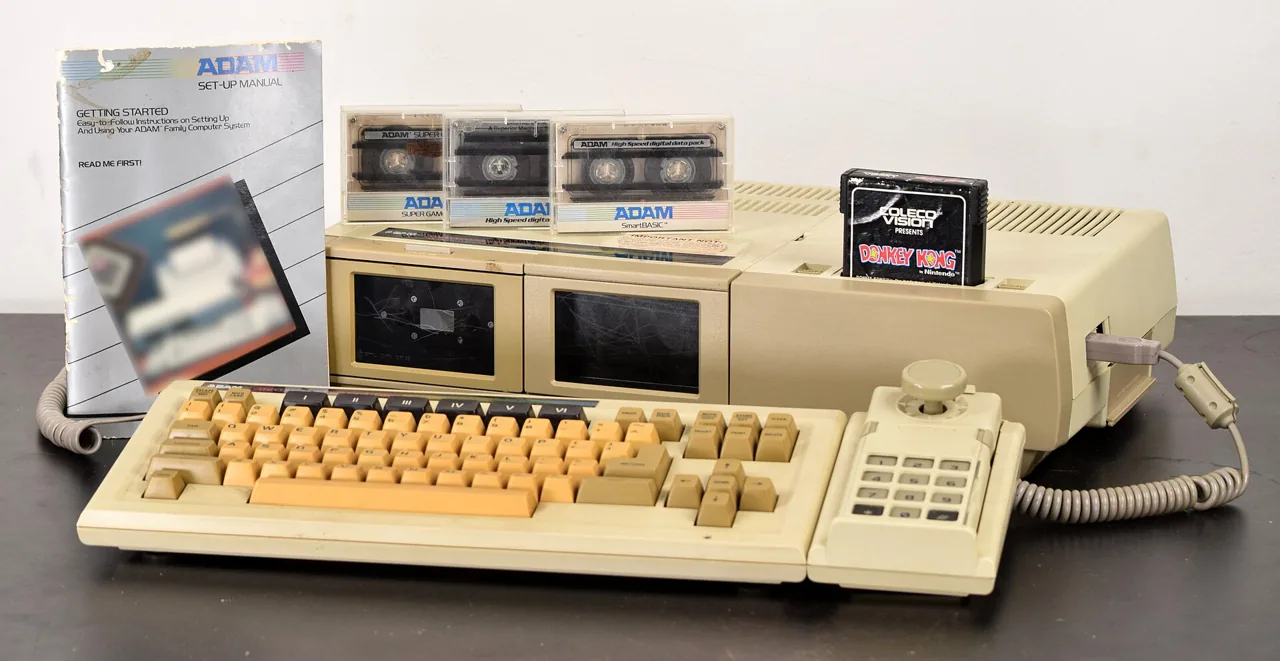
The Adam arrived amid fanfare as a fully integrated home computer system, unusual for including a letter-quality daisywheel printer and data storage drive in the base package34. Coleco Industries positioned it as answering consumer demand for a machine that could handle productivity, education, and entertainment without costly add-ons4. Its advertised price hovered around $600, though later reports noted a rise to approximately $75031216, still undercutting many competitors by a wide margin. BYTE magazine claimed the nearest equivalent system cost three times as much6.
The Adam used a Zilog Z-80A microprocessor as its main CPU39, with 80K of user-accessible RAM standard, expandable to 144K via add-on modules47. The system relied on a proprietary digital data-pack drive, a high-speed tape mechanism Coleco claimed matched floppy disk transfer rates at lower cost through "Fastransfer" circuitry5. A 5¼-inch double-sided, double-density disk drive with 360K capacity was promised for less than $400 and expected in 19841315. The included daisywheel printer supported tractor-feed via an optional $125 accessory15, and the 75-key typewriter-style keyboard featured full-travel sculptured keys and six special-function keys34.
One of the Adam’s more peculiar design choices was its distributed processing architecture: in addition to the main Z80A, separate processors were embedded in the keyboard, printer, and storage drives9. These components communicated via a proprietary bus Coleco dubbed "Adam-Net"9. The system shipped with built-in BASIC and a word processor developed by InfoSoft8, and the BASIC interpreter was reportedly so close to Applesoft that programs could be transferred between Adam and Apple II systems without modification7.
Gaming compatibility was a major selling point: the Adam could run all ColecoVision cartridges34, and the included controllers doubled as cursor-control devices7. An adapter for Atari VCS 2600 cartridges was also planned12. The system launched with Buck Rogers Planet of Zoom on data pack412, and Coleco promised a library of CP/M software on data packs, including productivity tools like SmartFiler, financial managers, and educational titles based on Dr. Seuss and The Smurfs5. Third-party developers such as Sirius and Sierra released software in the Data Storage format11, while Synapse and Epyx planned to release games on diskette for Adam in 198413.
CP/M compatibility was advertised, though not natively. Digital Research’s Personal CP/M operating system was to be available on disk or data pack15, and accessories would enable its use12. InfoSoft’s I/OS, a CP/M-compatible operating system, was developed for the ColecoVision Computer Module, suggesting a shared software lineage8.
Despite the ambitious packaging, the Adam’s rollout was plagued by delays, missing the 1983 Christmas season, a failure some contemporaries believed could doom the product3. Stockholder lawsuits followed, accusing Coleco of concealing technical and production difficulties10. The company’s stock halved from its pre-announcement peak10, and advertising budgets were slashed by $4 million10.
Reception was sharply divided. Some praised its integration and value6, but others found it underwhelming. One 1984 review concluded the Adam was “really no better than the standard ColecoVision console and in some respects, worse,” criticizing its game performance and questioning the quality of future software14. The claim that it was “the most sophisticated video game playing machine” ever made was dismissed outright14.
An expansion path existed for existing ColecoVision owners: Adam could be added as a module, transforming the game console into a full computer57, with upgrade kits priced under $4004. This tight coupling highlighted Coleco’s strategy of leveraging its gaming success to enter the home computer market, but it also tied the Adam’s fate to the limitations of that legacy hardware.
Ultimately, the Adam stands as a machine of bold bundling and questionable execution. It delivered more hardware per dollar than nearly any contemporary, but its reliance on tape storage, distributed CPU architecture, and delayed launch undermined its potential. The surviving documentation is silent on key technical details, such as clock speed, ROM size, display resolution, sound hardware, dimensions, and final sales figures, leaving gaps in the record that primary sources have not filled.
References
- Telly Turtle manual Colecovision Adam 1984 (1984)
- Richard Scarry's Best Electronic Word Book Ever-manual-Coleco-Adam-1984 (1984)
- Introducing IBM PCjr
- Electronic Games Issue 22 Vol 02 10 1983 Dec (1983)
- logical gamer jul83
- 1984 08 BYTE 09-08 Modula-2 (1984)
- Electronic Fun Computer and Games Vol 01 10 1983 Aug (1983)
- logical gamer aug83
- Archive item #198308
- logical gamer novdec83
- Electronic Games Issue 33 Vol 03 09 1984 Nov (1984)
- Compute Issue 039 1983 Aug (1983)
- Computer Fun Issue 01 1984 Apr (1984)
- Electronic Fun Computer and Games Vol 02 05 1984 Mar (1984)
- 1984 03 BYTE 09-03 Simulation (1984)
- Electronic Games Issue 21 Vol 02 09 1983 Nov (1983)