Commodore Amiga 4000
Commodore’s final high-end desktop Amiga, released in multiple configurations with Motorola 68030 and 68040 processors, AGA chipset, and Zorro III expansion, representing both the peak of Amiga engineering and its commercial unraveling.
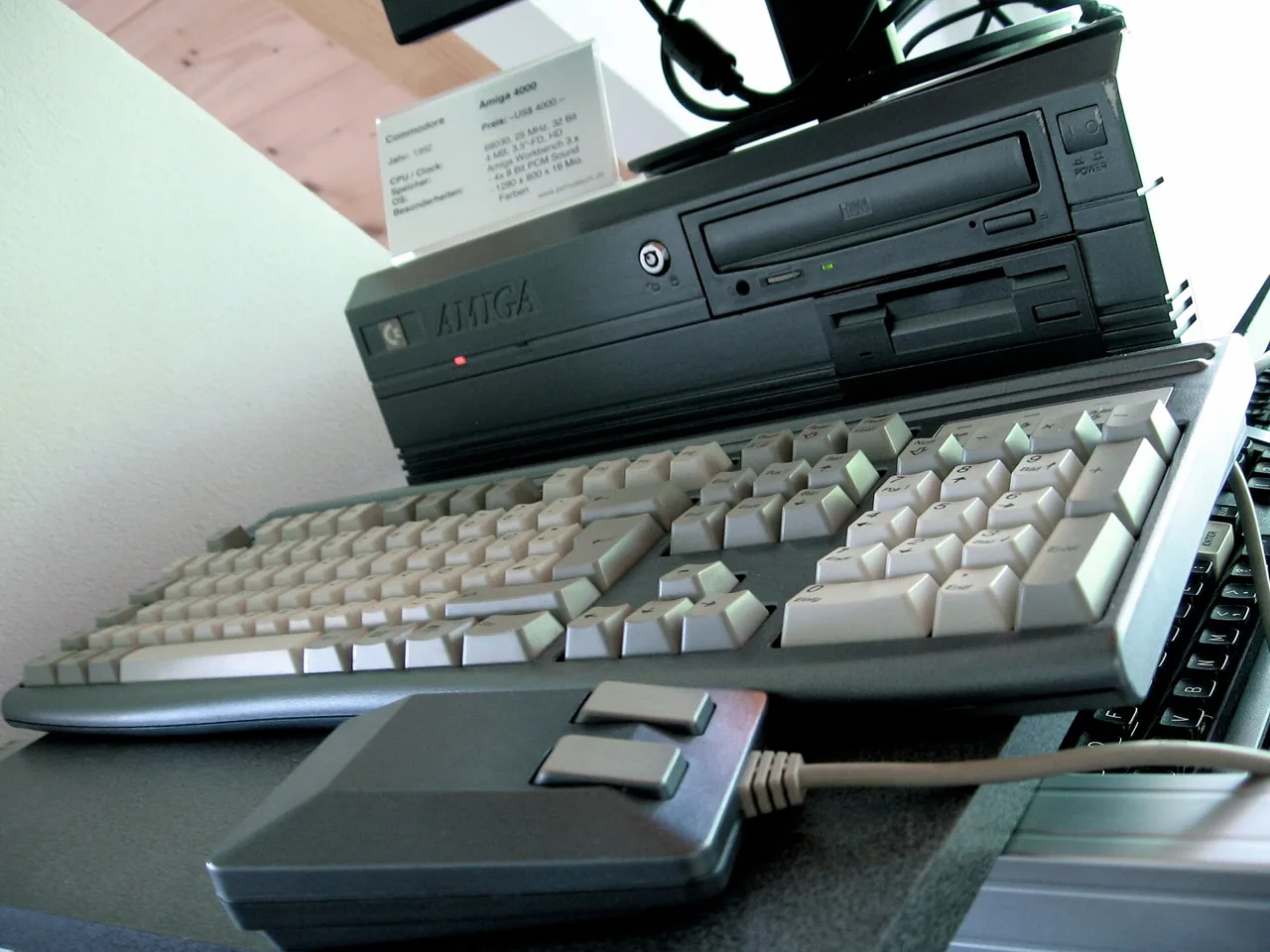
The Amiga 4000 arrived not as a clean break but as a culmination of Commodore's high-end Amiga development7. It shipped with the AGA chipset, internally designated Alice and Lisa, which reportedly delivered a tangible performance leap over earlier custom chips when paired with AmigaDOS 3.03. The motherboard included an internal IDE controller, enabling high-speed storage access6.
Processor options defined its variants: the A4000/030 used a 68030ec CPU at 25 MHz7, while the A4000/040 upgraded to a 68040. Memory configurations varied widely; the system supported optional chip and fast RAM configurations expandable to 16 MB on the motherboard7. The system distinguished between Chip-RAM and Fast-RAM, with configurations such as 2 MB Chip-RAM and 4 MB Fast-RAM appearing in bundled systems12. SIMMs were 32-bit, available in 2 MB and 4 MB densities45.
Expansion was anchored by Zorro III slots: 4 to 16/32-bit slots, according to one source7. A 16-bit Zorro bus design minimized CPU load during data transfers6. A 32 KB 16-bit cache memory further reduced CPU burden6. The system included nine total interfaces7. A 10 Mbit Ethernet card, compatible with the Commodore A2065 and SANA-II drivers, allowed network booting via integrated BOOT-ROM, and was available as an add-on for the A40006.
Storage configurations included 120 MB and 250 MB hard drives in early models89, with later tower versions supporting SCSI drives up to 4 GB11. CD-ROM options included 4x ATAPI and 8x SCSI drives12. The operating system was typically AmigaOS 3.1, bundled with manuals and software12.
Tower Variants and Third-Party Assembly
The Amiga 4000 T (also A4000T) marked a shift in production strategy. After Commodore’s decline, QuikPak Corp., a Canadian firm, took over manufacturing and distribution of the A4000T in spring 1995 following Escom’s acquisition of the Amiga line11. QuikPak, already experienced in chip production and hardware testing, assembled systems with configurations such as 6 MB RAM and 850 MB SCSI HD, priced at $1,997 for the 68040 version11. Higher-end models with 68060 processors, up to 34 MB RAM, and 4 GB SCSI drives reached $3,99911.
Eagle, a German systems integrator, also produced Amiga-based systems under license, a departure from Commodore’s previous policy of exclusive in-house manufacturing12. The Eagle 4000 TE used Amiga 4000 motherboards but allowed customization: buyers received the board and standard accessories, excluding processor cards, drives, and memory12. Eagle offered configurations with the original 68040/25 MHz processor from AMIGA Technologies or a Cyberstorm Mark 2 68060/50 MHz card12. Graphics options included the CyberVision card2, and one bundle included a 1 GB Seagate EIDE drive and 4x ATAPI CD-ROM, priced at 3918 Mark12.
Market Reception and Contradictions
Despite criticism, the A4000 was received with “redelijk enthousiast” enthusiasm in the Amiga community, praised for making a “echte sprong voorwaarts” in graphical capability for the first time since the A10003. One reviewer called it “the greatest development to the Amiga since its conception in 1985”7. Yet this acclaim was not universal: another account states the machine “fand wenig Gegenliebe bei den Käufern von Anfang an”1415. The A4000/040, while technically superior, was criticized for being so similar to the /030 model that “any comments or criticisms… equally apply”7.
Software compatibility extended beyond native applications. Emulation packages allowed running PC 386/486, Atari ST, and C64/128 software, with future support promised for SNES and Mega Drive3. A specific PC emulation package, version 4.0, enabled Windows 3.11 and MS-DOS within an Amiga window, storing files on the Amiga’s hard disk10. Version 4.0 of that software required at least a 68020 processor and introduced 486 emulation10.
Commodore teased future developments: at the time of the A4000’s release, the company was reportedly working on CD-ROM support and had announced the upcoming AAA chipset3. These promises, like the machine itself, arrived at the edge of collapse. They were ambitious, technically sound, but commercially adrift.
References
- Amiga Magazin 1996-07 (1996)
- Amiga Magazin 1996-07 (1996)
- Amiga Magazine-25 met Cognition en Metins Software Story
- Amiga Magazine-28 met Metins artikel over demos
- Amiga Magazine-28 met Metins artikel over demos
- Amiga Computing Issue 105 Nov 96
- CUAmiga 046 Dec 1993 (1993)
- Amiga Joker 1993 12 (1993)
- Amiga Joker 1993 12 (1993)
- Amiga Computing Issue 101 Jul 96
- Amiga Advis (1997 01)(Dea Media)(DA)(300dpi) (1997)
- Amiga Computing Issue 100 Jun 96
- Amiga Joker 1994 11 (1994)
- Amiga Joker 1994 11 (1994)