Commodore Amiga 500
Commodore’s mass-market Amiga 500 shipped with 512K RAM, a built-in 3.5" floppy drive, and Workbench 1.3, targeting home users through aggressive trade-up pricing as low as $299.95 by 1992.
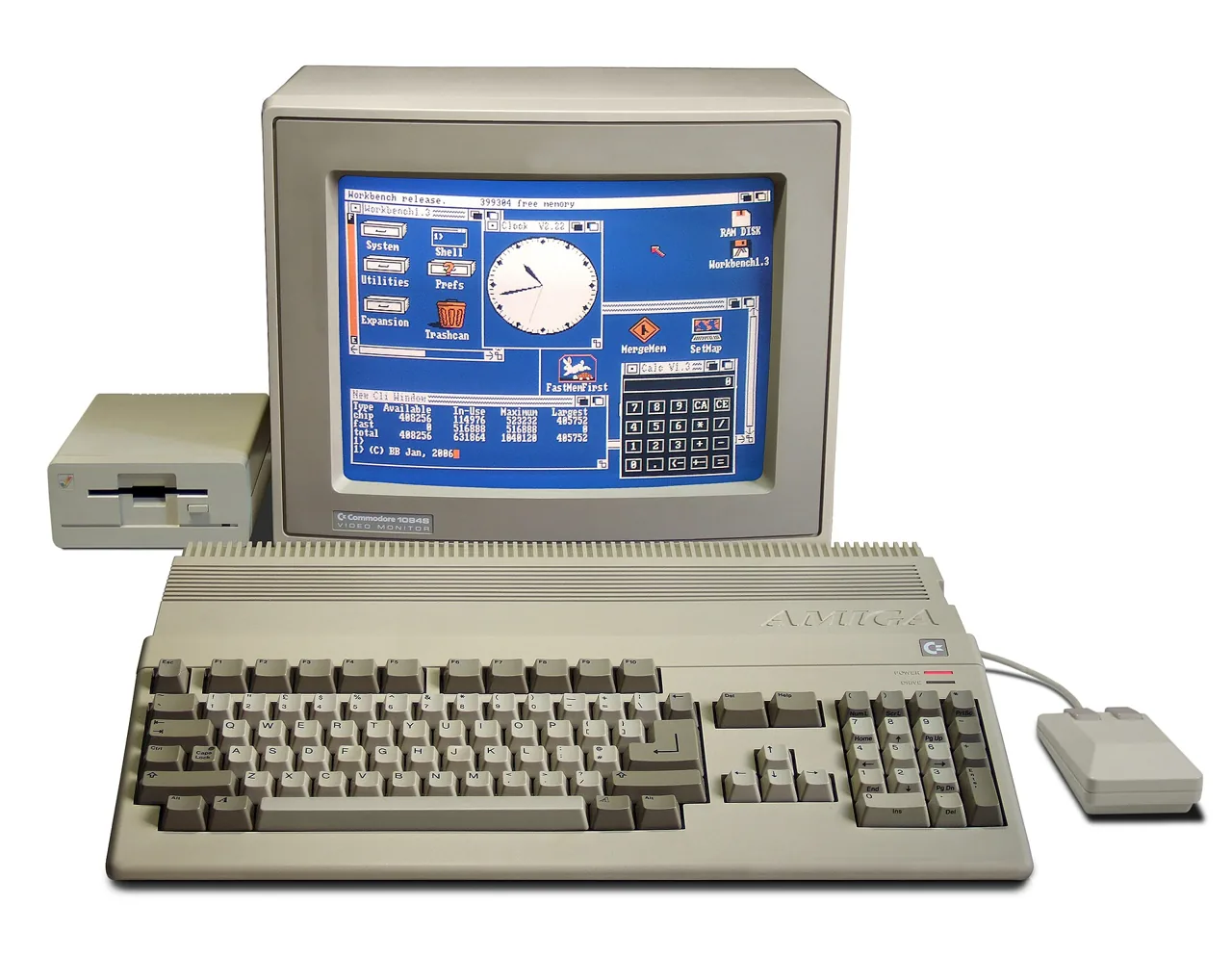
By the early 1990s, the Amiga 500 had become the face of Commodore’s consumer push, positioned not as a raw performer but as a self-contained multimedia appliance. Its standard configuration, 512KByte RAM, built-in 3.5" floppy disk drive, Amiga Mouse, joystick, and power adapter, arrived ready for immediate use without mandatory add-ons12. The bundled software suite, including KindWords word processor, FusionPaint, and commercial titles like Indiana Jones and the Last Crusade and F/A-18 Interceptor, framed the machine as equally capable in productivity and entertainment2. Workbench 1.3 served as the graphical operating environment, supplemented by Workbench 1.3 Extras2.
Pricing evolved dramatically in its later years. While early 1991 listings showed a special price of $549.00, Commodore-authorized promotions allowed owners of older Commodore systems, such as the VIC-20, 64, 128, or Plus/4, to upgrade to an Amiga 500 for $399, a deal extended through December 31, 19912. TENEX claimed credit for breaking the $400 barrier and, in 1992, offering the first Amiga 500 under $300, at $299.951. In the UK, configurations like the A500 1Mb Cartoon Classics sold for £379.99, while the First Steps bundle reached £459.999.
Despite its integrated design, expansion was both anticipated and fragmented. Commodore reportedly had no plans to produce its own RAM expansions or hard drives for the A500, leaving the market to third parties16. The A501 memory expansion module, 512KByte with real-time clock/calendar, plugged directly into the side port without disassembly, bringing total RAM to 1MByte12. Alternatives included the SupraRAM 500, Microbotics m501s, and the RC500 RAM expansion priced at $49289. Larger upgrades like the SuperRam 500RX supported up to 8MByte using ZIP RAM and featured AutoConfig9. Hard drive options such as the HD8+0/42F-II were offered at $519.00 as part of a starter bundle2, and the AMIGA 600 30 MB Harddisk appeared in contemporaneous listings, though its direct compatibility is unconfirmed67.
Peripherals extended the A500 into video production and external storage. The optional A520 TV Modulator provided RF and composite outputs, enabling connection to televisions or VCRs19. The 1084S color monitor, sold with a special bundle price of $299.95 when paired with the A500, supported composite input and could also serve Commodore 64/128 systems with a separate cable19. External drives like the MASTER 3A1 (880K) and A1011 (1MByte) offered additional storage89. Genlock devices, Pal-Genlock, Y-C-Genlock, and Sirius-Genlock, all bundled with Scala 500 Junior, enabled video overlay work67.
Marketing materials in Germany promoted the Amiga 500 as "die neue Computergeneration der neunziger Jahre" and "ein supermoderner Computer," emphasizing ease of use via mouse and capabilities across text, graphics, animation, speech, and music11. The design philosophy was explicitly human-centered: "Der Mensch im Blickpunkt der Technik"11. Rumors circulated in 1989 of a potential redesign separating the keyboard and system unit, akin to the Amiga 1000, but Commodore was expected to retain the one-piece form to control costs16.
The Amiga 500 shared product space with the Amiga 2000, 2500, and later the Amiga 600, 1200, and 500Plus in European catalogs5679. It was eligible for the Amiga Power Up Program, allowing trade-ins toward an Amiga 300034. Byte Magazine recognized the platform’s cohesion, calling the Amiga "the most complete multimedia platform you can get in a single box"34. Cabinet solutions like the MINI-TOWER-Gehäuse, complete with power supply, hinted at enthusiast-driven rehousing efforts for the A500 and A500Plus67.
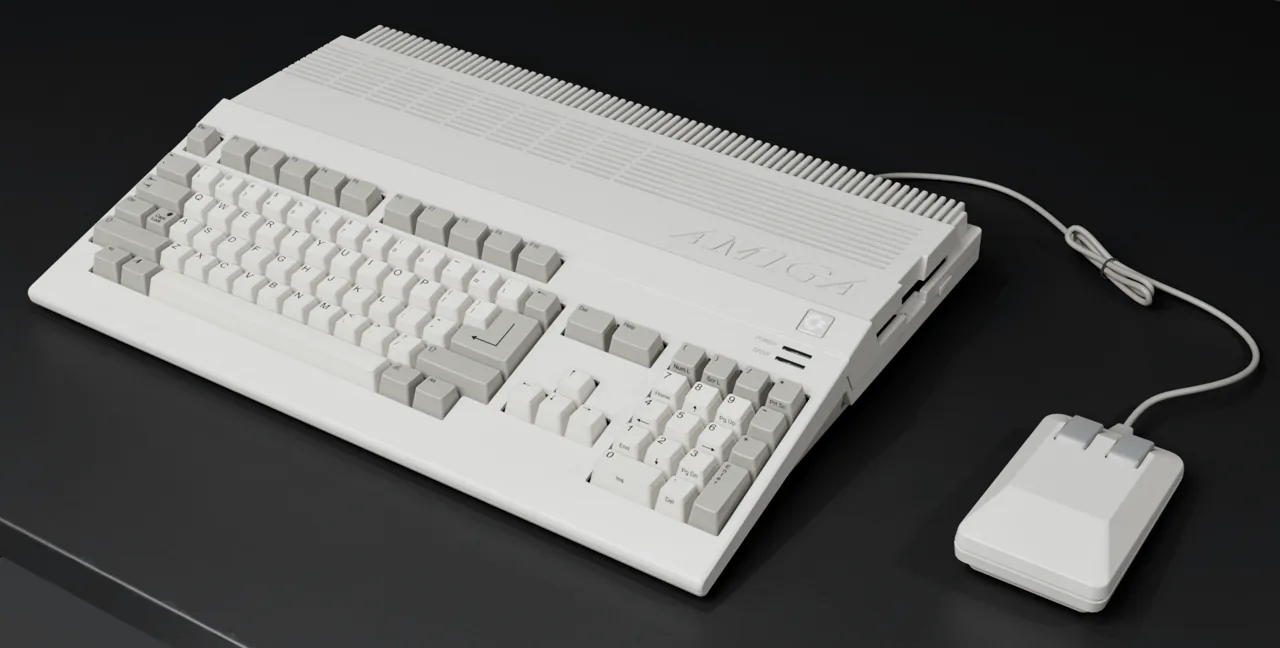
Original:dark_igorek, CC BY 4.0, via Wikimedia Commons. source
References
- TheEverythingBookForCommodoreAndAmigaComputersmid-summer1992 (1992)
- TheEverythingBookForCommodoreAndAmigaComputersholidayEdition
- Amiga World Issue 058 1991 07 IDGC I (1991)
- Amiga World Issue 058 1991 07 IDGC I (1991)
- TheEverythingBookForCommodoreAndAmigaComputerssummer1989 (1989)
- Amiga Joker 1993 12 (1993)
- Amiga Joker 1993 12 (1993)
- Amiga World Issue 059 1991 08 IDGC I 300dpi (1991)
- Amiga Computing Issue 042 Nov 91
- TheEverythingBookForCommodoreAndAmigaComputersfall1992 (1992)
- Amiga-Fever-Steckt-Alle-An
- Compute Issue 104 1989 Jan (1989)