Commodore PET 2001-8
Commodore shipped the PET 2001-8 as its first widely available personal computer, an 8K BASIC machine in a white metal case, delivered to early customers in October 1977 after a last-minute shift from a planned 4K model.
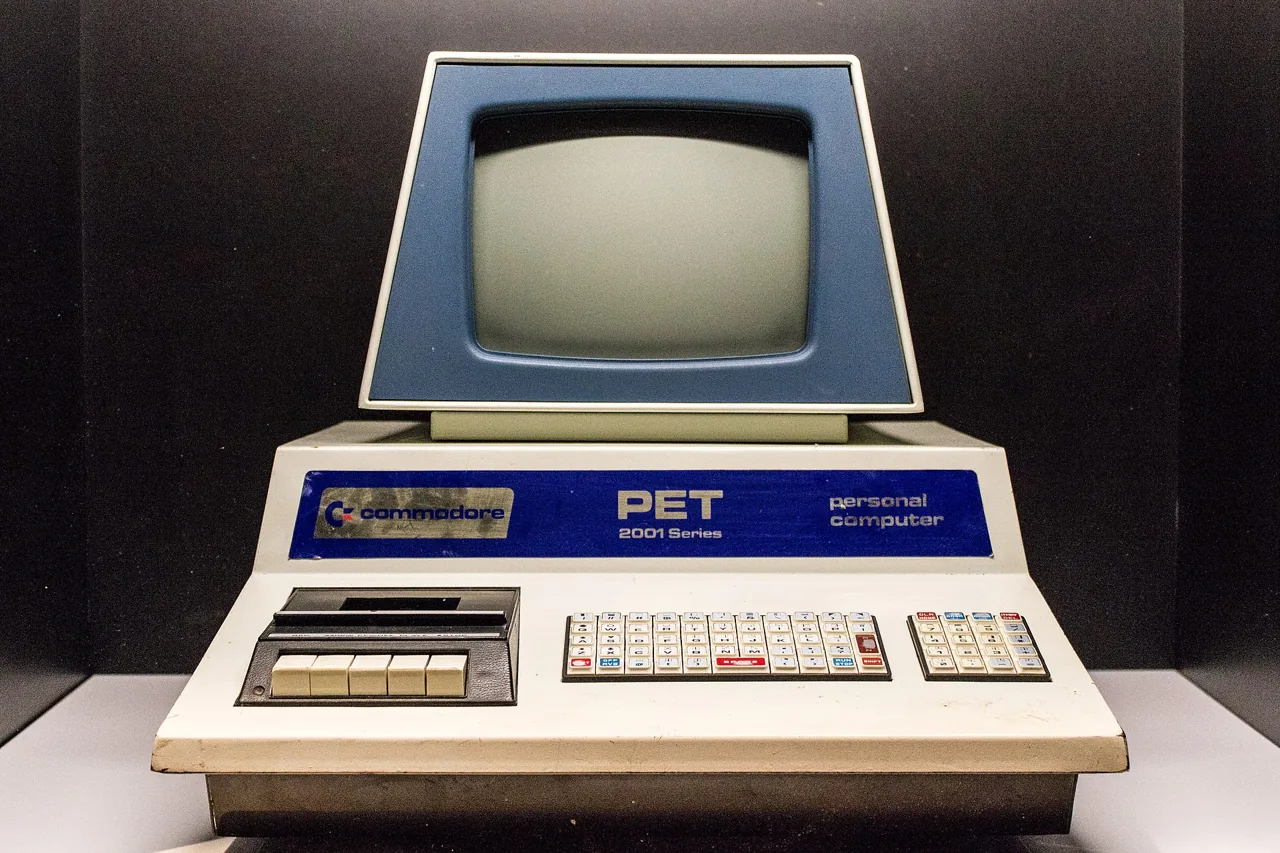
The PET 2001-8 materialized not through marketing fanfare but through logistical improvisation. One of the earliest documented units, serial #0010081, arrived in New Haven on October 25 after a cross-country journey from Palo Alto, having been rerouted from an initial 4K configuration when Commodore informed buyers in late September that only 8K versions would ship, offering either a $200 upgrade or a refund1415. This pivot, executed mid-delivery, reflects the machine’s status as a first-run product forged in supply constraints rather than consumer research. The final unit measured 17½" wide, 19" deep, and 15½" high, weighed about 37 pounds, and rested on feet spaced to require only a one-foot-square surface for stability14. Its case, painted white metal, gave it the appearance of laboratory equipment more than a home appliance1415.
The PET 2001-8 ran BASIC in 8K of RAM, a configuration explicitly supported by software such as MEM-EXPLORER, which required at least 8K and used Microsoft PET BASIC with embedded 6502 machine-language routines9. The machine was compatible with METRIC-CALC™, a BASIC-based system designed specifically for the 2001-8 or a 2001-4 augmented with an external 4K memory unit23. Despite its minimal memory, the 2001-8 served as the foundation for a suite of technical workbooks covering string handling, graphics, cassette I/O, and logic operations including GOSUB and ON X1. These documents treated the PET not as a toy but as a teachable system, with structured curricula implying an educational or professional target audience.
Peripherals expanded its utility beyond standalone computation. The PET 2022 printer, a dot matrix unit with tractor feed and full graphics support, allowed forms handling on plain paper, while the PET 2023 offered similar capabilities23. The PET 2040 Dual Drive Mini Floppy Disk system provided 343K of usable storage, an intelligent peripheral that offloaded disk management tasks3. For connectivity, the PET to IEEE Cable sold for $39.95, and an external cassette unit or second C2N cassette could be added for $9556. A retrofit kit, the ROMRETRO KIT, offered an updated operating system for $906. The Commodore Service Kit, priced at $24.95, suggested Commodore anticipated field maintenance5.
The 2001-8 was explicitly labeled the "original PET" in contemporary documentation, distinguishing it from later variants such as the 2001-16B and 2001-32N, which featured typewriter-style keyboards and increased memory7810111213. The 2001-8KN, with large keys, carried the same $795 price as the standard 2001-8K6. Word processing software such as Commodore Word Pro II and III was available for the original 2001-8, indicating efforts to position it for business use despite its limited memory7810111213. Accessories like Petunia, a $29.95 music-playing add-on, and the Video Buffer, which enabled secondary display output, were sold individually or as a Combo package5.
After receiving endless complaints about the calculator-style keyboard of the original PET 2001, Commodore released models with a full-size keyboard4. The integrated cassette drive, standard on the 2001-8, disappeared in subsequent revisions, suggesting a transitional design4. The motherboard and interface PCB for the 2001-8 were available separately for $80, indicating Commodore supported component-level replacement or replication7810111213.
References
- 1979 08 BYTE 04-08 LISP (1979)
- micro 14 jul 1979[ocr] (1979)
- MICRO Vol14-7 79
- Computers that made Britain v1
- micro 16 sep 1979[ocr] (1979)
- 1980 04 BYTE 05-04 Printed Software Becomes a Reality (1980)
- MICRO Vol25-6 80
- micro 25 jun 1980[ocr] (1980)
- MICRO Vol18-11 79
- MICRO Vol20-1 80
- micro 21 feb 1980[ocr] (1980)
- micro 20 jan 1980[ocr] (1980)
- MICRO Vol21-2 80
- micro 02 dec 1977[ocr] (1977)
- MICRO Vol02-12 77