Commodore Plus/4
Commodore introduced the Plus/4 in June 1984 as a 64K RAM home computer with built-in productivity software, marketed alongside the C-16 but incompatible with the C-64, and priced at £299 in the UK and $299 in US department stores4891016.
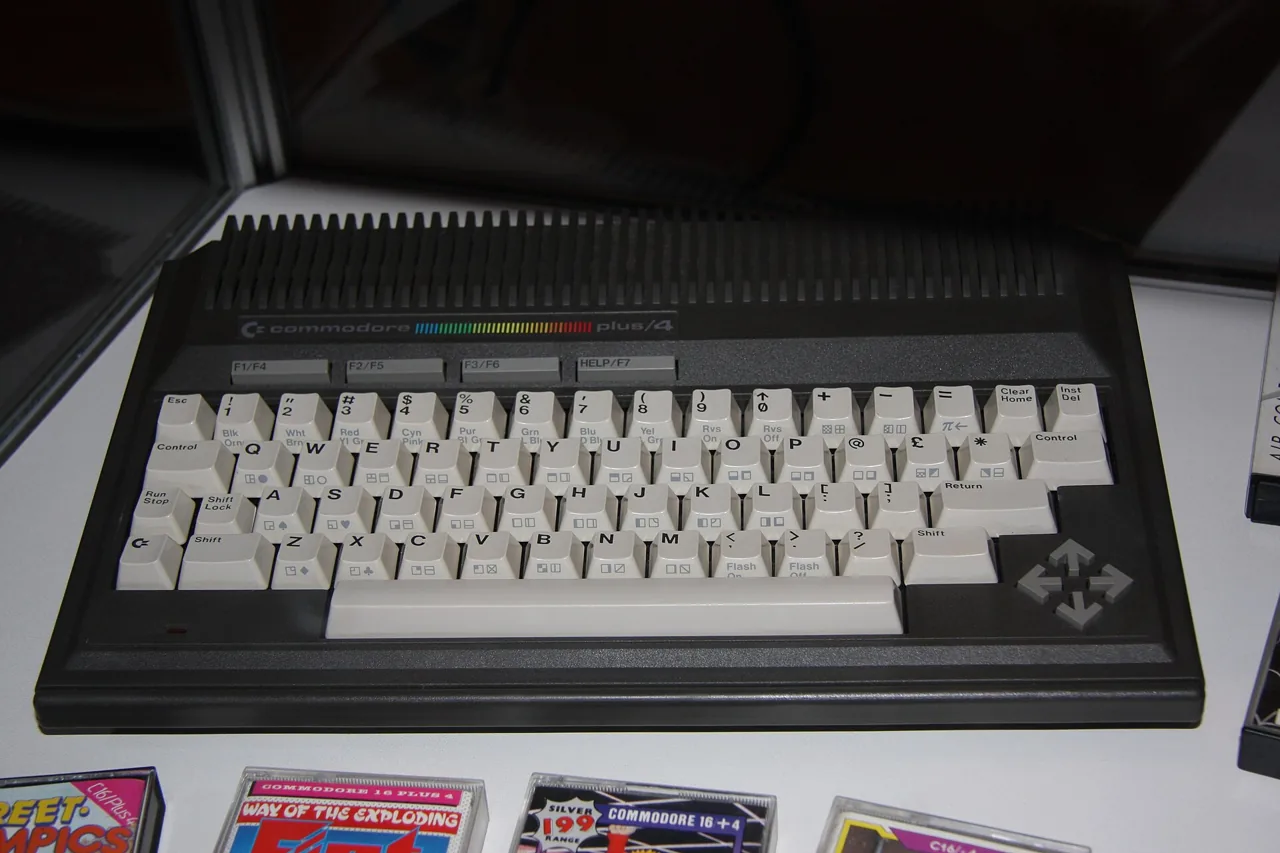
The Plus/4 was pitched as a business-capable machine for the home, equipped with four integrated applications: word processor, spreadsheet, database, and business graphics, stored permanently in 32K of ROM5679. This software suite was meant to justify its positioning as a productivity tool, a departure from the gaming and hobbyist focus of the C-6479. The ROM also contained an improved version of Commodore BASIC with over 75 commands, including support for business functions and error highlighting via the HELP key7916.
Under the hood, the Plus/4 ran on a 7501 CPU, machine-language compatible with the 6502 used in the VIC-20 and C-64, with a clock selectable between approximately 0.9 and 1.8 MHz456810. It had 64K of RAM, of which 60K was available to the user in BASIC5. The machine offered a 40-column by 25-line text display and a graphics resolution of 320 × 200 with access to 121 colors: 15 base hues with 8 brightness levels plus black56.
The keyboard featured 67 typewriter-style keys, including four programmable function keys arranged in a dedicated row and cursor keys in a block layout at the bottom right126. Its industrial design was modern and wedge-shaped, compact enough for a desk but criticized for its non-standard interfaces126.
Input/output included two proprietary joystick ports, a redesigned cassette interface incompatible with earlier Commodore models, a serial interface, and a cartridge/parallel connection36. The non-standard joystick and cassette jacks drew immediate backlash; users could not connect existing C-64 joysticks or Datassette drives without adapters36. However, devices using the round serial port (such as disk drives) and the Commodore 1702 color monitor remained compatible3.
Despite its hardware compatibility with the C-16 and ability to run C-16 software, the Plus/4 could not execute C-64 programs due to memory and architectural differences45810. This incompatibility was widely criticized, especially by C-64 owners who had invested in software and peripherals124810. The absence of sprite support and a dedicated sound chip further limited its appeal for games and multimedia81016.
Commodore maintained that the Plus/4 was not a C-64 replacement but a parallel offering, a claim reiterated in German-language materials6. Yet the market responded poorly. By early 1985, the UK price had been slashed from £299 to £150, a reduction described as "savagery on an unprecedented scale"9. The axe had fallen9.
The machine’s legacy is one of misjudged positioning. It carried the weight of Commodore’s ambition to bridge home and business computing, but its technical incompatibilities and lack of software support doomed it4810. Jim Dionne, marketing manager at Commodore USA, reportedly considered a C-64 compatibility motherboard to add sprites and sound, but no such product reached production12. The surviving documentation is silent on whether any prototypes were built.
Later software releases, such as Script/Plus and Calc/Plus, suggest a minor ecosystem persisted, albeit on a narrow base11. The monitor compatibility list for the 2002 model confirms the Plus/4 shared video output standards with the C-64, C-128, and Amiga, indicating some level of peripheral longevity15.
| Manufacturer | Commodore |
| RAM | 64K (60K user-available in BASIC) |
| ROM | 32K (BASIC, OS, and four applications) |
| CPU | 7501 (6502-compatible), 0.9–1.8 MHz |
| Display | 40 × 25 text; 320 × 200 graphics, 121 colors |
| Keyboard | 67 typewriter keys, four function keys, HELP key |
| I/O | 2 proprietary joystick ports, serial, cassette, cartridge/parallel |
| Dimensions | 67 × 203 × 338 mm |
| Launch price | £299 (UK), $299 (US), ca. 1350 DM (Germany) |
| Price reduction | £150 (UK, early 1985) |
References
- RUN (1984) Nr 02 (November - December) (1984)
- RUN (1984) Nr 02 (November - December) (1984)
- Compute Issue 055 1984 Dec (1984)
- TIBUG-1996-03-04 (1996)
- SpecialProgram04
- Computer Kurs 20
- YourComputer 1985 01 (1985)
- TIBUG-1996-03-04 corrected (1996)
- PersonalComputerNews099-16Feb1985 (1985)
- TIBUG-1996-03-04 corrected (1996)
- ASM.N15.1987.10-Trashing (1987)
- BYTE Vol 10-01 1985-01 Through The Hourglass (1985)
- Computer And Video Games Issue 049 Nov 85
- TIBUG-1996-03-04 (1996)
- 2002 Monitor Users Guide (2002)
- Computers that made Britain v1