Exidy Sorcerer
Exidy’s 1978 microcomputer for the technically patient, sold as a $895 system with S-100 expansion and a focus on CP/M compatibility, though burdened by ambiguous documentation and a garbled technical legacy.
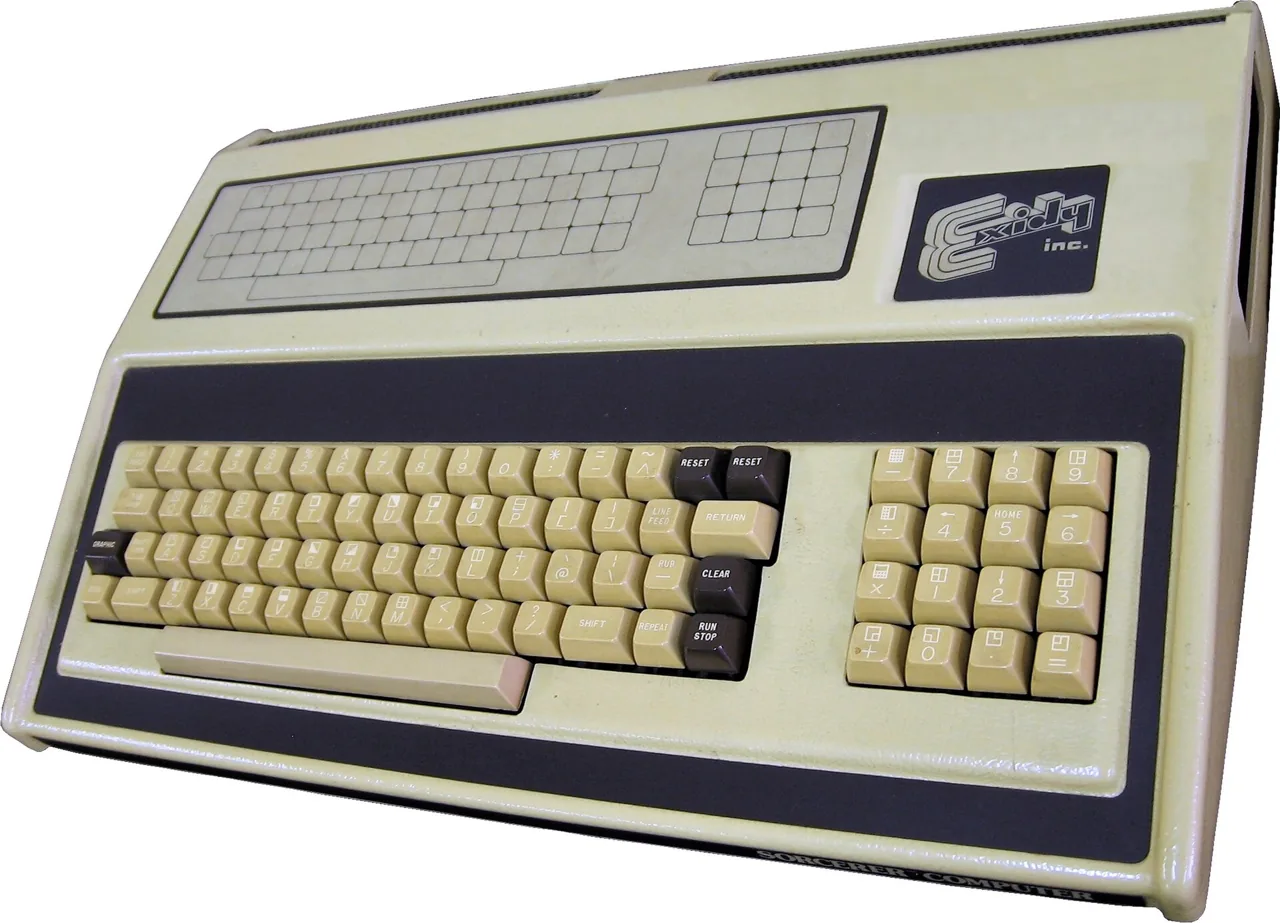
The Sorcerer emerged from Exidy, Inc., a Sunnyvale-based firm better known in 1978 for its arcade games than personal computing. It positioned the machine as a deliberate synthesis, claiming it integrated “the best features of other computers” with proprietary flexibility 2. Priced at $895 2, it targeted users unwilling to cross the four-figure threshold but unwilling to sacrifice expandability. Its identity, however, is complicated by conflicting documentation: a 1980 BYTE article describes it as both “a 780 CPU based micro-computer” and “a 280 CPU based micro-computer” in the same sentence, suggesting either OCR corruption or internal confusion about the processor lineage 13. Given Exidy’s later CP/M implementations, the intended CPU was almost certainly a Z80 variant, but the surviving record does not confirm model or clock speed.
Memory architecture followed a tiered expansion model. A 4K ROM housed the resident monitor 13, while RAM began at an unspecified base. The system supported internal expansion to 48K 13, and 12K 16, and “64K BYTE EXPANDABLE RAM” 15. The discrepancy between “expandable to 48K” and “64K expandable” remains unresolved in the documentation, possibly indicating a later revision or marketing overreach.
The display subsystem was a standout. With a graphic resolution of 240 x 512 13 and a text mode of 30 lines by 54 characters using an 8 x 8 dot matrix 13, it outpaced many contemporaries in screen density. It supported full ASCII in upper and lower case, standard graphic symbols, and allowed users to define up to 128 custom characters, a feature particularly useful for scientific or symbolic applications 13. This capability appeared in niche domains; one 1979 user employed a Sorcerer to automate eclipse predictions, noting compatibility with multiple BASIC dialects 1.
Input relied on a 63-key data processing keyboard augmented by a 15-key numeric pad 13, a layout suggesting business or technical use. I/O included dual cassette interfaces for program storage, a common, low-cost medium at the time. Software was available from Exidy and third parties like North American Software, which sold a $69.95 toolkit, a $34.95 word processor called Sword, and $24.95 graphics utilities 34. Parallel and serial interfaces were standard; the parallel port used a 7-bit data path when connected to a Centronics-compatible printer, as documented in a 1983 MX-80 manual 11. Expansion occurred via an S-100 bus, referred to in garbled form as “5·100 expansion” 13, allowing integration with a broad ecosystem of peripheral cards.
Software strategy centered on CP/M. Advertisements from 1980–1982 list the Sorcerer bundled with either “Lifeboat CP/M” or “Exidy CP/M,” including specific variants like “CP/M-8051/4” and “CP/M-808” 912, though the significance of these suffixes is undocumented. By 1982, Exidy Systems, a likely spinoff or division at 1234 Elko Dr., Sunnyvale, offered Multi-Net 80, a networked CP/M environment linking up to 16 Sorcerers to a central 64K global processor for file sharing 10. A single-user system cost ~$6,000; a 16-user setup reached ~$34,100 10. This positioned the Sorcerer not as a hobbyist toy but as a node in a small-scale office network, a rare ambition for the era.
In summer 1979, Exidy sponsored a software contest open to BASIC programs across business, education, games, and personal management categories 56. Four Sorcerers were awarded as grand prizes, and Exidy promised a published anthology of winning entries, coordinated by Paul Terrell in Marketing Communications 56. The contest reflected Exidy’s attempt to cultivate software legitimacy, though no evidence confirms the book’s release.
Despite claims of technical synthesis and expandability, the Sorcerer’s legacy is fragmented. Its documentation contains anomalies (contradictory CPU references, inconsistent RAM specs, garbled interface descriptions) that suggest rushed production or poor quality control. It could function as a terminal, listed as “dm2500” in one system manual, and was described as a “smart” device in network contexts 14, but physical dimensions, weight, power requirements, and sound capabilities are absent from surviving sources. The trademark registration of “SORCERER” 15 indicates commercial intent, yet sales figures and production timelines remain unknown.
The machine’s fate appears tied to the rapid consolidation of the CP/M ecosystem. While it offered real technical merits (high-resolution graphics, S-100 expansion, and networked operation), its ambiguous specifications and lack of clear revision history undermined reliability. It was not a failure, but neither was it a standard-bearer. It served those who could decode its inconsistencies, and for them, it delivered.
References
- 1979 07 BYTE 04-07 Automating Eclipses (1979)
- 1978 10 BYTE 03-10 Chess for the Microcomputer (1978)
- Byte Magazine Atari Articles
- 1981 06 BYTE 06-06 Operating Systems (1981)
- BYTE Vol 04-08 1979-08 Lisp (1979)
- 1979 08 BYTE 04-08 LISP (1979)
- MICRO Vol73-07 84
- 1981 07 BYTE 06-07 Energy Conservation (1981)
- 1982 12 BYTE 07-12 Game Plan 1982 (1982)
- 1982 01 BYTE 07-01 The IBM Personal Computer (1982)
- MX-80 and MX-100 Training Mar83
- 1980 08 BYTE 05-08 The Forth Language (1980)
- 1980 11 BYTE 05-11 High-Resolution Graphics (1980)
- 03-3255-01 System 8000 ZEUS Reference Manual Rel 3.1 198305 (1983)
- 1979 12 BYTE 04-12 Numerical Analysis (1979)
- Hofacker - Beherrschen sie ihren Commodore 64 (C. Lorenz)