Sharp PC-1500
Sharp’s 1982 pocket computer combined 3.5K RAM, expandable to 11.5K, with a 7×156-dot graphics-capable display and a full typewriter-style keyboard, positioning itself as a portable alternative to desktop systems in key markets like Brazil.
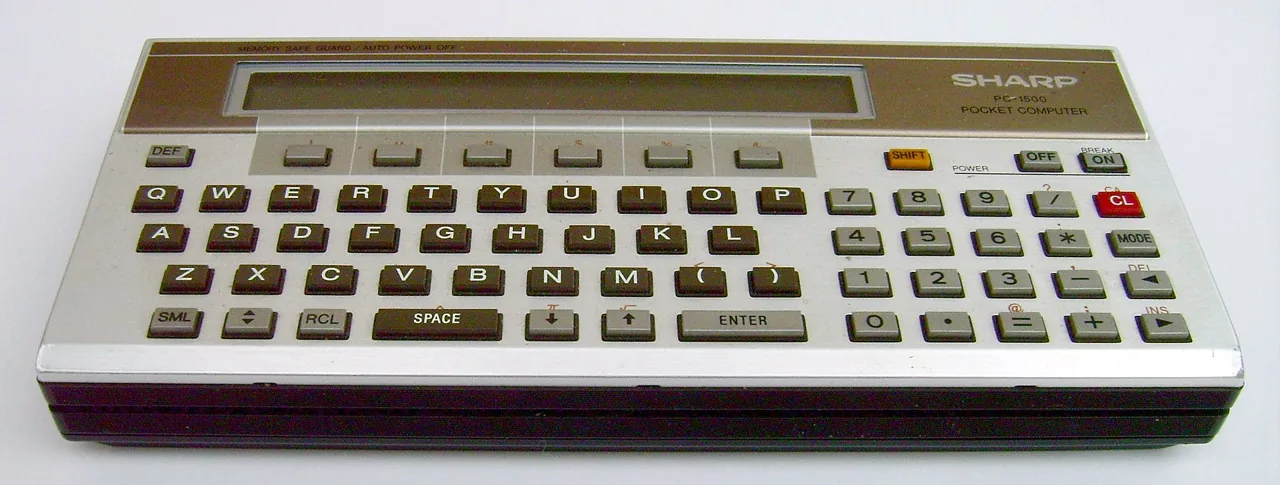
The PC-1500 emerged as a direct evolution of the PC-1211, which had launched earlier in 1982 and was noted as the first of its class in Brazil2. Where the PC-1211 set the baseline, the PC-1500 pushed boundaries with increased memory, an enhanced BASIC implementation, and a design that integrated CPU, RAM, keyboard, and display into a single 375-gram unit measuring 195 × 86 × 25.5 mm2. Manufactured in Manaus by Sharp do Brasil, it was marketed as a self-contained computational tool with ambitions beyond typical programmable calculators2.
A C-MOS 8-bit CPU optimized for low power consumption and high-speed processing formed the central component, paired with 16K bytes of ROM holding Extended BASIC and 3.5K bytes of user RAM81516. RAM could be expanded to 7.5K using the CE-151 module or to 11.5K with the CE-1558. A C-MOS battery ensured memory retention during power-off and battery changes, a critical feature for a portable device dependent on four standard 1.5V cells81516. An optional 110/220V AC to 6V DC adapter provided stationary operation2.
The keyboard adopted a typewriter-style layout with a numeric keypad on the right, a rare concession to data entry in a pocket-sized device348. Symbols such as commas, colons, and semicolons required the Shift key, and six keys were programmable for user-defined functions, enabling workflow customization348. The 7×156-dot display supported both text and graphics, rendering upper- and lower-case letters, numbers, and special characters in a single line81516.
Its most distinctive peripheral was the CE-150, a combined printer, plotter, and cassette interface unit. This device enabled 4-colour graphic and text output at high resolution (500 × 200), with selectable character sizes (9 options), print directions (4), and digit widths (from 36 down to 4 digits)81516. The CE-150 also provided remote cassette control for program and data storage, a feature built into the PC-1500’s architecture via its side-mounted multi-contact expansion connector28. Later expansions included the CE-148 RS232 and Centronics interface, the CE-152 cassette recorder, and even a direct floppy-disc interface supporting a 3-inch, 250 KB drive, available as a mains-independent unit5679. Notably, this floppy setup required no CE-158 adapter, simplifying integration567.
Software support extended beyond the bundled 16K Extended BASIC. The system could run PLUS CE-150 8K Graphics BASIC, and documentation included ready-made programs in Portuguese for various applications28. An operating system manual was available, and inquiries were made regarding the availability of a documented ROM listing and Pascal or Fortran compilers1. Buyers received a free BASIC programming course at Sharp’s Pocket Computer Information Center, underscoring the company’s investment in user capability2.
Reviewers in mid-1982 praised the PC-1500 as “extremely good value for money” and “a delight to use,” with one stating, “I was so impressed with the PC-1500 that I bought it”34. Its appeal lay in portability and the CE-150’s multifunctionality. However, the documentation, while “good and very readable,” was judged insufficient for complete beginners, though those with prior experience on programmable calculators would adapt more easily34.
Priced at £169.95 in the UK including VAT and DM 528.00 in Germany, it occupied a mid-tier position813. In Brazil, it was sold through authorized dealers and major department stores, backed by a national technical support network and a three-month warranty, though no maintenance contracts were offered2.
The PC-1500’s success directly led to the introduction of the more compact PC-2500, marking Sharp’s continued investment in the pocket computer segment12. A variant, the PC-1500(-A), appeared in documentation related to floppy drive compatibility and supported up to 28 KB of BASIC-RAM when equipped with the SMM-22 module567. Despite its capabilities, the system’s reliance on cassette storage and limited RAM by later standards constrained its longevity, though its technical reference manual remained in circulation as late as 198611.
Specifications
| CPU | C-MOS 8-bit CPU |
| ROM | 16K bytes (Extended BASIC) |
| RAM | 3.5K bytes (expandable to 7.5K with CE-151 or 11.5K with CE-155) |
| Display | 7 × 156 dot, single-line, graphics-capable |
| Keyboard | Typewriter-style with numeric keypad, six programmable keys |
| Power | Four 1.5V batteries; internal backup; optional 110/220V AC adapter |
| Dimensions | 195 × 86 × 25.5 mm |
| Weight | 375 g (13 oz) |
| Expansion | Lateral multi-contact connector for CE-150, memory modules, RS232, floppy |
| Peripherals | CE-150 (printer/plotter/cassette), CE-151 (4K RAM), CE-155 (8K RAM), CE-148 (RS232/Centronics), 3-inch 250 KB floppy drive |
References
- ComputerPersoenlich 83 20
- enciclopedia pratica de informatica vol 3
- ComputingToday198207 (1982)
- ComputingToday198207 (1982)
- ComputerPersoenlich 84 03
- ComputerPersoenlich 84 04
- ComputerPersoenlich 84 05
- Archive item #198206
- Computer And Video Games Issue 017 Mar 83
- NZ-bits-and-bytes-issue-2-01
- 1986 Bumper Book of Programs (1986)
- Computer Kurs 49
- ComputerPersoenlich 83 03
- Personal Computing Today Aug 1982 (1982)
- ComputingToday198209 (1982)
- ComputingToday198209 (1982)