Sord M5
Sord Computer Systems entered the home computer market in the early 1980s with the M5, a machine engineered for graphics and sound capabilities uncommon in its class, though constrained by limited base memory and a fragmented software expansion model.
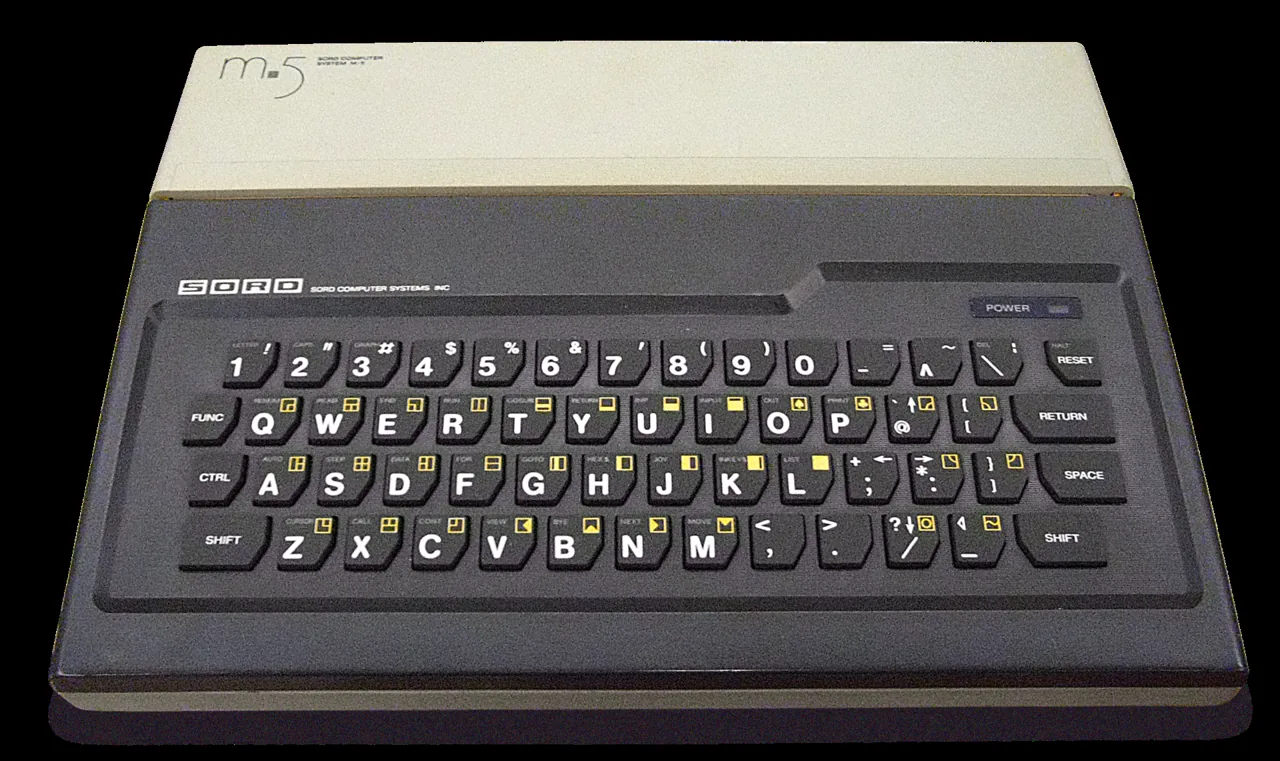
The Sord M5, also marketed as the SORD M5 Creative Computer, emerged as a deliberate pivot by Sord, previously known for office systems, into the hobby computer market7. Its design prioritized visual and audio performance over raw memory, featuring a Z80A microprocessor running at 3.6 MHz2 and 20K of total RAM, of which only 4K bytes were allocated as system RAM239. This tight memory footprint was immediately flagged as a liability in period assessments, especially when compared to competitors offering 48K configurations at lower price points1.
What the M5 lacked in base memory it attempted to compensate for with specialized graphics and sound hardware. It supported two distinct graphics modes: GII, offering a 192 x 256 resolution with two colors per 1 x 8 pixel block2, and a multi-colour mode at 48 x 64 pixels with unrestricted color combination2. The machine dedicated 16K bytes of Video-RAM to graphics processing39 and supported 32 user-definable sprites, referred to in documentation as "special figures", enabling smooth animation and game development237. A 16-colour palette was available for display27, though exact color specifications remain undocumented.
Sound was handled by an SN76489A chip, providing three tone channels and one noise channel2. The inclusion of a PLAY statement in its BASIC environment and support for multiple note forms, such as organ and piano, gave it an edge in audio programming2. These features made the M5 particularly attractive to games programmers, who could achieve "stunning effects with the minimum of fuss"1.
The machine shipped with a 55-key touch-sensitive keyboard described as "typewriterlike"13, housed in a two-tone grey case with yellow and white lettering, measuring 262 x 185 x 36mm and weighing 1kg1. Its construction was noted for a clean, high-quality PCB layout with no visible last-minute modifications1. Access to internal components was severely restricted; the service manual warned that opening the case risked damaging the ribbon cable connecting the keyboard1. A lift-up lid provided access to the cartridge slot, reinforcing the machine's sealed, consumer-ready design1.
Software came primarily via ROM cartridges and audio cassettes3. The base package included the BASIC-I (Introductory) cartridge, but full utilization of the machine required additional purchases: the BASIC-G cartridge enabled graphics and sound commands and reportedly added either 4K or 8K of user memory, a discrepancy between sources245. The FALC cartridge offered a database and spreadsheet function and was described as a "programming aid closer to ordinary language than Basic"17. Game tapes typically contained two full-color, sound-enhanced titles245. Most ROM packs were 16K bytes in size3.
Expansion options included a 32K memory add-on245, a 160K microfloppy disk drive using 3-inch media2457, an RS-232 interface245, and a supported graphics printer245. Two optional joypads were supported via dedicated controller sockets123.
Pricing varied significantly by region and configuration. In Japan, the base unit cost about $1873, while in the UK it retailed at £149.95 including VAT811. A fully equipped system, capable of TV and cassette connection, reportedly cost $775245. The machine was distributed in Sweden by Scandinavian Micro Computer AB in Gothenburg7 and in the UK through Coteglade Ltd of Swansea11. A price reduction was implemented by CGU and Sord UK in late 1983811.
Critics acknowledged the M5’s technical ingenuity but questioned its market viability. While praised as a "very neat and clever machine indeed"1, its reliance on expensive cartridges to enable core functionality was seen as a major drawback1. The lack of published memory maps further alienated machine code enthusiasts1. Despite promotional claims of "unmatched features and maximum flexibility at an affordable price!"245, the need for extensive add-ons pushed the total cost into a competitive disadvantage.
Specifications
| Processor | Z80A |
| Clock Speed | 3.6 MHz |
| Total RAM | 20K |
| System RAM | 4K bytes |
| Graphics RAM | 16K bytes |
| ROM | 8K bytes (monitor) |
| Memory Expansion | Up to 32K via expansion box |
| Graphics Modes | GII (192 x 256), multi-colour (48 x 64) |
| Sprites | 32 user-definable |
| Sound | 3-channel tone + 1 noise channel (SN76489A) |
| Storage | Audio cassette, ROM cartridges; 160K microfloppy (optional) |
| I/O | RF output, composite video, cassette I/O, printer, RS-232 (optional), two joypad ports |
| Keyboard | 55-key touch-sensitive |
| Power | AC or DC power supply |
| Dimensions | 262 x 185 x 36mm |
| Weight | 1kg |
| Case Finish | Two shades of grey, yellow and white lettering |
References
- Archive item #198308
- NZ-bits-and-bytes-issue-1-11
- 1983 04 BYTE 08-04 New Chips (1983)
- NZ-bits-and-bytes-issue-2-01
- NZ-bits-and-bytes-issue-2-01
- Datorhobby1983-1 (1983)
- Personal Computing Today (1983-11) (1983)
- ComputerPersoenlich 83 08
- Personal Computing Today (1983-11) (1983)