Texas Instruments TI-99/4
Texas Instruments released the TI-99/4 home computer with 16K RAM, 26K ROM, and a built-in TI-BASIC interpreter, positioning it as a high-end personal computer centered on Solid State Software command modules for instant program access.
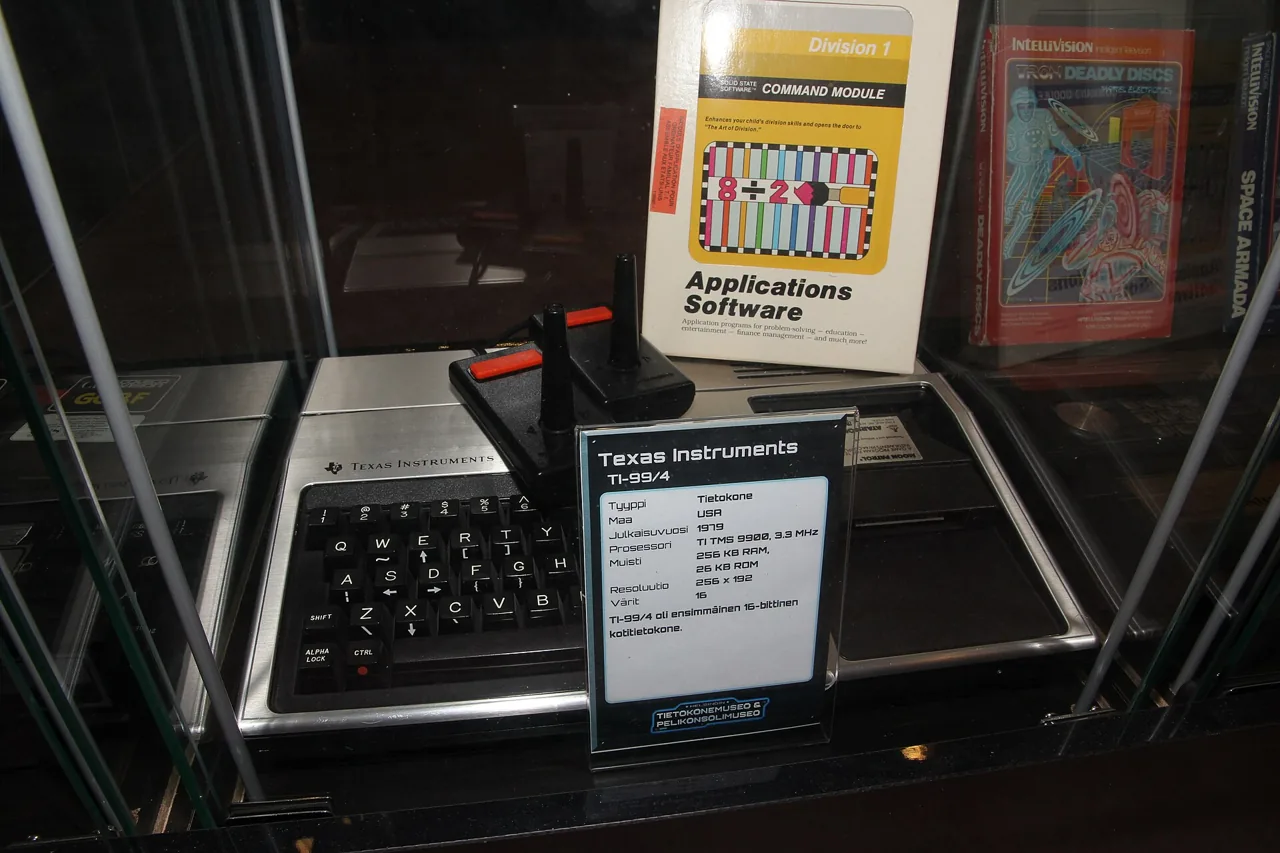
The TI-99/4 arrived as a fully assembled home computer with 16K bytes of programmable memory and 26K of read-only memory, expandable to a total of 72K 2. It featured a library of Solid State Software command modules (ROM cartridges that provided immediate access to applications without loading delays) 4. These modules ranged from educational titles like Early Learning Fun and Beginning Grammar to business tools such as Home Financial Decisions and Investment Analysis, each priced between $19.95 and $69.95 4. The system included TI-BASIC, a 13-digit floating-point implementation described as a "powerful extended BASIC programming language" in early promotional materials 24.
A 13-inch color video monitor was included with the system, supporting sixteen colors for graphic display, though exact resolution, text-mode capabilities, and graphics modes are absent from surviving documentation 24. Audio output delivered a "wide range of sound effects," though no technical specifications for sound generation are recorded 4. Optional peripherals included a Solid State Speech Synthesizer, advertised with notable emphasis and sold separately 2. Remote controls were available as accessories, each featuring a 360-degree rotary lever and side-mounted pushbutton, allowing two to be connected simultaneously 4.
Storage expansion relied on external devices: a Disk Memory Drive retailed for $499.95, while an RF modulator was priced at $49.95 10. The system supported a printer, RS-232 interface, and telephone coupler (modem), the latter retailing at $224.95 410. A 32K Memory Module was offered as an add-on for $399.95 10. Software on floppy disk included adventure titles like Adventureland, The Count, and Pyramid of Doom, all priced at $29.95, while Car Wars appeared as a command module at $39.95 515. The Pirate Adventure package shipped in dual formats, floppy disk and command module, at the same $29.95 price point 5.
Marketing materials from 1980 list the TI-99/4 system at $1150 4, while other contemporary sources cite a $950.00 retail price 610 or an "Our Price" of $999 2. A 1982 advertisement lists a "TI 99 4/A" with RF modulator at $199.95, but this refers to the later TI-99/4A model and not the original TI-99/4 1. The surviving documentation does not specify the CPU used in the TI-99/4, though later models like the TI-99/4A used the TMS 9900 16-bit processor, a detail not confirmed for this earlier variant 3. Similarly, no operating system is named in the available sources, nor are dimensions, weight, keyboard layout, or expansion bus architecture described.
The TI-99/4 served as the foundation for specialized software packages, including the Invoice Management system, which required the base computer, disk drive, RS-232 interface, an 80-column printer, and either the Personal Record Keeping or Statistics command module 12. Despite its high initial cost and limited documented technical transparency, the machine emphasized plug-in usability over user-modifiable firmware or low-level access. Its design prioritized immediate functionality through proprietary cartridges, a strategy that constrained software flexibility but simplified operation for non-technical users. The absence of cassette interface details, combined with the premium pricing of peripherals, suggests a deliberate focus on disk-based and cartridge-driven workflows from launch.
References
- 1982 12 BYTE 07-12 Game Plan 1982 (1982)
- 1980 05 BYTE 05-05 Floppy Disks (1980)
- ComputingToday198211 (1982)
- 1980 01 BYTE 05-01 Domesticated Computers (1980)
- Byte Magazine Atari Articles
- 1981 07 BYTE 06-07 Energy Conservation (1981)
- Interface Age-1981-06 (1981)
- Invoice Management PHD5027 (1980) manual (1980)
- BYTE Vol 07-05 1982-05 Japanese Computers (1982)