Vectrex
The Vectrex, developed by Western Technologies/Smith Engineering and released by General Consumer Electronics in 1982, was the only home console to generate vector graphics using a built-in cathode-ray tube, distinguishing it from television-based systems of its era.
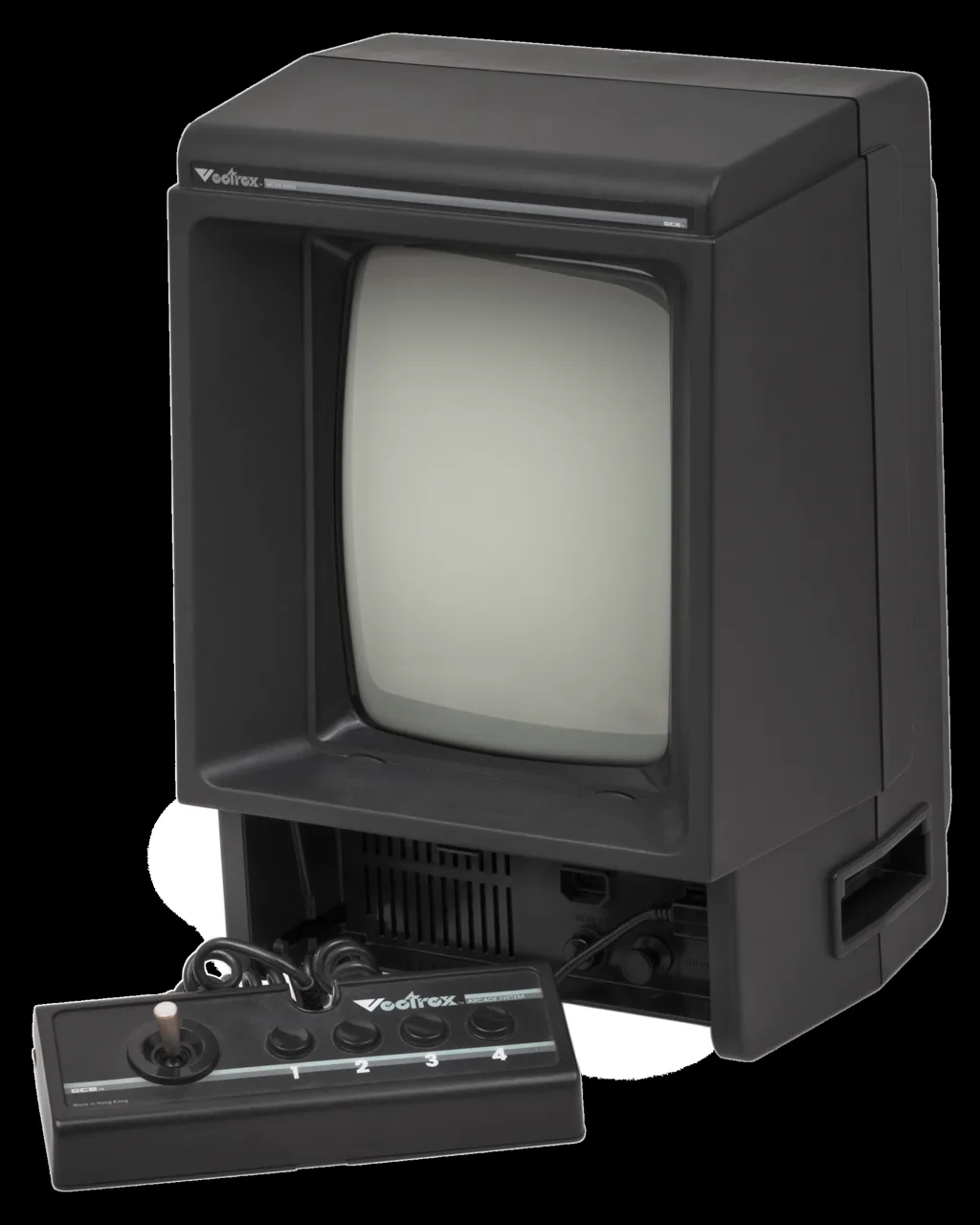
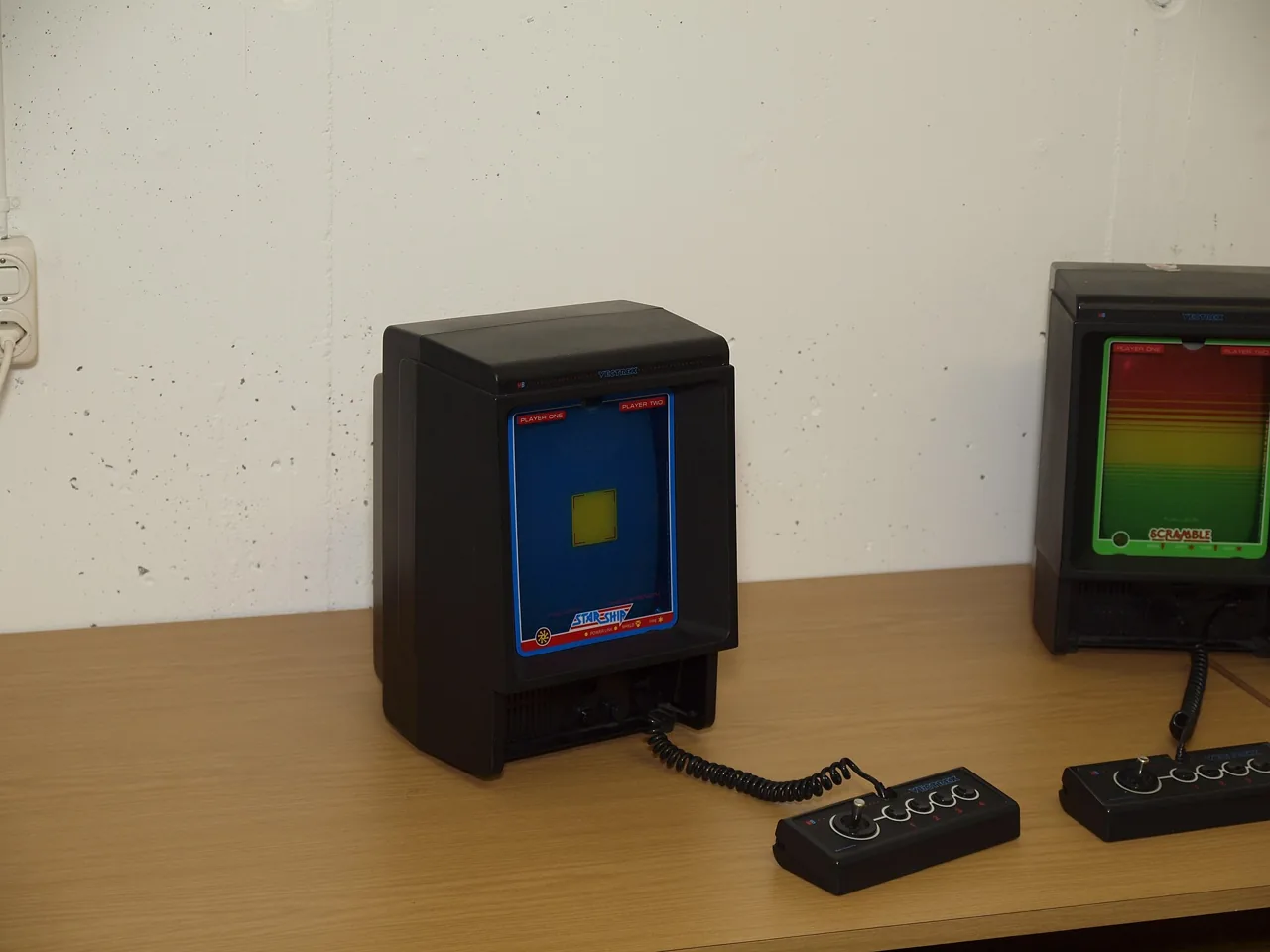
The Vectrex differed from its contemporaries by functioning as a standalone display, not requiring a television. It housed a 9-inch black-and-white vector-scan CRT1716, though one source cites a 10-inch monitor8. The screen’s vertical orientation and 80-column by 40-line resolution7 lent itself to arcade-style proportions, and its vector technology enabled sharp, glowing lines capable of simulated depth through rotation and zooming effects unachievable on raster displays7. To simulate color, each game shipped with a translucent plastic overlay that clipped onto the screen bezel, a low-tech fix that became a signature trait71116.
The system centered on the Motorola 68A09 microprocessor, running at 1.6 MHz derived from a 6 MHz crystal via an internal divide-by-four circuit1. This was a more advanced choice than the MOS 6502 used in many home systems of the time, and lent the Vectrex a performance edge in vector calculations8. The system could address 32K of external memory, with all 16 address lines accessible on the expansion bus1. An 8K ROM housed the built-in game Mine Storm, a deliberate homage to Asteroids18. Despite its standalone nature, the machine supported cartridge-based software, with titles including Pole Position91214, Scramble7, and Berzerk7, totaling over twenty official releases9. Each cartridge reportedly cost around $3016.
Auditory output was handled by the General Instrument AY-3-8910 sound chip, supporting three simultaneous channels with diverse audio effects. The same chip later appeared in the Atari ST and Intellivision8. Controls consisted of a 360° self-centering joystick and four concave action buttons, connected via a 4-foot detachable cord713. The chassis featured a recessed handle, suggesting portability, though its weight made true mobility impractical8.
General Consumer Electronics (GCE) began production in August 1982 and released the unit that October at $199810, though one source claims $249.9911 and another cites a suggested price near $20016. It debuted at the Summer CES in June 19828. In March 1983, Milton Bradley acquired GCE and expanded distribution overseas, including a Japanese release as the Bandai Vectrex Kousokusen8. Despite critical acclaim and steady sales1016, the system faced headwinds: a high price compared to the Atari VCS or Intellivision11, and a limited software library. A year after launch, the video game market collapsed, and the Vectrex was discontinued as a casualty11.
Accessories included the Vectrex 3-D Imager915 and the Light Pen, available for approximately $409. A carry case and dust cover retailed for $13.95 and $4.95 respectively2. A keyboard and memory expander were under development, as was a wafer tape storage device, though none achieved widespread release5.
The Vectrex earned a cult reputation for its industrial design and technical ambition8. Paul Newell’s Scramble won an Arcade Award from Electronic Games magazine in a category seemingly created for the platform10. Tom Sloper, designer of Bedlam, also created Spike, the system’s unofficial mascot10. By 2003, working units fetched $70–130 in the US and £100–180 in the UK, with Japanese Bandai models commanding £250–40010. Its rarity today reflects both its short lifespan and the fragility of its CRT-based design.
References
- Vectrex Service Manual
- Vectrex PassportMagazine OCR
- Depliant Vectrex
- VectrexMinijackInputMod2014 (2014)
- VectrexBrochure
- Vectrex–Service Manual HP-3000–Attachment 1–Vectrex Waveforms
- Archive item #198308
- 300 Baud 01
- logical gamer jul83
- EDGE.RETRO.N3.2003.Guide.collecting-DURiAN (2003)
- Electronic Games 1994-08 (1994)
- Electronic Games Issue 21 Vol 02 09 1983 Nov (1983)
- Electronic Fun Computer and Games Vol 01 03 1983 Jan (1983)
- Electronic Games Issue 20 Vol 02 08 1983 Oct (1983)
- logical gamer novdec83
- Electronic Games Issue 18 Vol 02 06 1983 Aug (1983)