Apple Power Macintosh 6100
Apple’s entry-level PowerPC-based desktop, introduced as the most affordable model in the initial Power Macintosh lineup, marking the company’s transition from Motorola 68k to RISC architecture with a 60-megahertz PowerPC 601 processor.
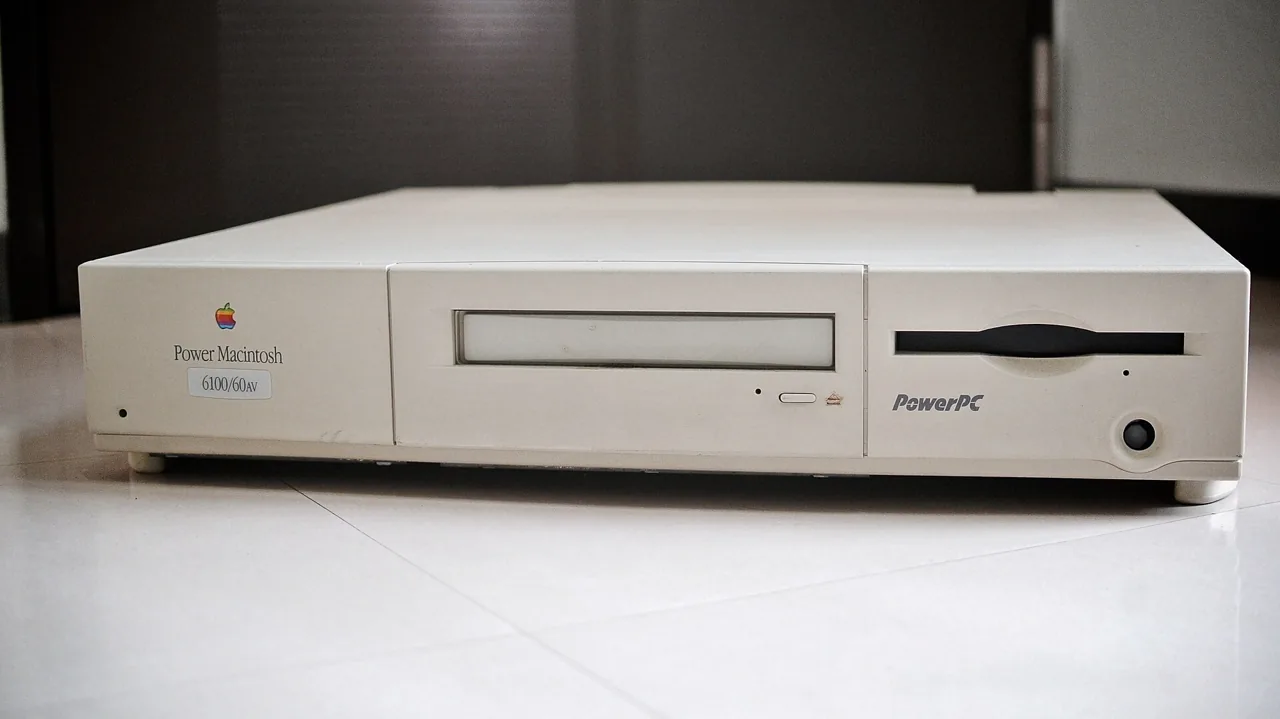
The Power Macintosh 6100/60 and its multimedia-focused sibling, the 6100/60AV, were positioned as the accessible gateway to Apple’s new high-performance computing era1. Built around the 60-megahertz PowerPC 601 microprocessor, a product of the AIM alliance between Apple, IBM, and Motorola, these machines delivered a built-in floating-point math coprocessor, a notable upgrade over earlier Macintosh models that often relied on software emulation or optional FPUs1. The base configuration included 8 megabytes of RAM, expandable to 72 megabytes, offering modest but usable headroom for early PowerPC software adoption1.
Both models supported a broad range of displays, including monochrome, color, VGA, and SVGA, though the 6100/60AV extended this capability significantly by supporting 32,000 colors on all Apple displays and adding compatibility with NTSC and PAL video standards1. The AV variant also introduced S-video and composite video input and output, enabling direct connection to televisions, camcorders, and VCRs, a rare integration for a desktop computer at the time1. This model included eleven built-in ports and the ability to drive a second simultaneous display, compared to the eight ports and single-display limit of the standard 6100/601.
Networking was handled via built-in Ethernet and AppleTalk, allowing for file sharing without requiring a dedicated server, a practical feature for small offices and home users1. The inclusion of GeoPort- and LocalTalk-compatible serial ports enabled telecommunications functions directly through software, supporting features like built-in speech recognition and text-to-speech capabilities, which were tightly integrated into the system software1. Audio was handled with 16-bit stereo input and output1.
Backward compatibility was a key selling point: the Power Macintosh 6100 could run virtually all existing Macintosh applications, and those optimized for the PowerPC architecture reportedly executed at two to six times the speed of comparable 68040-based Macs1. With SoftWindows, the machine could also run MS-DOS and Windows applications, though only in special configurations and with performance limitations1. The floppy drive read Macintosh, Windows, MS-DOS, OS/2, and ProDOS formats, making it unusually versatile for cross-platform data exchange1.
Despite its role as the budget option in the Power Macintosh family, the 6100/60 was outpaced by its siblings: the 7100/66 ran 10 to 25 percent faster, while the 8100/80 achieved 50 to 100 percent greater performance375. Still, its integration of advanced multimedia and networking features made it a functional hub for early adopters. In Japan, the 6100/60AV carried a price of 100,000 yen, a figure that suggests a premium positioning despite its entry-level status12.
The machine’s legacy lies in its role as a transitional workhorse, not the fastest nor the most expandable, but the most accessible point of entry into Apple’s PowerPC future. Its integration of video I/O, networking, and cross-platform compatibility in a single affordable chassis reflected Apple’s attempt to redefine the desktop computer as a multimedia communications center, a shift beyond the traditional view of the computer as a productivity tool.
Specifications
| CPU | 60-megahertz PowerPC 601 |
| CPU Co-developers | Apple, IBM, Motorola |
| Floating-point coprocessor | Built-in |
| RAM | 8 MB (expandable to 72 MB) |
| Display support | Apple and third-party monochrome, color, VGA, SVGA |
| 6100/60AV video features | 32,000 colors on Apple displays; NTSC/PAL support; S-video and composite I/O |
| Ports (6100/60) | 8 built-in ports, 1 expansion slot |
| Ports (6100/60AV) | 11 built-in ports, second display support |
| Networking | Built-in Ethernet and AppleTalk |
| Audio | 16-bit stereo input and output |
| Serial ports | GeoPort- and LocalTalk-compatible |
| Floppy disk compatibility | Macintosh, Windows, MS-DOS, OS/2, ProDOS |
| Software features | Speech recognition, text-to-speech, QuickTime, TrueType fonts |
| Application compatibility | Macintosh apps (full); MS-DOS/Windows apps with SoftWindows (special configurations) |
| Price (Japan) | 100,000円 (6100/60AV) |
References
- ApplePowerMac6100-60-BW2P
- ApplePower7100-XX-BW2P
- PowerMac7100-66-BW2P
- ApplePowerMac81oo-AV-BW2P
- Micom Basic 1996 06 (1996)