Apple Power Macintosh 8100
Apple's top-of-the-line PowerPC workstation, pitched squarely at professional publishers, engineers, and anyone who had already wrung everything out of a Quadra.
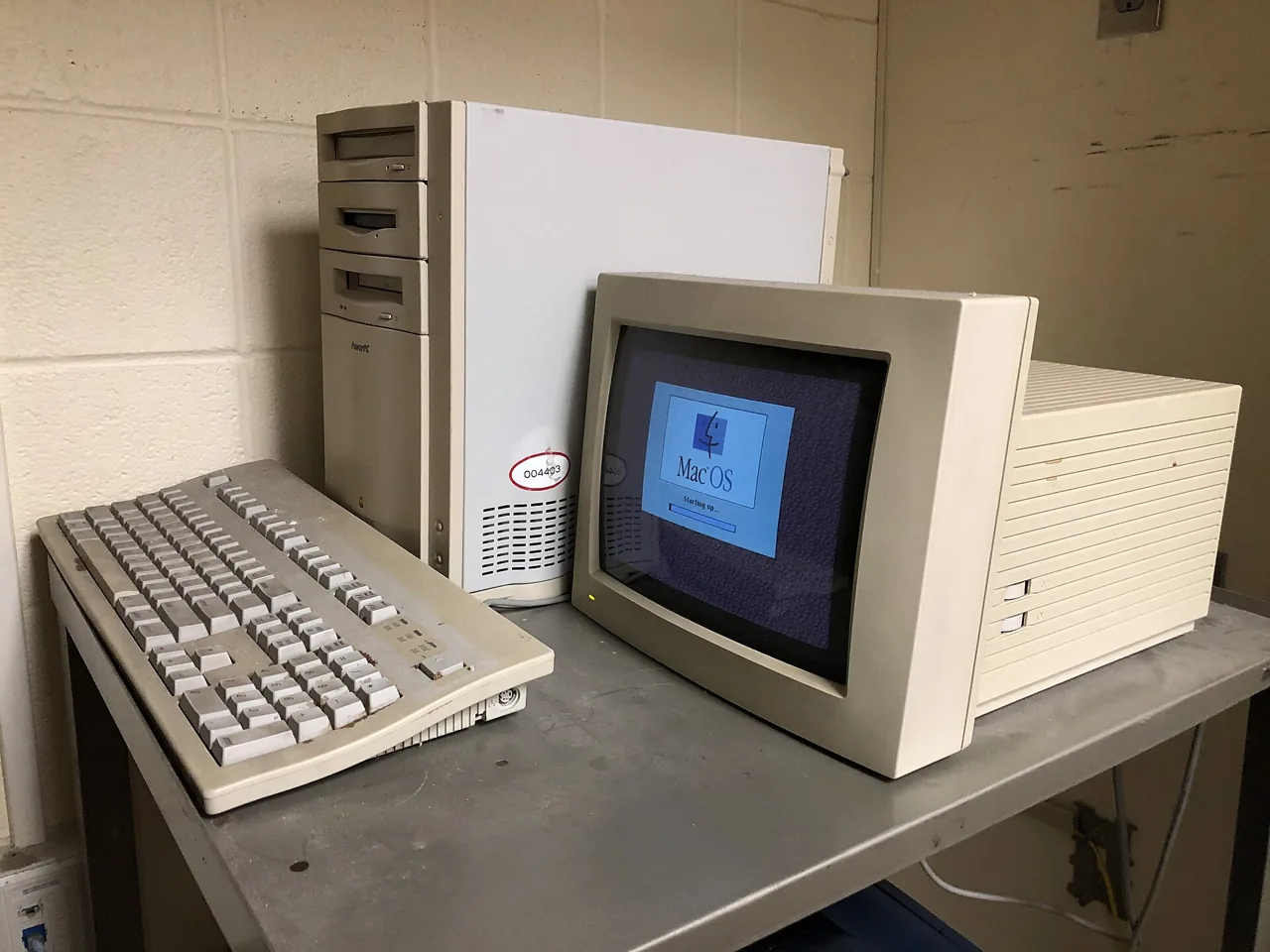
The Power Macintosh 8100 existed in three distinct configurations: the 8100/80, the 8100/80AV, and the 8100/110, each built around the PowerPC 601 microprocessor, a chip co-developed by Apple, IBM, and Motorola.12 The 601 ran at 80 MHz in the base and AV models and stepped up to 110 MHz in the flagship.12 Apple's own marketing declared the 8100/110 "the fastest Macintosh computer ever," which is the sort of claim that ages badly in any product line but presumably was true at the time of printing.1
The processor carried a built-in floating-point unit,2 a meaningful inclusion for the memory-hungry publishing and CAD workloads the machine was designed to serve.
The Three Models
Apple positioned the 8100/80 as "the most affordable of these high-speed computers," the 8100/80AV as the version that "adds advanced video capabilities," and the 8100/110 as the outright speed champion.1 That three-tier structure within a single chassis was fairly deliberate: give the buyer a reason to spend more, but make sure even the entry model lands in respectable territory.
The AV distinction was meaningful. The 8100/80AV added S-video and composite video input as well as output, making it usable with televisions, video cameras, and video recorders. That feature set was aimed at the multimedia production market Apple was actively courting.2
Specifications
| Processor | PowerPC 601 (co-developed by Apple, IBM, Motorola) |
| Clock speed | 80 MHz (8100/80, 8100/80AV); 110 MHz (8100/110) |
| VRAM (standard) | 2MB |
| VRAM (expanded) | 4MB (with additional 2MB card) |
| Hard disk options | 500MB or 1GB (8100/80 and 8100/80AV)2 |
| Floppy | 1.4MB Apple SuperDrive, built-in (documented for 8100/80AV)2 |
| Optical | Internal CD-ROM drive (documented for 8100/80 and 8100/80AV)2 |
| Audio | 16-bit stereo input and output |
| Expansion slots | 3 × NuBus |
| Networking | Built-in Ethernet; built-in AppleTalk (documented for 8100/80 and 8100/80AV)2 |
| Serial ports | GeoPort (compatible with GeoPort and LocalTalk cables) |
| AV video (8100/80AV only) | S-video and composite in/out |
RAM, VRAM, and Display
Memory expansion followed a SIMM-based scheme: 4MB via a single 4MB SIMM, scaling through 8MB, 16MB (two 8MB SIMMs), and 32MB (two 16MB SIMMs), configurations documented for the 8100/80 and 8100/80AV.2 The machine shipped with 2MB of VRAM, expandable to 4MB with an additional 2MB card.12 That expansion mattered for display coverage: at the standard 2MB, the machine could drive up to 17-inch Apple color displays at 16.7 million colors; at 4MB, that ceiling rose to 21 inches at the same color depth (documented specifically for the 8100/80 and 8100/110).1 Display compatibility extended to all Apple monitors and most third-party options, including monochrome, color, VGA, and SVGA.12
Software Compatibility and Speed Claims
The PowerPC transition created an awkward two-speed software world. Applications rewritten for the PowerPC ran at reportedly two to six times the speed of previous Macintosh computers.12 Older Macintosh software ran through emulation. It was functional, but the performance gap was real and depended heavily on how much of any given task hit the emulation layer.
For users who needed to cross platforms, SoftWindows software from Insignia Systems allowed the 8100 to run MS-DOS and Windows applications.12 The 8100 supported reading disks formatted for Macintosh, Windows, MS-DOS, OS/2, and ProDOS.1 An Ingram Laboratories test from 1994 put the 8100/110 at 45 percent faster overall than a comparable PC, with some graphics and publishing workloads reportedly approaching twice the speed of equivalent PC hardware.7 Those numbers come from a single source and should be taken as period benchmarks rather than settled truth.
The built-in software features were genuinely substantial for the period: 16-bit stereo audio in and out,12 QuickTime for video and sound (documented for the 8100/80 and 8100/80AV),2 speech recognition and text-to-speech via PlainTalk (documented for the 8100/80 and 8100/80AV, and reportedly available only for North American English),2 and Apple Guide for interactive on-screen assistance.1 Built-in Ethernet networking was present across the line,12 and the machine supported background file sharing without requiring a dedicated server.2
The Upgrade Angle
Apple documented a logic board upgrade path for 8100/80 and 8100/80AV owners,34 and separately offered a Power Macintosh Upgrade Card that brought certain Macintosh Quadra users into the PowerPC fold.3 The 8100/80 and 8100/80AV were themselves documented as running 50 to 100 percent faster than the Power Macintosh 6100/60.2 The upgrade ecosystem suggests Apple understood that not everyone would or could buy new hardware outright, and that protecting the installed base of high-end Macintosh users was worth the engineering effort.
The three NuBus slots gave the machine genuine expansion headroom for professional add-in cards,1 and the GeoPort serial ports supported both LocalTalk cabling and GeoPort telecommunications hardware.12 Original pricing is absent from the surviving documentation.
References
- AppleMacPower81XX-BW2P
- ApplePowerMac81oo-AV-BW2P
- ApplePowerMacUpgrade-BW2P
- ApplePowerMacUpgradeBoard-BW2P
- An Introduction to Copland 1995 (1995)