Apple PowerBook 100
Apple's entry-level PowerBook 100, introduced as the most affordable model in the PowerBook family, reused core circuitry from the Macintosh Portable but implemented aggressive power management to extend battery life in a compact form factor.
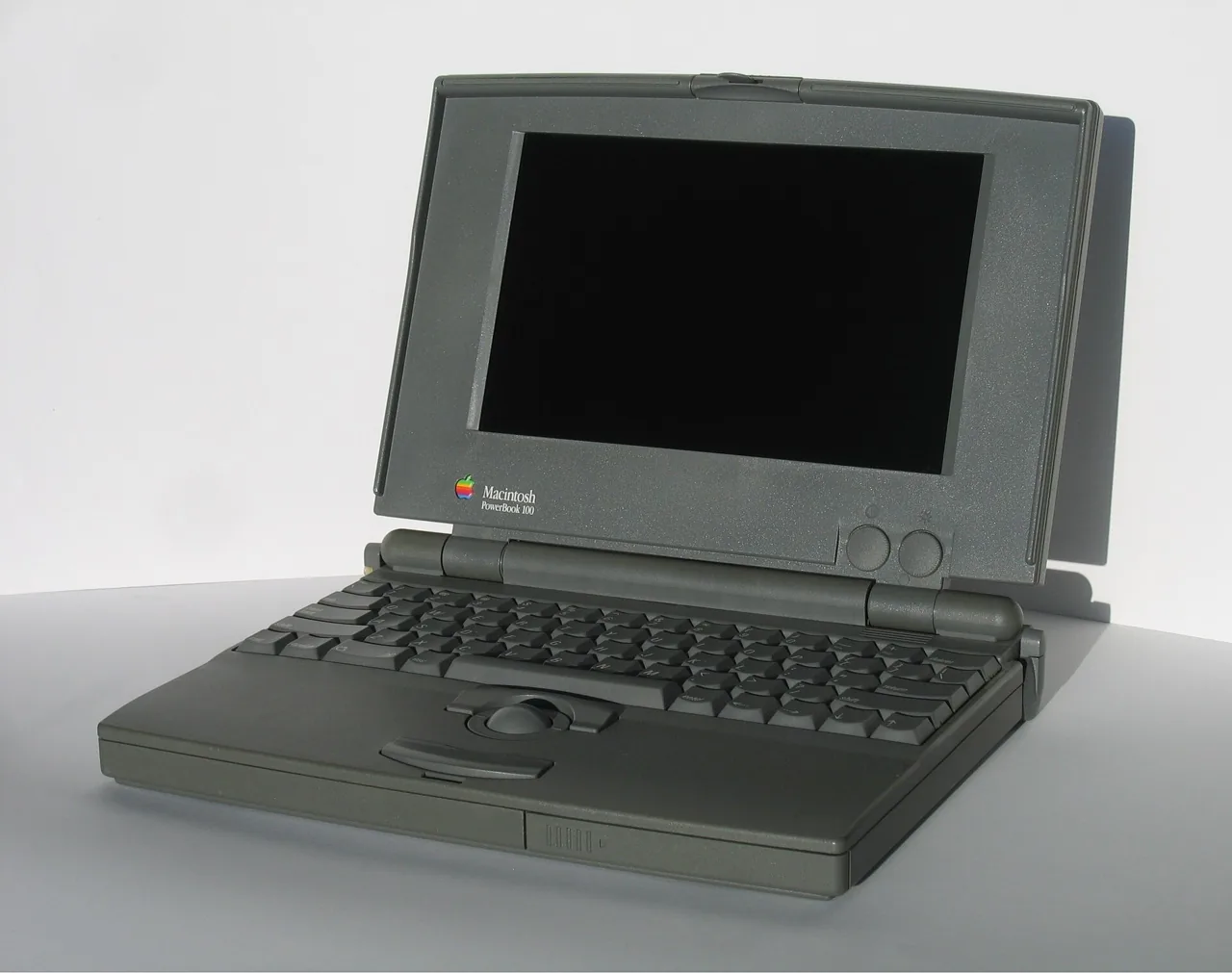
The PowerBook 100 was not a clean-sheet design. Its internal architecture is functionally nearly identical to that of the Macintosh Portable, a fact acknowledged in Apple's own developer documentation1. What distinguished it was a deliberate engineering pivot toward efficiency and cost reduction. The system used a Motorola 68HC000 microprocessor running at 15.667 MHz, selected for its CMOS construction and lower power draw compared to the standard 6800014. The chip retained a 16-bit external data bus and 24-bit address bus, while internal registers remained 32-bit, maintaining compatibility with the Macintosh operating environment while reducing power consumption4.
Power management was handled by a dedicated 8-bit CMOS microprocessor, a subsystem that actively governed system behavior during idle periods. The machine employed a two-state variable wait state system that dynamically adjusted the effective clock frequency, dropping from 15.667 MHz to 979.187 kHz when inactive1. This was a tangible, measurable power-saving mechanism, not a marketing abstraction, and it formed the backbone of the PowerBook 100’s claim to portability. The system also relied on a CMOS custom chip with a long-life lithium battery to maintain clock and calendar data, and additional lithium backup batteries preserved system state4.
Three ASICs (application-specific integrated circuits) consolidated the PowerBook 100’s internal logic, reducing component count and board complexity1. This integration came at a cost: early motherboards (part number 661-0673) included non-removable fuses4. If such a fuse blew, the entire motherboard had to be replaced, a design decision later corrected, as Apple noted that all new motherboards shipped with removable fuses4. Other key field-replaceable units included the daughterboard (661-0674), the FSTN display (661-0675), and the trackball assembly (661-0676)11.
Expansion was constrained but functional. The machine relied on external peripherals connected via its HDI-20 port for a 1.4 MB floppy drive4. Internal 20 MB and 40 MB hard drives were available as optional configurations, both using the Apple SCSI interface4. The HDI-30 SCSI port supported up to five daisy-chained devices at 1.5 MB/sec4. RAM expansion was possible via proprietary PSRAM cards: 2 MB or 4 MB variants, the latter operating at 100 ns11. These same cards were compatible with several other PowerBook models, including the 140, 145B, 160, and 17011.
From a software perspective, the PowerBook 100 was identifiable via the Gestalt Manager, returning a machine selector code of 25, a definitive fingerprint for developers writing conditional code1. Apple marketed it as capable of running “thousands of Macintosh software programs” and emphasized its ability to connect to networks and peripherals6. It was positioned explicitly as the most affordable model in the new PowerBook family, a strategic entry point into Apple’s portable line6.
The physical dimensions are sparsely documented; one fragment notes a height of 5 inches, though the context within the source is ambiguous1. The weight, display resolution, and original price are absent from the surviving documentation. The service manual makes no mention of a built-in modem, only referencing a “modem shield and modem” as a separate component, and no specifications for sound hardware beyond the presence of input and output ports46. The operating system is not specified in any of the provided sources. The base RAM configuration can be inferred from service documentation indicating total memory of 4096K with a 2 MB expansion card or 6144K with a 4 MB expansion card, implying a base configuration of 2 MB4.
References
- Powerbook 100 Developers Note 1991 (1991)
- Repair Apple Macintosh PowerBook 100 Goughs Tech Zone
- ApplePowerBook150-BW2P
- PowerBook 100 Service Source
- Powerbook brochure
- PN 072-8124 Apple Service Module Identification Manual-Jun 1994 (1994)